Make Photo

Rick Sammon likes to say “Don’t just take photos, make photos”. It is a great advice. And the photo in this post is a great example of that.

I had photographed this tree a few days before and came back to Kubota Gardens that day with a single goal to make more interesting picture of this tree. I got “inside” the tree. It was cozy and warm inside under the canopy of red and yellow leaves. I started with the same kind of photos at before. They were typical photos of branches with fall leaves.

Then I noticed a single leaf caught in the middle of a tree where many branches were coming out from the main trunk. Now, that was interesting. I took a few photos.

The single leaf did not really stand out it was blending in with the branches. There was a simple solution to that. I grabbed a bunch of leaves that were already on the ground and dropped on top of the single leaf. Now they had a party.

I took a few images again. It was nice but it was plain. The image of something mystical started brewing in my head. What if I make an image of a Heart of Autumn. The heart of autumn would be glowing. And a flash light could help with that.

Fortunately, I had a powerful spot light in my car (well, I always have several flashlight in my car). I overcame my laziness and packed my gear, went back to the car, grabbed the spotlight and went back to the tree.

Now I was shooting with a spot light. It took a few iterations to get light spot right in the middle of the pile of leaves. I still did not feel like I got it. The leaves in the background were as bright as those I was lighting up. it did not feel like leaves at the heart of the tree were glowing. The solution was to make reduce overall exposure of the image, while get more light on the leaves that I wanted to glow.

The end result:

Heart of Autumn
Heart of Autumn

A Dream About Water

I’ve wrote about light painting before and I’ll likely write more again as this really fascinates me in photography. For me it is a lot of fun playing with lights, a lot of creativity as I create something that was not there in the first place, and a lot of surprise as most of the time what I get is unexpected.

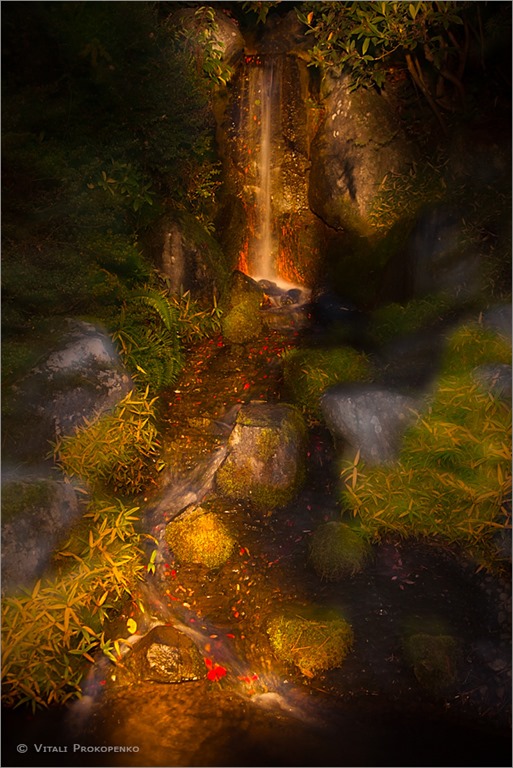
Here is an image that got me very excited about light painting again. I spent a day photographing fall foliage in Kubota Gardens in Seattle (I’m still working on post-processing those photos). At dusk as it got dark enough for exposures to go up to 30 seconds I started playing with light painting with two waterfalls I found in the gardens.

I found the upper waterfall to be more interesting of the two because it had red leaves caught in the stream and I could get a more dynamic image with foreground and background.

There were two new things I played with this time. First, I brought two different flashlights: one had cool light and the other one had warm light. So, I could do not only light painting but also color painting. The other thing that I played with was focus, shifting focus in the middle of light painting. This created dreamy effect.

For those interested in more technical details here is how I took this image. The camera was on a tripod, aperture wide open (f/4 for the lens that I used), shutter was 30 seconds. It was pretty dark already, my camera was not able to focus just using ambient light. First I would use very powerful warm flashlight. I would point to a rock in the middle of the frame and focused the camera using auto focus. I would turn off auto focus then. Turn off the flashlight, so it does not light up something accidentally, and release shutter. Then quickly with the same powerful warm light I would trace the waterfall and the creek back and forth a few times to ensure that individual spots or streaks of light a now visible. That was taking me about 5 seconds. Then I would turn off flashlight and defocus the lens. The rest of 25 seconds I was using weak cool flashlight to light up sides of the frame while the camera was out of focus. I did this ten times or more, every time getting a different image – I love the element of surprise. This I think is the best out of the series.

A Dream About Water
A Dream About Water

Pastel Colors of Fall

Finally, the colors of fall foliage is behind us. It is my favorite time of year. For photographers October is like August for farmers – time to collect the harvest. The reason I’m saying “finally” is because I felt burnt out pushing myself too much trying to capture it a s much as possible. For some time I tried to keep up with post-processing but then gave up – I was not getting enough sleep that way. And that was combined with two more art shows that I needed to get ready for.

Now, when fall foliage is almost gone in Pacific Northwest and my last art show of this year is behind me, I can catch up on post-processing, blogging, planning.

***

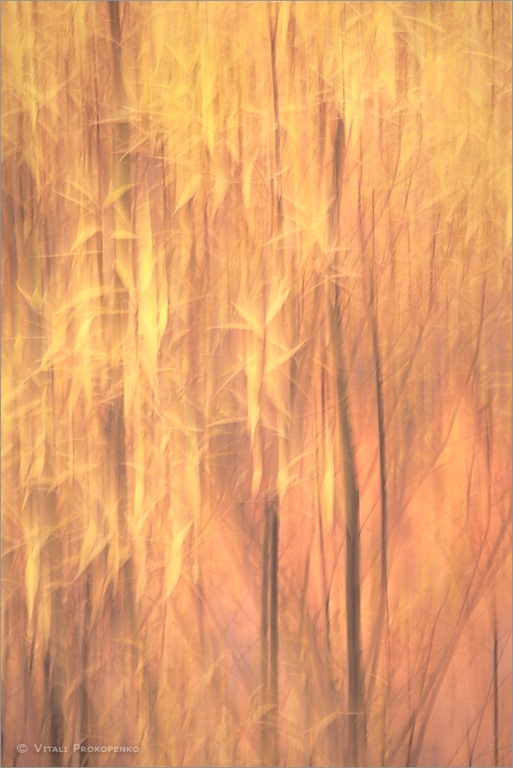
For a few months I’ve been fascinated with pastel colors. I like their subdued soft feel. So, this fall I’ve done several images with intent of having pastel colors.

An important thing about photographing color is to be clear that the subject of a photo is color, not individual branches, leaves or trees. To me it means getting rid of all those details in an image.

One technique to do that is to take photos with long exposure handheld and intentionally move camera in some direction. It seems to work the best when moving camera along visually strong lines such as tree trunks or branches.

On Fire
On Fire

Fall Butterflies
Fall Butterflies

Fall Forest
Fall Forest

Happy Halloween

I took this photo in the Palouse back in August this year but was holding it back to use it to wish everyone a happy Halloween. Enjoy this image of an abandoned house on one very stormy summer night. It looks very much like a haunted house.

_MG_5089

Breaking Patterns

Do you know what fascinates me in my visual world? Patterns. Here is an image I made last weekend, when I was passing by a small island of young aspen trees:

_MG_1913

Do you know what fascinates me even more? Breaking patterns. Just seconds after I made the image above I noticed another island of young aspen trees with one tree bent and still having leaves breaking the pattern of bare trunks:

_MG_1928

Imaginary Worlds: Soothing Moon

While Sun for me is something strong and powerful, Moon is soothing and quite. It is on the other side of the world. Dreamy and sleepy. What can be better than sit at night covered with a cozy blanket looking at shimmering surreal world in a moonlight.

_MG_4787

Imaginary Worlds: Power of Sun

I’m always fascinated with the big ball of fire floating up in the sky every day of our life, with incredible gravitational and nuclear forces at work fighting over control of the matter. The Sun gives life and it burns it. Its energy is the source of all the changes on the Earth.

That’s the way I see it: overwhelming, overpowering.

192_9228

Imaginary Worlds

I’m not sure where I picked this up but I was stuck with a thought that Photoshop is bad for photography. as a landscape photographer I should use as little of it as possible. It dawn on me that I was holding myself back from what I craved for a long time. I wanted to create landscapes from my imaginations. I always envied artists who could draw what they saw in their minds, not what they saw with their eyes. So, this summer I started working on a new project “Imaginary Worlds”. In this project I use multiple images to combine into one. I don’t limit my creativity.

The first of the series was in my post a month ago: From Real into Surreal. Though I was not yet conscious at that point about why I was attracted to it and where it was going. This image is the first one where I was consciously working on it as a new project. (click on it to see larger size)

_MG_3969

From Real into Surreal

“The thing’s hollow – it goes on forever – and – oh my God – it’s full of stars!” – Arthur C Clarke “2001: A Space Odyssey”

When I was a kid I loved science and I loved science fiction, not the kind with goblins, demons and fairy tale creatures but the kind about interstellar voyage and discovery, distant stars and worlds around them.

One of those stories that I remember particularly well was about a world with three suns, a world where darkness had no place, a world without stars, with intelligent race who believed there is only small space around them, that they are alone in the Universe. Every so often a global cataclysm was sweeping thru the planet as all three suns where aligning and giving a gift or curse of night with all the stars in the sky. Every adult on the planet would turn mad from the shock of realization that there were infinite number of worlds in the Universe, that they are not alone. What remember from the story the most is that feeling of shock and awe of seeing so many stars.

Now I’m a grown up man but I still love science fiction. How is it relevant to photography? What if we imagine a world where stars can be visible even during day…

***

A while ago I published this photo from my trip to the Palouse: Taking Advantage of Imperfections. I like the photo. It has some surreal quality to it. But to me it was not finished yet or at least it was not what I intended for it.

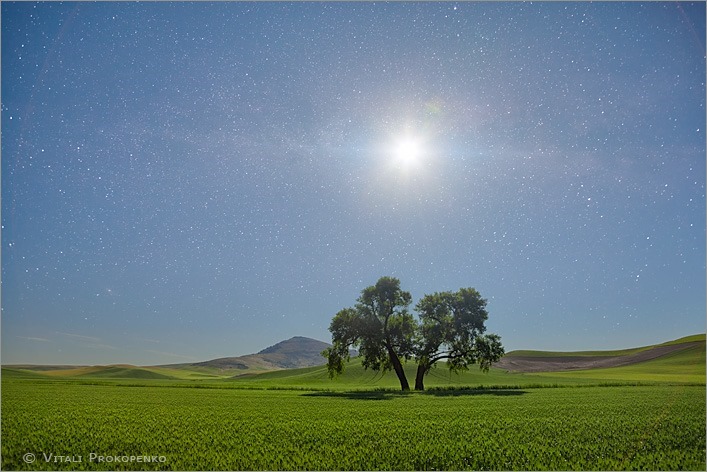
I wanted to create an imaginary world where sun and stars can be seen at the same time. I took the same photo at night with intention to merge the two into one. When I did it it became even more surreal. At the same time I recognized that the pattern of stars from that view point was completely random. They were randomly filling the sky making it more interesting but not adding anything to the composition.

If only I had Milky Way spreading its wings around the Sun, along the sun rays extended by imperfection in my polarizer – that would be really interesting. So, on my recent trip to Rainier I photographed Milky Way positioning it within frame where I ‘d like to have it on the final image. Here is the end result the way I intended it. To me it looks even more surreal than before and at the same time somehow very harmonic.

_MG_3000

I’m interested in what you think about these to images?

Quiet Story

In my experience photos with amazing light such as sunsets and sunrises are most popular among viewers. Yet I have a lot of photos that don’t have grand scenery or amazing sunset but tell a quiet story about the place. Such as this one of a seaweed left on the rocks of Rialto Beach as the water recessed during low tide.

I’m not sure what to do about them. They fill small gaps in the story about Olympic National Park, making it more complete. At the same time I feel like the story becomes too long, especially a story about such diverse place as Olympic National Park.

_MG_9533