Taking a Risk

As I mentioned in the previous post I’ve recently visited Palouse during winter time. I watched for this opportunity for a while. Everything seemed to fit this time. But the day before I left for a trip I checked road conditions and they were icy. One city – Spokane – alone saw more than 200 car accidents as a result of cars sliding down hills on icy road. And what Palouse is famous for? Right, hills!

That made me consider staying home instead. But my photo-biological clock was set already. I woke up at 2 am – the time I planned to leave to get there for sunrise. I thought it might be a sign that I should go. And I went. Turned out that the roads cleared up and driving was as safe as it could be. I finally could see Palouse in white – what a pleasure.

The morale of the story: sometime it is worth taking a risk. And be safe on your next trip!

Road to Steptoe Butte

Palouse in White

Winter Sunrise in Palouse

I’ve dreamt of seeing Palouse in white for several years but every winter when it was snowing in Palouse there was a snow storm at mountain summits that I would need to cross to get to Palouse and those summits would be closed. Finally, this year I caught a forecast of snow in Palouse while it was not snowing at all on the west coast of the state of Washington. This meant that I would have an opportunity to get there.

There was only one day on the forecast between snow and rain with possibility of sunshine. That’s the day I wanted to be there.

I woke up at 2am, checked driving conditions, put clothe on, re-checked equipment and took off for a long drive to Palouse. Four and a half hours later I was standing on Steptoe Butte looking at Palouse in white. I was there just in time for a gorgeous sunrise. It was like a Christmas dream come true.

Hand Waving

Photographer’s hand is a very useful tool. And it is useful not only for pressing a shutter button. It can also be used to create a shade for lenses to avoid lens flare. Or it can be used to block out sun that gets into a corner of a frame.

It can also be used as a gradient neutral density filter. With a long expose you can simply block out part of the frame for some time to reduce amount of light that gets into the frame. That’s exactly what I did when I took the photo below. While composing it I put my hand in front of a lens to cover sky down to horizon and took a note of how “deep” my hand should go to cover the sky. I pressed the shutter and started waving my hand in front of the lens, so my hand is not recorded but it blocked out enough light to produce dark moody sky.

Sure I could actually use gradient neutral density filter but it would not be so much fun. At some point I understood that photographer is a human and can carry only so much weight on his back. I started lightening up my backpack, gradient neutral density filters were one of the things that went away. In some way it actually made photography more interesting to me as I would spend less time unpacking my gadgets and preparing for a shot and spend more time seeing and connecting with a scene.

Kauai. Early Morning. Storm is comingKauai. Early Morning. Storm is coming

Close to Home

Lots of things are waiting to be discovered right around the corner. You just need to make the first step toward them.

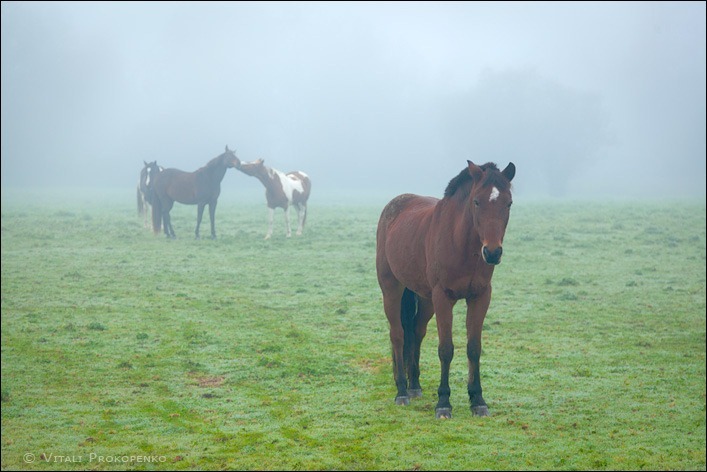
I adore photograph made in fog. At the same time there have not been much fog where I live. At some point I share my fog obsession with another local photographer and she suggested me to go to Carnation Valley in fall.

It is only about 10 minutes drive from where I live. To my surprise even when it is clear sky and sunshine outside the valley, the valley itself is filled with thick thick fog. This is likely because there are a lot of marshes there. Driving downhill into the valley is like diving into the fog.

From that point on I always go to Carnation in fall. Here are some photos I’ve made this year:

_MG_9152

_MG_9306

_MG_9438

_MG_9398

What Monet would do in photography?

Just finished watching a documentary on Monet’s life and his art. One of the things that captured my attention was that he closely followed research of a chemist who was doing research on relative perception of color by human. That research in part influenced Monet’s impressionist paintings.

This makes me wonder what research would Monet follow nowadays and what he would do with photography.

Dad and Photographer

I have not had much time doing anything photographic last week and won’t have this week either. We’re getting ready for my son’s fourth birthday.

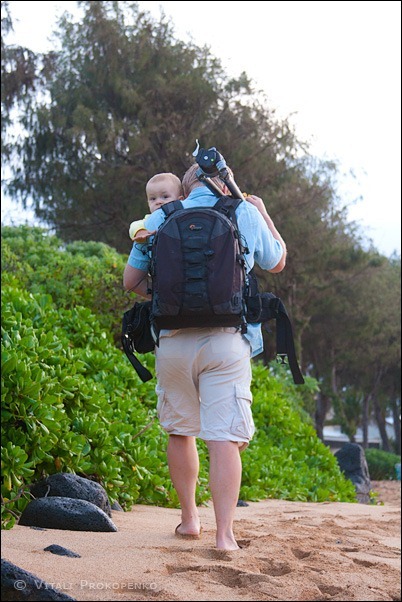
Being dad and photographer at the same time can be both challenging and rewarding. Here is how it is challenging carrying bag full of gear, tripod and my two year son after photographing sunrise:

IMG_5598

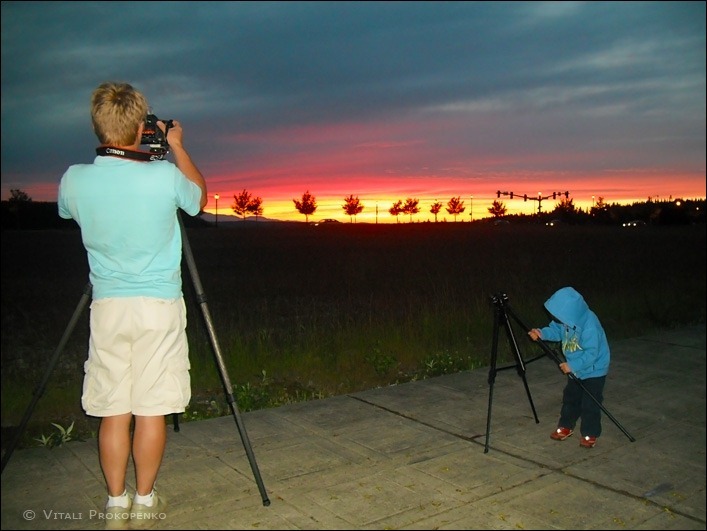
And here is how it can be rewarding. My son – now almost four year old – copying his dad:

1001288299_dscf2187

Image vs. Print

This question bugged me for a while: is an image an ultimate goal and result of creativity or execution and presentation are important as well? And I came to conclusion that execution and presentation are important.

Let’s talk about paintings for example. I think of paintings not only as two dimensional images. There is a third dimension – brush strokes. They capture artist hand motion and his emotions as much as color, composition or subject. When I look at those strokes I can imagine how the artist hand was moving, and that passes artist emotions to me. The brush strokes can be powerful, forceful, angry or they can be casual, light and soft. A reproduction of a painting can have accurate representation of an image but does not capture the brush strokes as well and in some sense erasing that third dimension.

I grew up in a fairly provincial town seeing only reproductions of paintings in books. Seeing them later in museums changed my perception of them completely. I remember how seeing one of van Gogh’s self-portraits in Seattle Art Museum (in a temporary exhibition) made unforgettable impression on me. Much of van Gogh’s face was not painted. Either skin-toned paper was used or paper was covered with skin-toned paint. And then on top of that van Gogh painted his beard, eyes, hair. It was like the face was already in that skin-toned paper, van Gogh just helped me to see it in a few brush strokes. No reproduction has been able to show that.

Now the paintbrush strokes can be meaningless too. For example, I have some cheap painting hanging in my house. It may have been produced by printing on canvas first and then laying paint on top to make it look like painting, the paintbrush strokes just random and “don’t fit”. That’s kind of example of good image bad painting. Another example of good image and good painting but where strokes don’t mean much [to me] is Pointillism which branched off Impressionism. In paintings that I’ve seen in museum executed with this technique application of dots looks very mechanical. While technique is interesting it did not give enough freedom to artist hand.

Same goes to photography but in photography it is a matter of technology and not directly related to us. Platinum-palladium print has incredible tonal range and looks like the image is in paper, where print from inkjet printer looks like image is coated on top of paper, like a polaroid emulsion transfer (in some sense). All that is left to us is to choose what matches what we want the best. And don’t get me even started on paper, I have ton of paper samples at home and I just enjoy looking at them and feeling their texture.

Is this important to most of people? No. Paintings are not much of importance either. And even famous ones. Have you been to Musée du Louvre and saw Mona Lisa? Have you looked at the crowd? How many people were looking at the painting and how many were actually with their backs toward the painting taking infamous “hey, I’m 10 feet from Mona Lisa painting” photo? And using flash despite all “no flash” signs? I like this statistic from Wikipedia: “Visitors generally spend about 15 seconds viewing the Mona Lisa.” Is it really worth only 15 seconds? (Granted it may have lost its value as painting and has become something else. Sadly.)

So what can we photographers do? We can do our best explaining this and teaching everyone to see this. Even if the rest think we are a bit crazy.

Olde Town. The Flag

The people who I’ve met in those small towns are down to earth Americans. Friendly, hardworking people. They invited me to their houses, welcoming me into their lives.

Maybe their country did not care about them much but they care about the country a lot. They proudly display their country flag everywhere. You can see it in old buildings, on the streets and next to each post office.

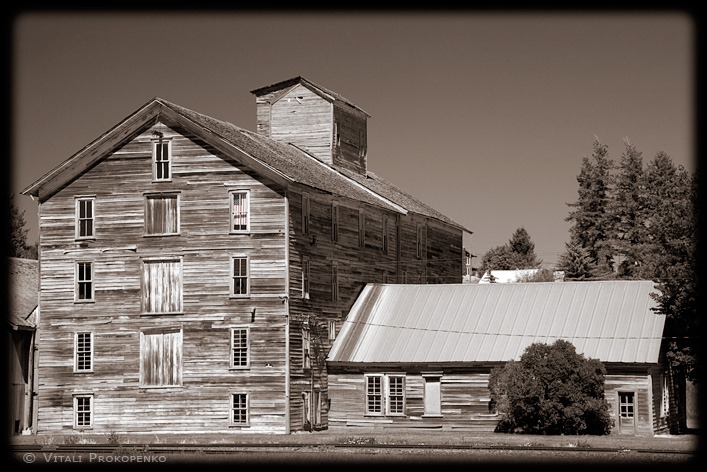
The Mill The Mill

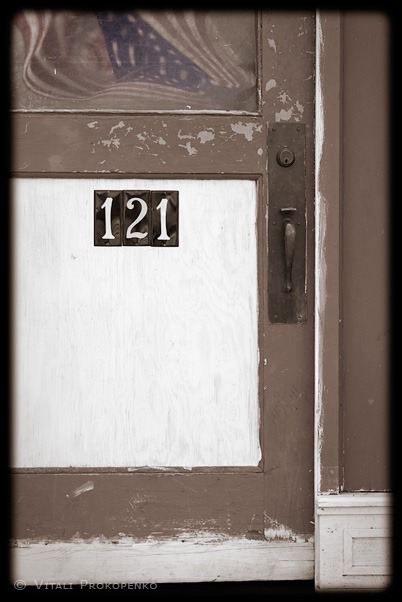
121121

Post Office

Post Office

Demilitarization of Photography

I find it a bit disturbing the amount of military words used by photographers. Shoot instead of take picture. Shot instead of a photograph. Weapon of my choice instead of camera and lenses. Just today I’ve read interview of one photographer where while talking about his street photography he said “I keep my weapon close [referring to camera] ready to fire”. Why so much aggression? Aren’t we supposed to make our world better with our art?

I avoid those word in my language and use real photographic words when talking about photography. For me photography is a peaceful experience. Let’s declare photography a demilitarized zone. Are you with me?

Olde Town. The Main Street

Just how deserted is Olde Town? Imagine you’re standing in the middle of the main road at noon, waiting for a car or human to pass by. At first you worry that you can be hit by some random car. Five minutes pass – no one. You’re surprised. Ten minutes pass – no one. You’re not worried about cars anymore. Half an hour pass and you’re wondering if this town is alive.

That is about how I felt standing in the middle of the main street of one of the towns in central Washington photographing. No car or person pass me by.

Main Road Main Road