Imaginary Worlds: Soothing Moon

While Sun for me is something strong and powerful, Moon is soothing and quite. It is on the other side of the world. Dreamy and sleepy. What can be better than sit at night covered with a cozy blanket looking at shimmering surreal world in a moonlight.

_MG_4787

Imaginary Worlds: Power of Sun

I’m always fascinated with the big ball of fire floating up in the sky every day of our life, with incredible gravitational and nuclear forces at work fighting over control of the matter. The Sun gives life and it burns it. Its energy is the source of all the changes on the Earth.

That’s the way I see it: overwhelming, overpowering.

192_9228

Imaginary Worlds

I’m not sure where I picked this up but I was stuck with a thought that Photoshop is bad for photography. as a landscape photographer I should use as little of it as possible. It dawn on me that I was holding myself back from what I craved for a long time. I wanted to create landscapes from my imaginations. I always envied artists who could draw what they saw in their minds, not what they saw with their eyes. So, this summer I started working on a new project “Imaginary Worlds”. In this project I use multiple images to combine into one. I don’t limit my creativity.

The first of the series was in my post a month ago: From Real into Surreal. Though I was not yet conscious at that point about why I was attracted to it and where it was going. This image is the first one where I was consciously working on it as a new project. (click on it to see larger size)

_MG_3969

From Real into Surreal

“The thing’s hollow – it goes on forever – and – oh my God – it’s full of stars!” – Arthur C Clarke “2001: A Space Odyssey”

When I was a kid I loved science and I loved science fiction, not the kind with goblins, demons and fairy tale creatures but the kind about interstellar voyage and discovery, distant stars and worlds around them.

One of those stories that I remember particularly well was about a world with three suns, a world where darkness had no place, a world without stars, with intelligent race who believed there is only small space around them, that they are alone in the Universe. Every so often a global cataclysm was sweeping thru the planet as all three suns where aligning and giving a gift or curse of night with all the stars in the sky. Every adult on the planet would turn mad from the shock of realization that there were infinite number of worlds in the Universe, that they are not alone. What remember from the story the most is that feeling of shock and awe of seeing so many stars.

Now I’m a grown up man but I still love science fiction. How is it relevant to photography? What if we imagine a world where stars can be visible even during day…

***

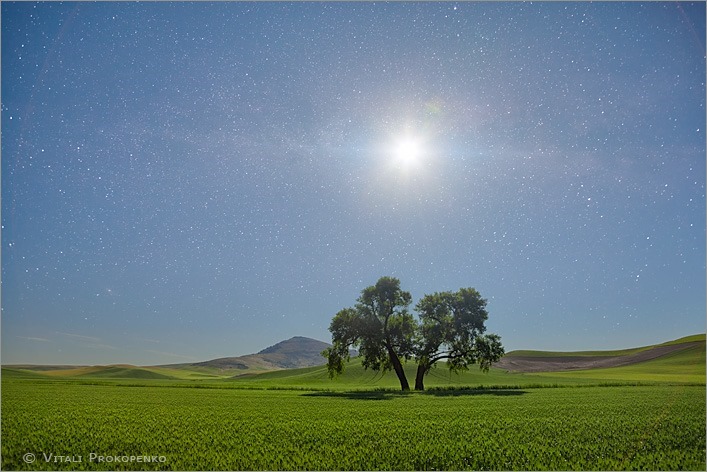
A while ago I published this photo from my trip to the Palouse: Taking Advantage of Imperfections. I like the photo. It has some surreal quality to it. But to me it was not finished yet or at least it was not what I intended for it.

I wanted to create an imaginary world where sun and stars can be seen at the same time. I took the same photo at night with intention to merge the two into one. When I did it it became even more surreal. At the same time I recognized that the pattern of stars from that view point was completely random. They were randomly filling the sky making it more interesting but not adding anything to the composition.

If only I had Milky Way spreading its wings around the Sun, along the sun rays extended by imperfection in my polarizer – that would be really interesting. So, on my recent trip to Rainier I photographed Milky Way positioning it within frame where I ‘d like to have it on the final image. Here is the end result the way I intended it. To me it looks even more surreal than before and at the same time somehow very harmonic.
_MG_3000

I’m interested in what you think about these to images?

Taking Advantage of Imperfections

I’m increasingly photographing with more and more challenging lighting. Such as including sun high in the sky into the picture. The creates a lot of glare in the photo. And I’m working thru those issues, finding how to avoid them or incorporate them in my pictures.

There is a couple methods I use to avoid glare in my pictures. First one that I used for a while already is to block out the Sun with a finger, take photos without the Sun and the glare. The next photo is with no fingers in the frame. Both photos should be taken with the same exposure, the same focus point, the same aperture and on tripod. I would take the normal photo as a base and then use the one where I blocked out the Sun to patch any areas with a glare. This methods works really well during sunset or sunrise when the Sun is placed closer to an edge of a frame.

The other method I discovered during my trip a week ago to the Palouse. Turns out that if I open aperture to its widest setting I get almost no glare or at least its impact becomes imperceptible. This method works well even if the Sun is in the middle of the frame. That’s the technique I used for the photo below that I took during the trip.

Again I would use the photo with aperture set to where I want it. In this case I wanted to close down aperture to get sun burst rays. Closing down the aperture produced a lot of glare in the sky, on the Steptoe Butte and in the fields, that would be hard to patch in Photoshop if I did not take another photo with open aperture and used parts of that photo to patch out all the glare.

Then I discovered that polarizer that I had on my lens had imperfection that resulted in light spilling further from the Sun in two directions along one line. (And just in case you did not know any additional glass surface adds more glare to the photo as sun light bounces back and forth between glass surfaces.) My first reaction was to remove the filter. But then I thought of incorporating that effect and make that line horizontal by rotating the filter. Later I also did take photos without the filter but I like the one with imperfection more. It gives some surreal feel to the scene.

_MG_3000

Many Faces of the Same Place

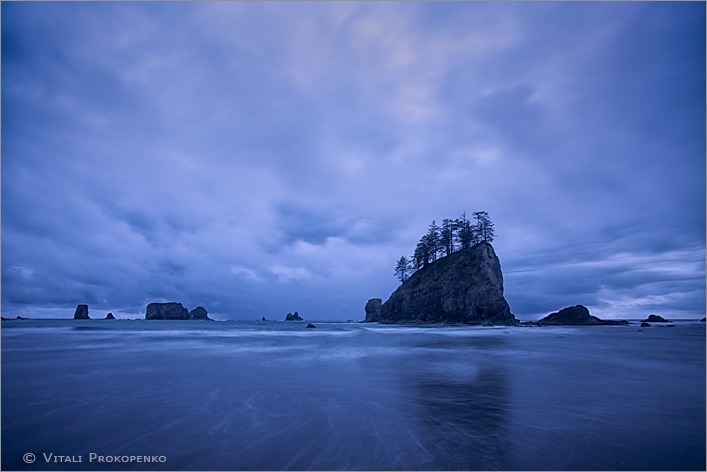
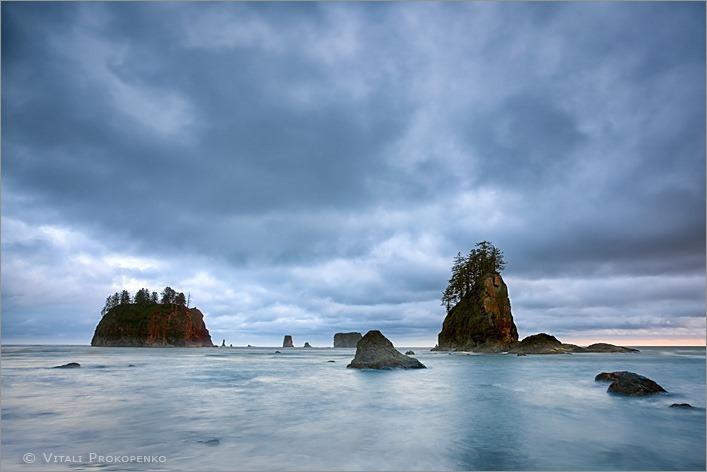
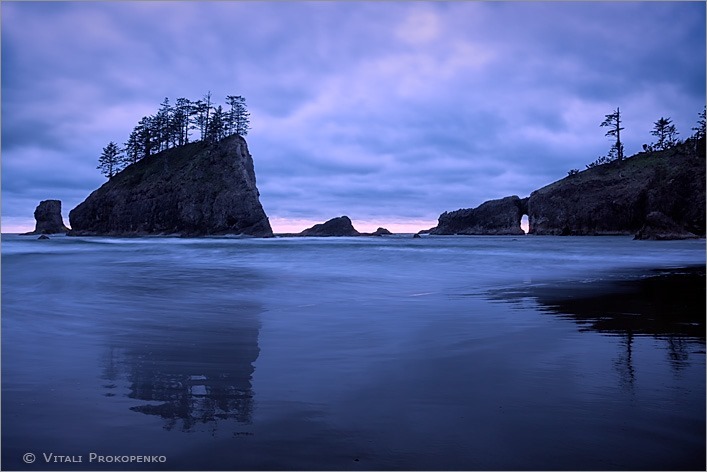
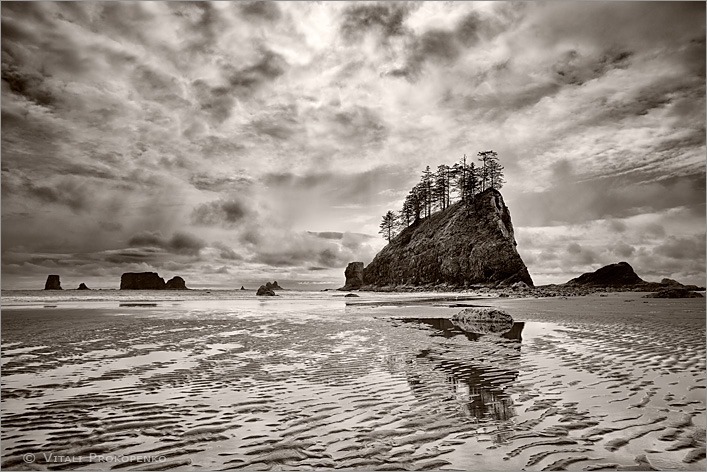
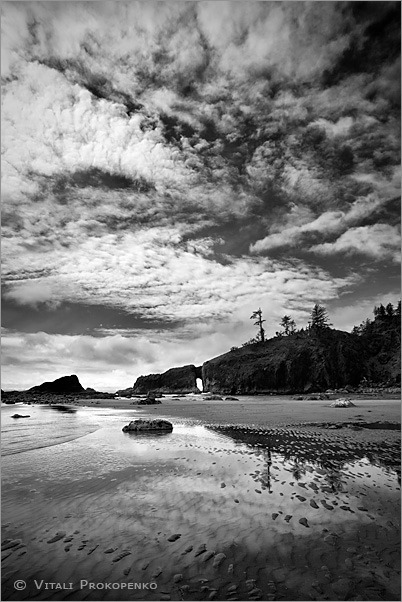
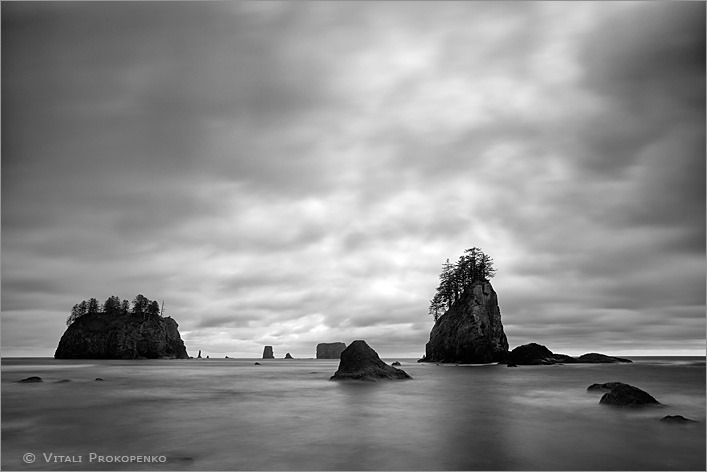
It is amazing how many different photos can be made in the same spot and of the same subject. Look at this photos for example. The same sea stack at Second Beach, just different atmospheric conditions, different light and different exposure.

And here is a couple of photos with a different angle:

Yet one more angle:

More photos of this place from my earlier trips can be found on my website: http:///www.vitphoto.com/?folio=Olympic.

Patience is a Virtue

Patience is a virtue for landscape photographer. Waiting for the right weather, for the right light takes indefinite amount of time.

In Olympics when it rains it pours. But it can stop as suddenly as it starts. This is my favorite time to photograph as I get great cloudy sky. All I need is a bit of patience.

On my second day of the last trip to Olympic Peninsula I woke up to a pouring rain. Well, what could I do about that? Nothing, really nothing. What I can do is to read a book or a magazine. And that’s what I did. I was sitting in a car in a pouring rain reading thru a recent issue of Lenswork. Once I was done with it I moved onto a photography book.

By the noon the rain stopped. I got out of the car put on my backpack and headed to Second Beach. I was rewarded with great skies. Just the kind I like.

_MG_7561

_MG_7615

_MG_7699

_MG_8131

Unexpected Happens

Photographing the same place again and again is like visiting an old friend.

A couple of weekends ago I went to Olympic Coast for 3 day photographic trip. I decided to start this year with visiting my old friend: Second Beach. By far it is my favorite beach for photography. There are so many different opportunities there.

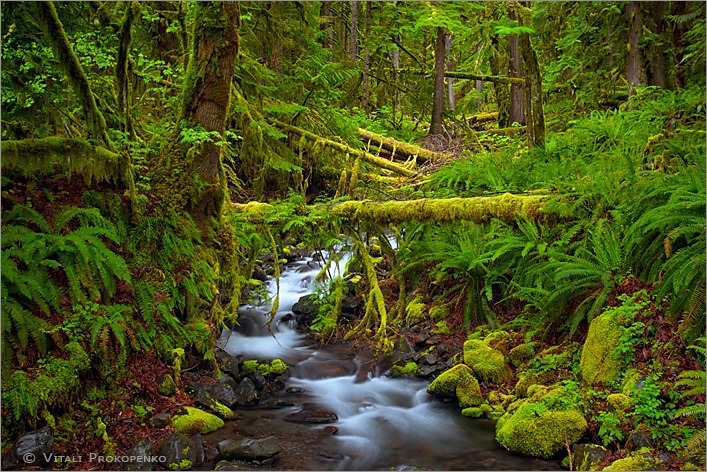
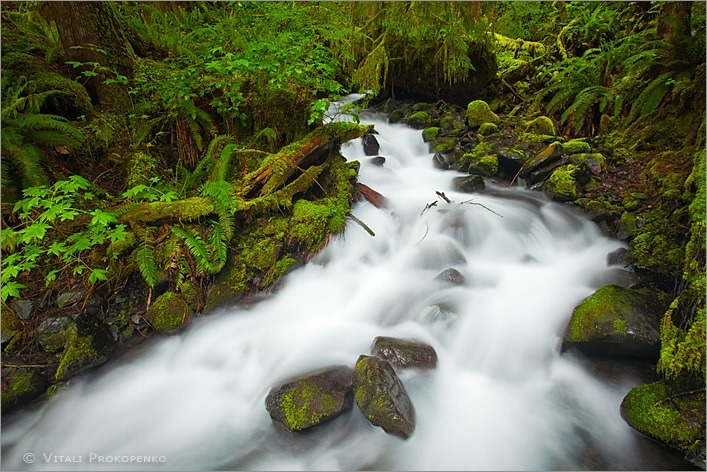
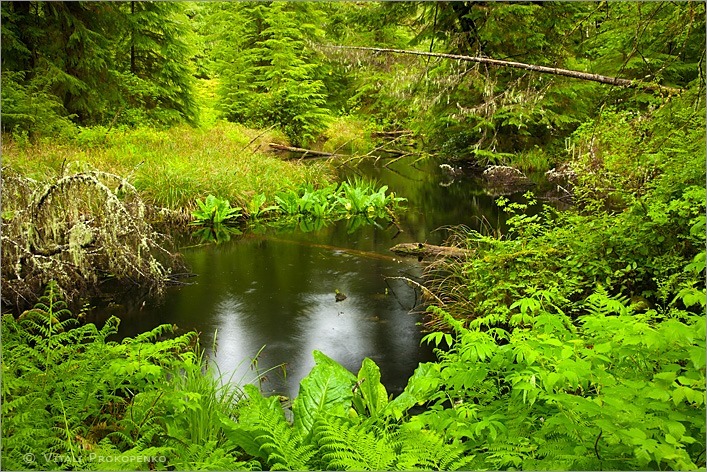
While driving there I noticed something else that caught my eye: an amazingly saturated greenery of fresh spring leaves. It was amazing. The result was that I spent most of the day time during those three days in a forest.

Now let me welcome you to Olympic Peninsular forest in spring.

Photographing Light

Can light be a subject of a photograph? I’m absolutely sure of it. More than that, light is often the main subject of my photographs.

A week ago I was walking in Seattle Arboretum looking for spring blossom. I made a few photos but nothing was clicking. I was ready to give up and headed back to my car, when I saw this light. Actually several kinds of light in one scene: rim light on tree branches, and sunrays breaking thru the branches forming a waterfall of light.

_MG_2481

Spring is Here

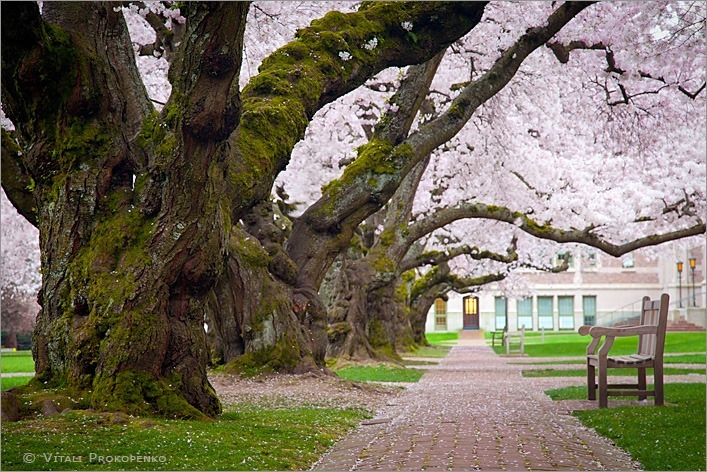
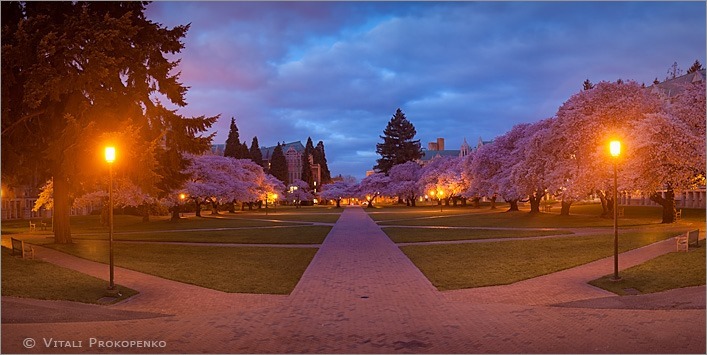
Finally, I’m done with processing my photos from my winter trip to Canadian Rockies. And all of a sudden spring arrived to Seattle. This means it is time for photographing cherry blossom. One of the most popular places for cherry blossom in Seattle is UW Quad. During weekend of nice weather the place is packed.

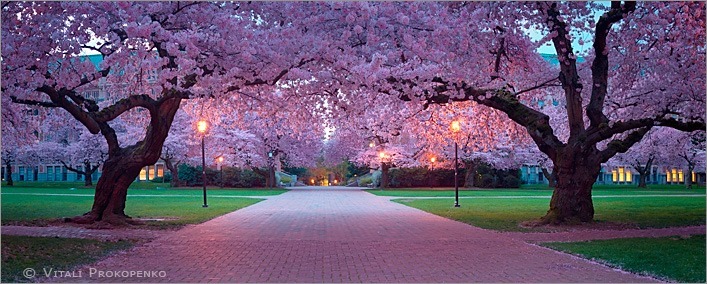
I typically go there early in the morning, somewhere around 6am. It is more deserted and with street lights it looks more interesting.

I noticed though that with each year more and more photographers come early too. On Saturday there were 20 photographers, on Sunday – 30. With tripods standing, bags lying on the ground and photographers walking around it becomes quite a challenge to have a clean photo. Well, it seems coming even earlier and on workday, I still can have the place to myself.

_MG_2346

_MG_3155

_MG_3209

_MG_3224

_MG_3235-Panorama

_MG_3522