Big Pine Road

Day 2, Afternoon

My next destination in Death Valley was Eureka Dunes. Eureka Dunes are remote but are worth the drive. Their size is magnificent and awe inspiring.

The way I got there was by Big Pine Road coming from Scottys Castle. It was about 2 hour drive on a rough unpaved road. The views were great and I stopped several times to take photos. The very first post of the series about this trip (Death Valley) has one of the views opening up for traveller.

There are a couple of interesting sites a long the way. First one is Crankshaft Crossing that actually have a few crankshafts lying around:

Crankshaft Crossing

And the other one is remains of a sulfur mine that was abandoned long time ago. With much of equipment abandoned to rust it looks like a scar on a landscape. One sheet of metal was loose and flapping in the wind making a squeaky sound. This made the place feel ghostly and spooky.

Mine 1

Mine 2

Mine 3

Seeing Big and Seeing Small

Day 2, Late Morning

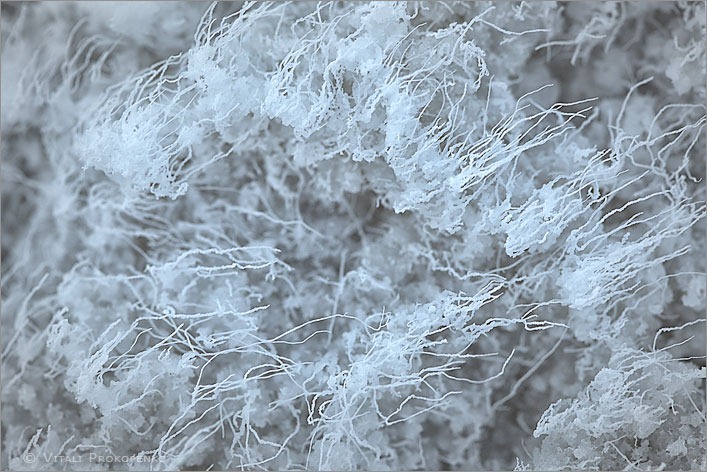
To photograph Badwater at sunrise I went far into salt flats. On my way back I started paying more attention at the variety of structures built by water, salt and wind. About a size of human hair whiter than white these crystals were creating islands of shimmery white in salt flats.

Salt Crystals Shaped by Wind

Salty Lines

Day 2, After Dawn

Photographing Badwater is all about finding lines that are interesting a leading somewhere. Like in this photo I found a line that can be anchored in the bottom corners and goes into the image pointing toward a cloud in the sky. And there is a nice loop at the end of it that matches the cloud.

Badwater
Badwater

Badwater

Day 2, Sunrise

Badwater

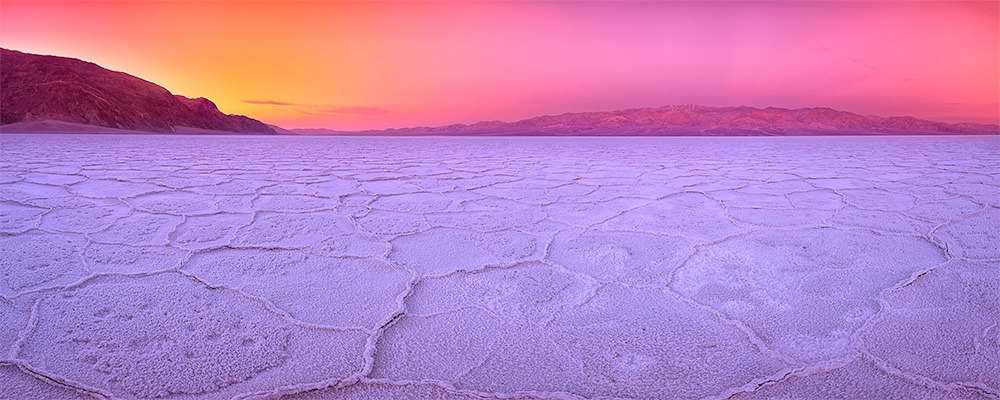
My first sunrise on this trip was at Badwater. That’s a large flat with lots of salt deposits from drying out water. The salt is brought by streams running down the mountains surrounding the valley in those rare cases there is a rain in Death Valley.

I wanted to capture psychedelic twilight and early dawn colors that I saw long time ago here but now with better techniques. This time colors were too weak, so I had to put gold-n-blue polarizer to give them a punch. I use this filter very rarely because it saturates and shifts colors too much for my taste. The only exception when I use would be photographing sunrise or sunset when rich orange colors would be expected and I don’t get those colors without this filter.

I liked how sky came out with gold-n-blue polarizer but I did not like the color cast on salt flats. Thus in post-processing I removed the color cast and put back the color of salt flats without gold-n-blue polarizer.

My first attempt to remove cast was to do color balance. Unfortunately, I could not color balance uniformly across the whole field. That’s because gold-n-blue polarizer produces different color casts depending on an angle to light source (Sun in this case). Given that this is more than 180 degree panorama the color casts produced by the filter in the middle and on the sides was significantly different. As I color balanced middle of the photo, I’d have unpleasant green color cast on the sides. As I color balanced sides I’d get magenta cast in the middle.

After that struggle I decided that the only way to fix color cast on the salt flats was to get rid of color information completely and bring back color from a photo without polarizer. The first step was putting a black and white layer on top of salt flats to remove color completely. Then I put photo filter with color picked from photo taken without the gold-n-blue polarizer. The last step was blending that with original color of this photograph to add variation and make smooth transitions between colors.

Dunes Are Alive

Day 1, After sunset

Dunes come to life after sunset. After heat of a day a cool breeze feels refreshing. Insects are flying, bugs are crawling, animal sounds fill the air. Lonely lights floating over dunes. Those are photographers coming back after photographing sunset. 🙂

In Dunes at Twilight

Death Valley

Day 1, Afternoon

This is a beginning of a story about my photographic trip to Death Valley. One of the things that I did differently this time around was writing a journal of some thoughts about scenes I saw and events that happened.

Death Valley is an unique place. It is a place of extreme heat, lack of water and Nature’s way to show adaptation and survival of life. It is a place of extreme contrasts – from heat of the bottom of the valley to cold mountain tops, from dunes at the bottom to forests at the tops.

Every time I go to Death Valley I spent most time in dunes. I’m captivated by their perfect geometry of line, shape and texture. That’s where I stent most of my time on this trip too. But let’s not skip too far ahead and start at the beginning.

Upon arrival to Las Vegas airport I rented a car – a large SUV with foldable second row of seats, so there is a large enough flat area in the back. The reason was that the way I travelled was very minimalistic: I slept in the car. Before going to Death Valley I stopped at the closest grocery store and loaded up the car with water and food for the whole trip.

Once all preparation was done without much delay I took off to Death Valley. After about 3 hour drive I arrived there. The weather was great. The sky was filled with clouds. It was not typical for Death Valley but great for landscape photography.

Road in Death Valley
Road to Eureka Dunes

Black and White – Naturally

I love color photography. At the same time I have a great appreciation for good black and white photography. Once in a while I do black and white photos myself albeit not as often as color. To be more accurate I do monochromatic photos as I like to tone or colorize them.

And sometimes the nature presents a photo that is monochromatic even in color. Like this photo of fog over Port Angeles. This is an actual color photograph and as you can see it is almost monochromatic.

Fog over Port Angeles

When Night Looks Like Day

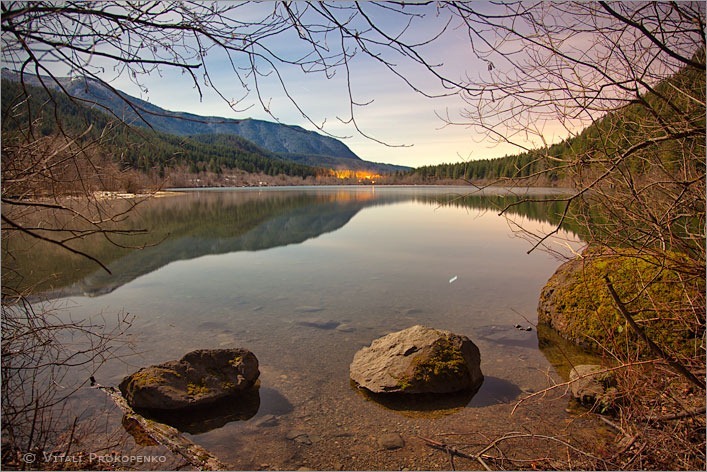
When night looks like day? When it is full moon. And tonight is full moon. With a fellow photographer I went to photograph Aurora which was supposed to be very strong today but the full moon was stronger. Its light was so strong that we could walk on a trail and work with photographic equipment without flashlights.

And here is a proof that night can look like day – a couple of photos I took tonight. The only hint of it being night are star trails in the sky.

Rattlesnake Lake in Moonlight #1

Rattlesnake Lake in Moonlight #2

Beauty Is Next Door

Yesterday we had a beautiful white morning in Klahanie (where I live). Everything was covered in snow. While jogging I discovered a part of a trail with trees covered in snow. When I got back home I put my camera backpack on, got tripod and took off back to this place to take a photo.

Klahanie Trail after Snow Storm

Simplicity

… Still going thru my photo archives (posted about it before in The Art of… Clean up) cleaning up photos that I feel I would not be interested in looking at ever again, categorizing those I’d like to keep and assigning keywords to them. While doing this I find some little gems that I feel deserved sharing.

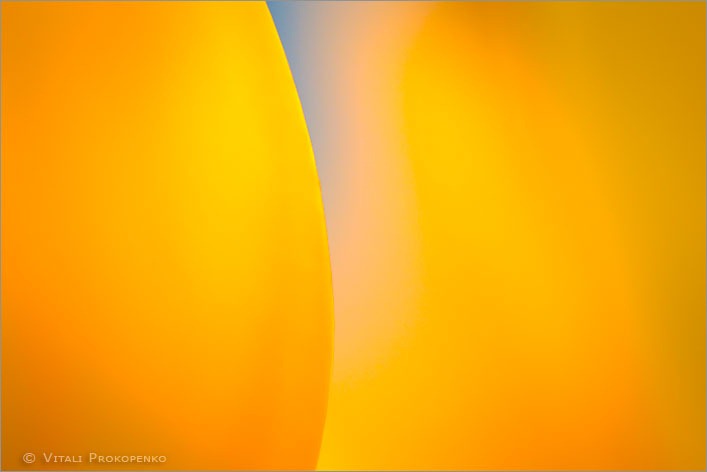
Here is one of such photos. This photos is about simplicity; simplicity of color and curve. I like pure yellow of the flower. I like light blue sitting in a shade between petals. The colors themselves bring me some joy but then there is also the perfect curve of the flower petal which is a pleasure to follow.

Color and Curve