Why photography?

This is a series of posts with translation of my interview published in Russian at http://landscapists.info/vitaly-prokopenko. The question from the interview: “What’s photography in your life? What do you do besides photography?”

What’s photography in my life? – It is a hard and complex question. A short answer: it is a meaning and passion, a way of self-expression.

Besides photography I have job and family. Before my son’s birth I was also snowboarding a lot. After my son’s birth one of my hobbies had to go. Photography stayed.

Best and worst moments

This is a series of posts with translation of my interview published in Russian at http://landscapists.info/vitaly-prokopenko. The question from the interview: “What are your most favorite and least favorite moments while photographing?”

Favorite moment #1: I get a photograph just the way I wanted or even better. Or a surprise – did not expect to find such beauty but nature presents a surprise and I am impressed take my camera out and start photographing.

Favorite moment #2: After hard day of photographing tired and excited at the same time after seeing lots of beautiful places, talk slowly with fellow photographers over dinner about things we’ve seen, impressions we’ve got and photographs we’ve made, relive the day’s experience and get a feeling the this day in my life was worth it.

Least favorite moment #1: When someone comes over and starts asking about my camera, lenses or simply compliment me on my gear. Gear is not why or what I’m interested in photography. It is just a tool, not a goal. Better ask me what I see, what I like about a landscape, how I compose a photograph.

Least favorite moment #2: When someone asks me if I got a good picture. While in a field I don’t know, I’ll know when I get back home. Small preview on a camera screen gives too high level overview of a photograph. I cannot say whether it is good or not.

Copyrights and Trademarks

Thank God he copyrighted Nature before we did, otherwise we would not have anything to photograph.

I’ve recently submitted a few of photographs to a juried book. While reading the rules I stumbled on this (copying copyrights and trademarks section in its entirety):

So, what are some of the things that will get your photo rejected?

  • Logos and Trademarks– this is a big reason for rejections. It doesn’t have to be a picture of a logo, just the presence of a logo in the image. Some actual examples:
    • Photo of a person wearing a baseball cap with an MLB team logo on it.
    • A small Nike swoosh on a pair of running shoes. It was pretty small, but still easily seen.
    • A Ferrari decal.
    • A logo on a building that was discernable as a logo.
  • Copyrighted material – So often makes one say “you’re kidding”.
    • Art work – things like paintings, public art. Most likely we’ll reject it, but if you know that it’s OK you’ll have time to argue your case.
    • Buildings – lots of buildings are copyrighted and the rules are weird.
      • Space Needle – a photo of the Space Needle isn’t OK, but if it’s part of the skyline that’s ok.
      • Eiffel Tower at Night – a photo of the Eifel Tower is OK, but not of it at night when the lights are on it. The light display is copyrighted.
    • Private Property – images of private property are often copyrighted
    • Check http://www.istockphoto.com/tutorial_copyright_list.php
      • If something is not listed on this site, it is not a guarantee that it’s OK.

That’s right – “are you kidding me?”. Thank God he copyrighted Nature before we did, otherwise we would not have anything to photograph.

Photography and Family

This is a series of posts with translation of my interview published in Russian at http://landscapists.info/vitaly-prokopenko. The question from the interview: “What your family thinks about your photography and travel?”

My wife is into photography too – she likes portraiture. She is also my best critic. As authors of our photographs we often see in them what is not there because we still remember the world around the photograph and what we felt when we took the photograph. The photograph might not have captured all that. I often ask my wife to look thru photographs that I’ve selected. She has good taste and she honestly tells me what she thinks. To have such critic close by is a blessing.

My tree year old imitates me. We presented him a real camera (while he is only three he can understand the difference between real things and toys). He takes pictures of everything he sees around. When we go somewhere together and I take photographs, I let him take click a shutter release button. Then with a proud he tells his mother that he has just taken a photo on a dad’s camera.

With the birth of my son of cause I do much less fine art photography. But I don’t regret even for a second. Right now raising my son is the most important thing for me – I want him to rise a good person. Maybe, when he grows up, he’ll share my interest in photography and we’ll be photographing together.

Taking Photographs

This is a series of posts with translation of my interview published in Russian at http://landscapists.info/vitaly-prokopenko. The question from the interview: “How do you prepare for taking a photograph? Do you see you image in your mind’s eye first and then wait for the right light, or take a photograph immediately as you see something?”

This differs from time to time. Sometimes I have an images in my mind’s eye even before I see it and take a photograph. And then I search for a place where I can make that photograph.

Sometimes, after studying a location at home, I imagine a lot of different photographs I’ll be able to take. Then when I arrive to the destination I find it looking completely different from what I have imagined. That is often disappointing. The important thing is not put camera aside. I almost make myself to start photographing in that case and after a couple of days I start seeing photographs around me my own way. Still after the first trip to a location I rarely bring good photographs, more often I use them to study the place at home and be clearer vision next time.

Sometimes I find a beautiful place but the light is not right. I take my compass out take a not of how the sun is moving across the sky, where I’d like it to be to get better light and most importantly when it is going to be there. Sometimes it means that I need to wait for a summer or winter.

Sometimes a place is beautiful, the sun is where I’d like it to be. It is just covered with clouds. I’m watching how clouds sail across the sky, how light and shadow moves across the land. And I wait until a sun breaks thru the clouds and shines on a particular rock, hill or tree. Here a spot of light is getting closer, it looks like in just a moment it will light up your subject. But not – a miss. Next. Again a miss. It seems like the light plays with you, does not let to catch itself. I can spend an hour like that – observing light and shadow. When finally a ray of the sun falls on that rock, hill or tree it is such a joy – here it is what I have been waiting for.

Sometimes everything looks dull, the sky is filled with clouds so thick they form one big cloud. Everything around is grey and flat. It seems like there is no chance there’ll be any sunset. Then suddenly just before sun drops below horizon, the last ray of the sun finds a tunnel in the clouds, breaks thru and lights up the sky in unbelievable hues.

Trip Checklist

This is a series of posts with translation of my interview published in Russian at http://landscapists.info/vitaly-prokopenko. The question from the interview: “You travel a lot. Could you tell a little bit about organizing your trips: how do you prepare for a trip, how much time it takes?”

It depends on how far I travel. If it is somewhere close by car, I almost always have everything in the car. I can without additional preparation just go somewhere for weekend. (After my son was born I need to discuss with my wife ahead of time if I want to travel somewhere.)

If I travel farther away by plane (alone or with my family), preparations take a week or longer. It is typically include the following (always in the order below:

  1. Study the place I’m going to. What to expect in terms of photography. I look at photographs of the destination made by other photographers, read travel guides, study terrain from satellite photos. For example, if it is near the ocean, what’s the ocean shore line is like, interesting rocks, where I’ll be able to walk to the shore.
  2. Decide what to take (if flying by plane, if going by car I take everything). Since there is a limit on carry on and lately I also need to carry my son’s belongings (and sometimes my son himself), I try to take a bare minimum. I make compromises without doubt. For example, I’ll leave macro lenses at home and take macro filter instead to use on another lenses, or don’t take lenses for some focal length.
  3. Sunset and sunrise times. What can get into the sun way during sunrise or sunset, can it be blocked by mountains, do I need to get to higher elevation. Moonrise and moonset times. Tide table – especially important if some parts of the shore are crossable only during low tide.
  4. Cleaning up equipment: cleaning sensor on camera, cleaning lenses and filter. Charging batteries.

Weather for photography

This is a series of posts with translation of my interview published in Russian at http://landscapists.info/vitaly-prokopenko. The question from the interview: “What’s your favorite weather for landscape photography?”

I like any weather for landscape photography besides clean sunny sky or single-tone grayish overcast sky.

That does not mean that I’ll put my camera aside in unfavorable weather. Rather than taking photos of landscape I’ll spend time doing macro-photography, experimenting or taking photos of people.

Waterfall Weather

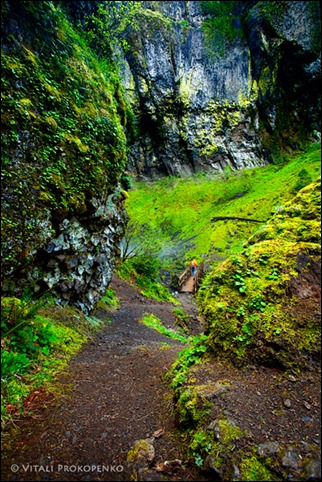
It is amazing how waterfalls create their own weather. On a recent trip we hiked to Elowah Falls (Oregon) to take photos. The weather was hot and sunny until we got up closer to this waterfall. Near the waterfall it was dark, cold, windy and rainy. It was dark from the shadow the rock formation cast; it was cold because a lot of cold water was coming down cooling down the air around; it was windy because falling water was making the air move; and it was rainy because of all the water mist surrounding the falls.

I could explain all that logically but as I was getting closer it felt like we were traveling into another world. After a while the world outside became less real and I had some surreal feeling returning back to sunny and hot world.


My photographic style

This is a series of posts with translation of my interview published in Russian at http://landscapists.info/vitaly-prokopenko. The question from the interview: “Your photographs are unbelievably relaxing, looking at them your feel like you step into a good fairy tale. How do you achieve such effect?”

That’s an interesting observation. Somehow I’ve never thought about this. Now that you noticed it I think [this is part of my photographic style] it is directly related to how I feel when I photograph. For my photography is like meditation. When I’m photographing nature I have a feeling of complete balance inside. Daily routine becomes something very-very distant and unreal.

Beauty around me becomes part of me. Flowers, pines, ocean, mountains, sky, sun has been here and will be here independently of me, independently of people. They just let us enjoy their beauty. It is all quiet and calm around, just birds singing and whisper of wind. There is some inconceivable grandeur in all of it.

Who had the most influence on my photography?

This is a series of posts with translation of my interview published in Russian at http://landscapists.info/vitaly-prokopenko.

I started with reading books by John Shaw. A lot of my photographs at the beginning were attempts to repeat some of his photographs. Repeating is good for studying technique and composition. I was spending a lot of time comparing what I got to his photographs and trying to understand why there was harmony in his, they were capturing attention, they were “singing”, while mine were too static and boring. Decomposing his photos forced me to learn a lot about photography.

While imitating John Shaw’s photographs I did not feel completely satisfied, there was something else I wanted to see in photography. Once browsing books on photography I ran into a book by Freeman Patterson “Photo Impressionism and the Subjective Image” and it immediately captured my attention. It was exactly what I was searching for. After that I bought and read all his books.

His photographic esthetics are the closest to my heart. (That’s probably not surprising, giving that I like impressionism in art and improvisation in music.) I don’t want my photography to be limited to documenting events. Photography should reflect what you see and what you feel, not what your camera happened to capture. After all camera does not know what you’re photographing and for sure does not feel anything.

Also big influence for me has been Jay Maisel. Maybe not as much by specific photographs but his individuality, style and being open-minded to all kinds of photography, seeing photographs in everything that surrounds you. Under his influence I don’t want to limit myself just to landscape photography, only color photography or black-and-white. In photography as well as in any other art there cannot be limits – it is always exploration and excitement of finding something new outside a box in which we currently are.

Moving away from photographers who influenced me, I’m just finishing book by Stephen King “On Writing” and it certainly will influence my photographic process and my photography. Most things that he writes about in this book can be applied to photography as well.