Taking Advantage of Imperfections

I’m increasingly photographing with more and more challenging lighting. Such as including sun high in the sky into the picture. The creates a lot of glare in the photo. And I’m working thru those issues, finding how to avoid them or incorporate them in my pictures.

There is a couple methods I use to avoid glare in my pictures. First one that I used for a while already is to block out the Sun with a finger, take photos without the Sun and the glare. The next photo is with no fingers in the frame. Both photos should be taken with the same exposure, the same focus point, the same aperture and on tripod. I would take the normal photo as a base and then use the one where I blocked out the Sun to patch any areas with a glare. This methods works really well during sunset or sunrise when the Sun is placed closer to an edge of a frame.

The other method I discovered during my trip a week ago to the Palouse. Turns out that if I open aperture to its widest setting I get almost no glare or at least its impact becomes imperceptible. This method works well even if the Sun is in the middle of the frame. That’s the technique I used for the photo below that I took during the trip.

Again I would use the photo with aperture set to where I want it. In this case I wanted to close down aperture to get sun burst rays. Closing down the aperture produced a lot of glare in the sky, on the Steptoe Butte and in the fields, that would be hard to patch in Photoshop if I did not take another photo with open aperture and used parts of that photo to patch out all the glare.

Then I discovered that polarizer that I had on my lens had imperfection that resulted in light spilling further from the Sun in two directions along one line. (And just in case you did not know any additional glass surface adds more glare to the photo as sun light bounces back and forth between glass surfaces.) My first reaction was to remove the filter. But then I thought of incorporating that effect and make that line horizontal by rotating the filter. Later I also did take photos without the filter but I like the one with imperfection more. It gives some surreal feel to the scene.

_MG_3000

Photographing Light

Can light be a subject of a photograph? I’m absolutely sure of it. More than that, light is often the main subject of my photographs.

A week ago I was walking in Seattle Arboretum looking for spring blossom. I made a few photos but nothing was clicking. I was ready to give up and headed back to my car, when I saw this light. Actually several kinds of light in one scene: rim light on tree branches, and sunrays breaking thru the branches forming a waterfall of light.

_MG_2481

Spring is Here

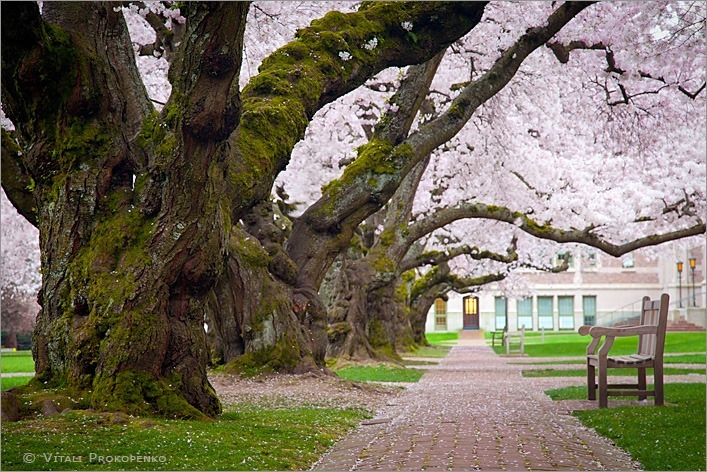
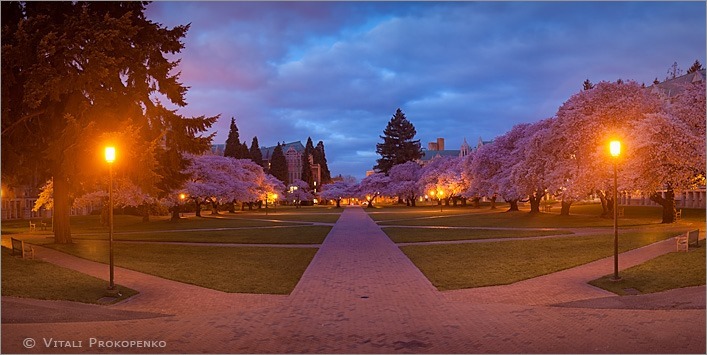
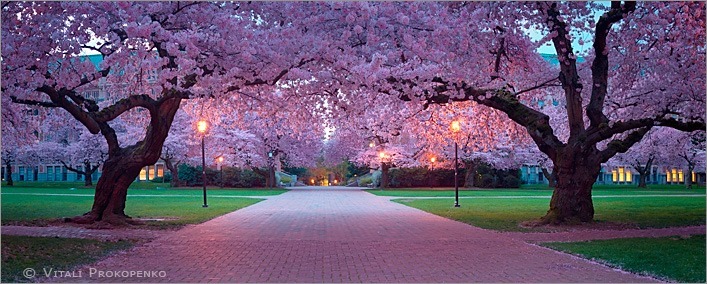
Finally, I’m done with processing my photos from my winter trip to Canadian Rockies. And all of a sudden spring arrived to Seattle. This means it is time for photographing cherry blossom. One of the most popular places for cherry blossom in Seattle is UW Quad. During weekend of nice weather the place is packed.

I typically go there early in the morning, somewhere around 6am. It is more deserted and with street lights it looks more interesting.

I noticed though that with each year more and more photographers come early too. On Saturday there were 20 photographers, on Sunday – 30. With tripods standing, bags lying on the ground and photographers walking around it becomes quite a challenge to have a clean photo. Well, it seems coming even earlier and on workday, I still can have the place to myself.

_MG_2346

_MG_3155

_MG_3209

_MG_3224

_MG_3235-Panorama

_MG_3522

Simplicity of a Curve

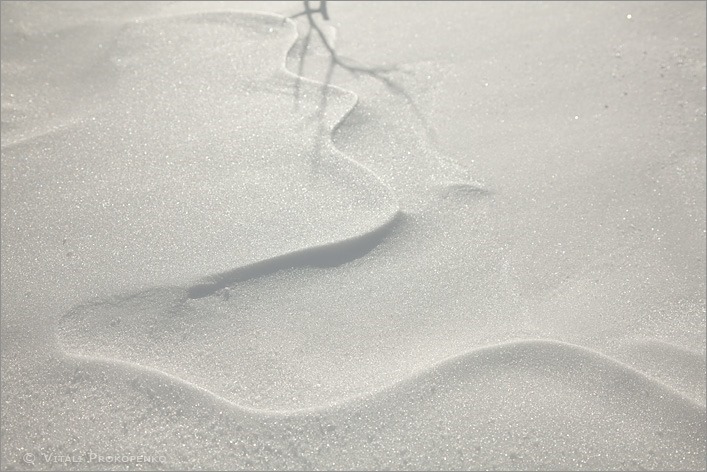
What can be simpler than a single curve in snow. It is like an artist calligrapher drew a hieroglyph with a single movement of hand.

_MG_9403

What’s interesting is that I found the same curve in a track of foot steps that a fellow photographer left behind.

_MG_9400

One Arrow, Many Photos

Just how many photos of the same subject can be made? Apparently a lot.

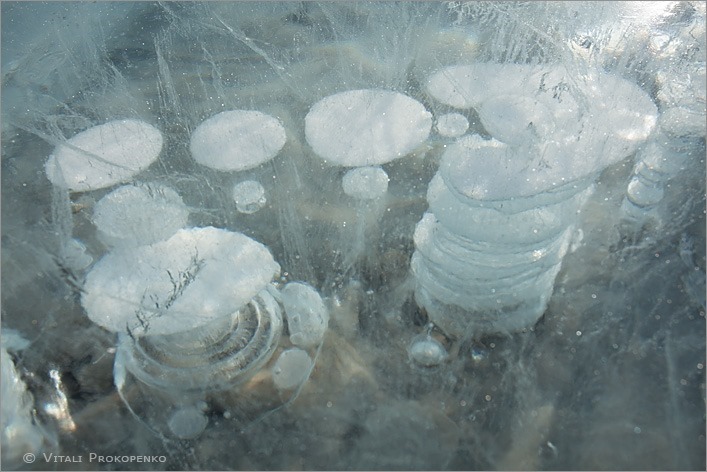
One of the key locations we photographed on the last trip to Canada was an artificial lake by a tiny town of Nordegg. The winter is bitterly cold their and the lake freezes deep enough to walk on ice. The constant wind blowing over the lake keeps the ice clean from snow. What’s most interesting is air bubbles that rise from the bottom of the lake just to be captured in ice building fantastic three-dimensional structures.

One of such structures was in a form of an arrow. I was so drawn to it that I spent hours photographing it over two days. Coming up with new and new ways to do it. Here is how it looked:

_MG_0283

Now how about using flashlight to highlight part of an arrow? That circle at the head of the arrow seems very attractive:

_MG_8975

How about showing the arrow in the context of the area surrounding it? Let it be the lead to othe bubbles:

_MG_8990

Let’s step further away. How about hiding the arrow in a landscape for a curious eye to find:

_MG_8915

I’ve done much more different photos of the same subject on that trip; they are just not as good.

I guess my point is that I don’t come-see-take a photo. I work with the subject, explore it visually and find many photos of it which eventually dwindles to a few ones I keep.

Up on a Hill

Sometimes you need to get up on a hill to see a view. Just like I did when we drove thru Canada.

We drove thru places of snow and ice that were picturesque enough. But then I saw a hill with a parking lot next to it. I stopped and climbed the hill. The view that opened up to me was breathtaking.

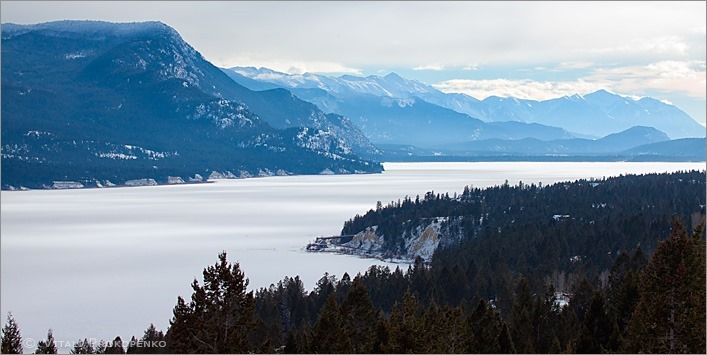
The vast flats of frozen river covered with snow, the soft spots of sun light breaking thru clouds, the blue hazy mountains in the distance and a cloudy sky above it all. The view was worth photographing, the awe was worth sharing. I called up the other guys and we spent some time photographing.

_MG_8395

Rear-View Mirror

One of the useful photographic tools: rear-view mirror. I often see a landscape there that makes me stop, jump out of the car and take a picture. Here is one of those photos from the last trip to Canadian Rockies. You can even see tire track from my car as I pulled to the side of the road.

What’s also interesting is that this light was gone in a few seconds. So, catch your moments!

_MG_8658

Let the Flashlight Be

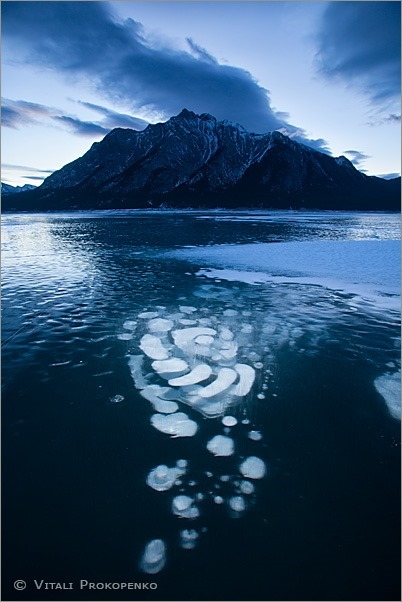
Another example of playing with light. This time it is not at night but at twilight. There was already enough of ambient light and I had to use two flashlights to highlight an interesting bubble structure in the ice.

_MG_0663

Lights in the Night

I’ve probably mentioned before that I love photographing at night. Ok, if I have not then I’ll say it now. I love photographing at night.

There are several reasons for that. First, I like element of surprise in night photography. Human eye cannot see that well at night (though you’ll be surprised to how well it can see once you give it time to adjust to low light). Thus I don’t quite see how photo will look like. After setting up first exposure just having a general idea, I take it and I get a surprise as I can see things that a human eye cannot see: details and shapes that are too dark to see, movement of clouds and stars at long exposure.

The second reason why I like night photography is because it gives me an opportunity to play with light: flashes, flashlights, gels. That’s where creativity really kicks in. Rather than capturing what’s presented to me in the best way possible, I create something out of my mind.

On this trip (just as on many others) I’ve dragged the whole gang out of cozy rooms into bitter cold two hours before sunrise to get some time for night photography. This time I played with flashes. I’d work on the ice and after certain number of steps would put a flash against the ice and fire it.

_MG_0596

Red Morning

Photographing sunrises and sunset is hard on Hawaii. Being close to equator the Sun pops up and quickly rises in the morning and it quickly drops down in the evening. There literally second to photograph sunrise or sunset.

Additional challenge for me was that at the place where we stayed the sunrise was blocked off by a mountain and clouds that the mountain attracted. I would have a peak of great clouds and light over the mountain thru trees, wires and buildings, wishing I’d be there every morning. Unfortunately, the was no road there.

Then one morning the clouds over the mountain cleared out and the light of sunrise spilled over the whole sky. The sky turned red and cast red light on the ocean and the land. And the ocean and the land turned red. Good thing I was persistent in going out every morning, hoping for a great light show. Persistence pays off.

Red Morning