A Dream About Water

I’ve wrote about light painting before and I’ll likely write more again as this really fascinates me in photography. For me it is a lot of fun playing with lights, a lot of creativity as I create something that was not there in the first place, and a lot of surprise as most of the time what I get is unexpected.

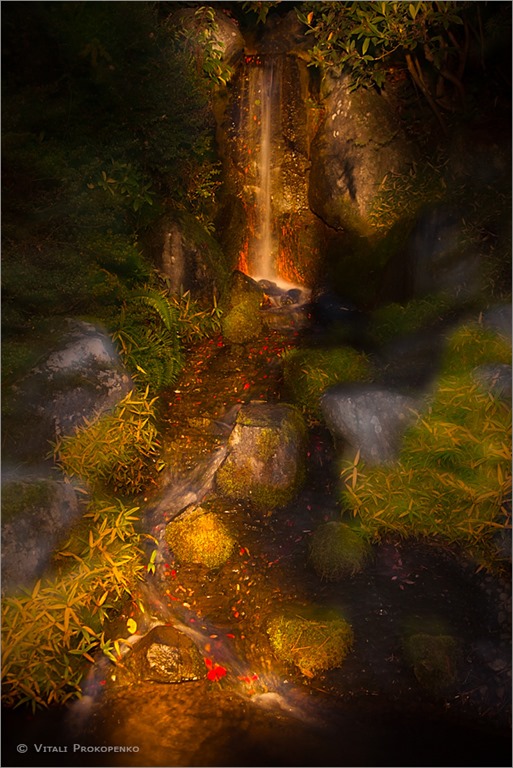
Here is an image that got me very excited about light painting again. I spent a day photographing fall foliage in Kubota Gardens in Seattle (I’m still working on post-processing those photos). At dusk as it got dark enough for exposures to go up to 30 seconds I started playing with light painting with two waterfalls I found in the gardens.

I found the upper waterfall to be more interesting of the two because it had red leaves caught in the stream and I could get a more dynamic image with foreground and background.

There were two new things I played with this time. First, I brought two different flashlights: one had cool light and the other one had warm light. So, I could do not only light painting but also color painting. The other thing that I played with was focus, shifting focus in the middle of light painting. This created dreamy effect.

For those interested in more technical details here is how I took this image. The camera was on a tripod, aperture wide open (f/4 for the lens that I used), shutter was 30 seconds. It was pretty dark already, my camera was not able to focus just using ambient light. First I would use very powerful warm flashlight. I would point to a rock in the middle of the frame and focused the camera using auto focus. I would turn off auto focus then. Turn off the flashlight, so it does not light up something accidentally, and release shutter. Then quickly with the same powerful warm light I would trace the waterfall and the creek back and forth a few times to ensure that individual spots or streaks of light a now visible. That was taking me about 5 seconds. Then I would turn off flashlight and defocus the lens. The rest of 25 seconds I was using weak cool flashlight to light up sides of the frame while the camera was out of focus. I did this ten times or more, every time getting a different image – I love the element of surprise. This I think is the best out of the series.
A Dream About Water
A Dream About Water

Breaking Patterns

Do you know what fascinates me in my visual world? Patterns. Here is an image I made last weekend, when I was passing by a small island of young aspen trees:

_MG_1913

Do you know what fascinates me even more? Breaking patterns. Just seconds after I made the image above I noticed another island of young aspen trees with one tree bent and still having leaves breaking the pattern of bare trunks:

_MG_1928

Unexpected Happens

Photographing the same place again and again is like visiting an old friend.

A couple of weekends ago I went to Olympic Coast for 3 day photographic trip. I decided to start this year with visiting my old friend: Second Beach. By far it is my favorite beach for photography. There are so many different opportunities there.

While driving there I noticed something else that caught my eye: an amazingly saturated greenery of fresh spring leaves. It was amazing. The result was that I spent most of the day time during those three days in a forest.

Now let me welcome you to Olympic Peninsular forest in spring.

Same Place – Different Look

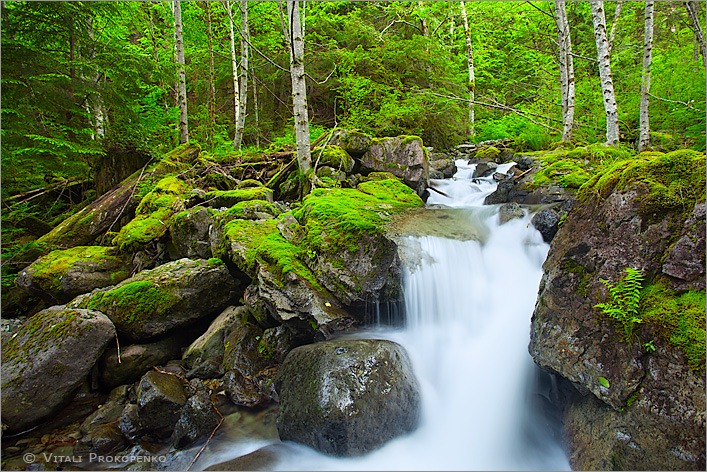
One interesting thing about nature photography is visiting the same place at different times of a year. Last spring I took a photo of one of the waterfalls on Change creek. Back then the trees were covered with fresh green leaves. Green moss was covering rocks.

I went to the same place about a month ago and it looked recognizable but at the same time very much different: bare trees and snow covered rocks.

Enchantment Lakes [2]

Day 1. Snow Lake

Fill the bottles with water. Put up backpack on. Drink as much water as possible. First step on the trail. What an exciting moment. Next step. And next. Just keep moving.

The first day of trip it was walking most of the day. We had occasional stops for water refill from a creek, sometimes for a photo opportunity (so to speak, more likely just to catch some breath). For breakfast, lunch and whenever hungry we were we only had energy bars.

Here is a creek we took water from and one of the photo opportunities we stopped for:

This way we got to Upper Snow Lake. It was not Enchantment Lakes yet. It was at the base or a steep part of the trail to Enchantment Lakes. I still had some energy to go but my friend decided to camp. Next day I learned that it was a very wise decision.

There was a lot of shrubbery turning yellow around our camp. Once the camp was settled I grabbed my camera and started working around searching for photographs. Here is one I consider most interesting out of those:

Thru the Leaves

Traveling in a company of other photographer is both fun and educational. We can pick up ideas from each other, extend each other’s knowledge and creativity. On one of such trips I picked up an idea from other photographer to photograph waterfalls thru leave or include leaves and branches as a framing element in the photos.

Here are two photos from that trip that gives the idea of what I mean. The first one uses branch as framing element and the graphic of another branch being moved by air forced down by the waterfall. In the other the branch is the main compositional element. I liked the graphic lines of the branch.

_MG_1861

_MG_1896

Intimate Waterfall

Long time ago I photographed waterfalls from a side to keep myself and equipment away from the water. One thing that I’ve started doing this year is working into water and photographing waterfalls from where the water flows.

Being in the water makes experience much more vivid. I can be more intimate with a waterfall; look at it face-to-face; take a photo of waterfall with water coming onto me. I hope it gives my photographs that intimate look.

Of cause, I have a special boots to keep my feet warm in freezing water. The boots themselves are kind of interesting development of a human mind in itself. Rather than fighting the water trying to keep your feet dry they let the water in and that water seals the boots. The little amount of water that got in is quickly warmed up by your body and the feet stay warm and cozy.

It sounds so much like what photographers do – letting the world around to sink into them and then lock it in with a camera.

Spring Spring (Homestead Creek)

Depth of Field Matters

One of the things photographer needs to think about is a depth of field. When photographing grand landscape, I typically set aperture to middle point between widest and most closed to get most sharpness in the image. For a landscape overall sharpness of an image is typically more important than depth of field.

The story is completely different when photographing close-ups. Depth of field becomes extremely important. It can make or break the image. And getting everything sharp is not necessarily a good thing. And I just happened to have two images to demonstrate the difference.

First, an “everything sharp” image. The aperture was closed to the sharpest setting for the lens that I used (f/8). To me the image ended up too flat. There is no separation between the lupine and shed boards, the lupine seems to be carved in the wall.

Lupine by a Shed

The second image, which I like, is with the lens wide opened (f/2.8). The lens is well focused on the lupine. It is tack sharp. The wall is slightly out of focus. This creates a three dimensional feel in the photograph, there is a space between the flower and the wall.

Lupine by a Shed
Lupine by a Shed

Another interesting thing to note is that I experiment with different depth of field, light, composition while photographing. I took 38 photos of this lupine over two days. Later I reviewed and pick just one of them that I felt worked the best.

Rhododendrons or Not?

Recently I went with a fellow photographers to photograph rhododendrons which are common on eastern hills of Olympic mountains. We were hoping for fog to have a good separation of rhododendron bushes from trees in background.

There was fog but not where we needed it. The only option left was to use shallow depth of field. My fixed 50mm lens got second life. I had not used it for a while but it was most appropriate in that case since it had the widest aperture of all my lenses.

Rhododendron
Rhododendron

The other options was to let it blend with with forest, make it part of it.

Spring Green
Spring Green

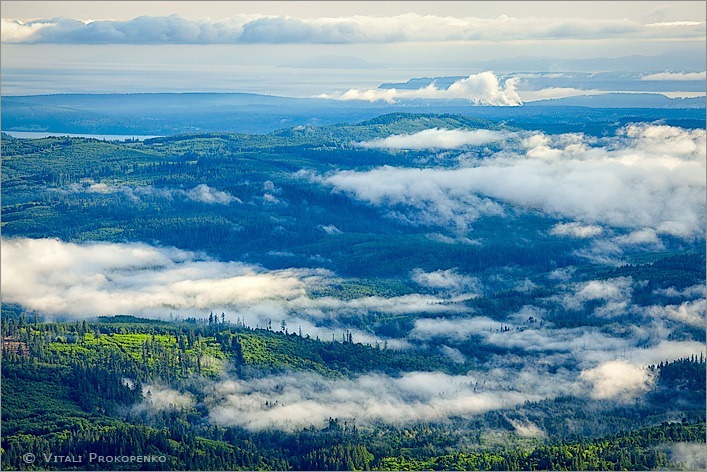
Did I mention there was fog but not where we needed it? Well, we ended up spending most of the time photographing that fog that was somewhere else:

Fog Over Lowlands
Fog Over Lowlands

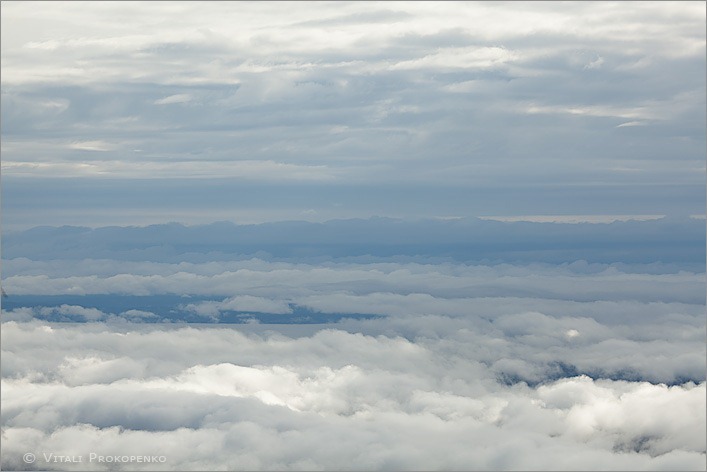
Fog Over Puget Sound

Soft Light

There is no such thing as bad light.

When I just started photographing the only good light I knew was a sunset or sunrise. Then I added daylight with sunlight breaking thru the clouds which was creating an interplay of shadow and light on the ground. But for longest time I thought grey overcast day is bad light that is not suitable for photographing anything.

Well, I was wrong. I just did not develop my eye enough to see what a beautiful soft light an overcast day can give. That’s the best light for photographing deep in the forest where direct sunlight falling down thru a thick canopy of leaves and branches create extreme contrast.

Overcast day on the other hand creates nice soft light that is smoothly descending thru every opening and canvasing the ground with soft highlights.

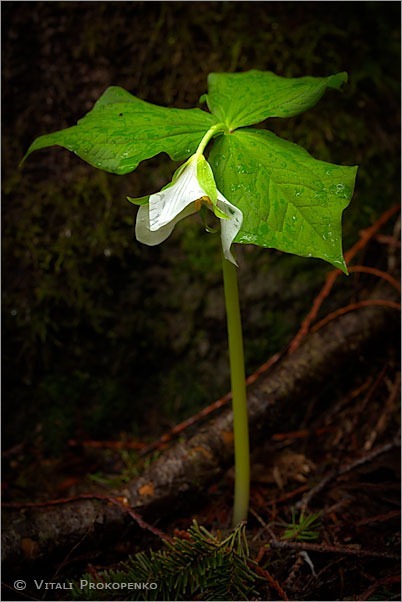
What a perfect opportunity to photograph this flower that is blooming deep in Pacific Northwest forests whole spring and summer. I love its perfect triangle of three petals and three leaves.