New eyes

The real voyage of discovery consists not in seeking new landscapes but in having new eyes.
Marcel Proust

Have I been to Mount Rainier National Park many times? Sure, I have. It is the closest national park to my home. Have I got a lot of photos from Mount Rainier National Park that I’m proud of? Nope. After all the trips I still did not have emotional connection with that place. The photos, while technically ok, were lacking emotions, strong graphics, or something interesting happening to me. As a result I thought Mount Rainier landscape was just not for me and have not visited it for a long time. Until recently.

Recently a group of three local photographers – Andrey Cherepakhin, John Song and Protik Hossain – lured me to go to Rainier again. They had specific places in mind which I have not visited before. I went along. And I’m glad I did.

Was the trick in having new eyes or was it in visiting places off a beaten path? I don’t know. One of those or both did the trick. Finally, I got photos that are beyond high quality snapshots and capture some emotional scenes of Mount Rainier.

PS At first I stopped typing here and just added photos below. Then I thought it would be worthwhile sharing what I liked about each of them.

———-

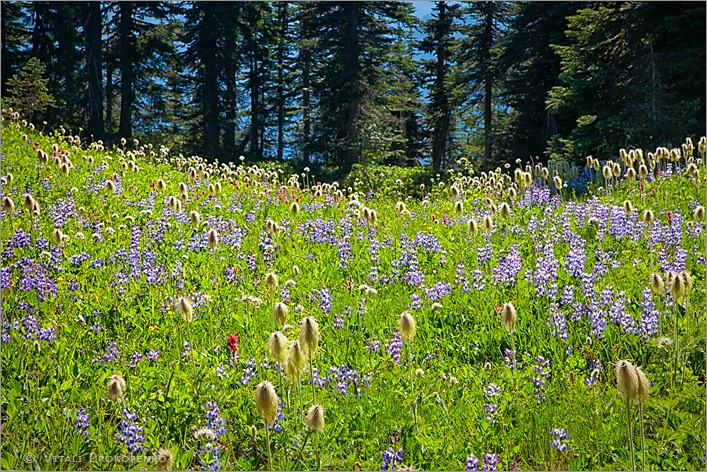
Summer Light and Pattern in a Chaos. I like summer feel of this photo. It was taken “into the sun”, bringing out a lot of green in the grass and lighting up the flowers. I like the contrast between light in the meadow and darkness in the trees. I like V-shape of two slopes. I like how seemingly random while flowers see to be in inverted V shape that draws you into the picture, gives it depth and perspective.
———-

Light and Shapes. Obviously the reflection is nice in absolutely still water. But what I really like in this photo is the light of the sun right before sunset caught in a sheet of ice floating in the water. The other thing that I like is that the shape of the highlighted piece of ice repeats the shape of Rainier in background.

———-

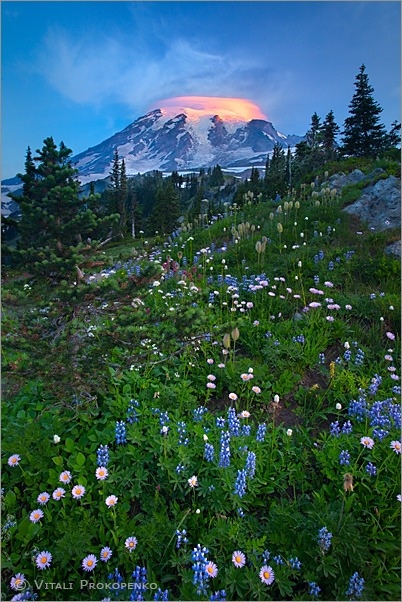
Light, Cloud and Frame. The cloud sitting on the top of Rainier, lit up by sunrise is an obvious thing that I like about this photo. The other two are how the mountain is framed by the tree on the left and the tree on the right and how flowers lead to the mountain.
———-

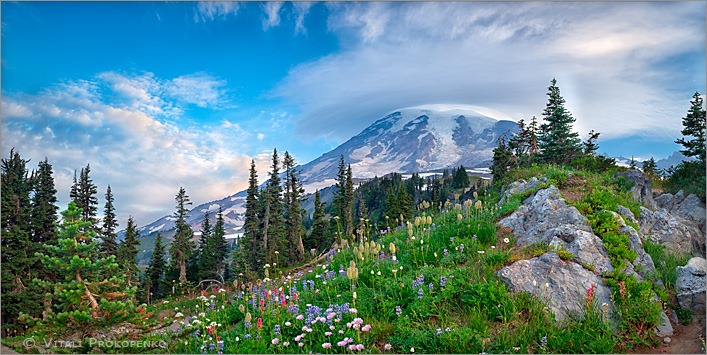
Shape and Curve. Rock formation on the right and the mountain make up one large curve.
———-

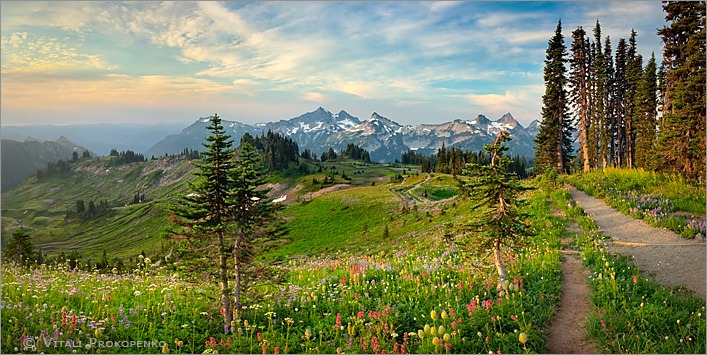
Leading line. The trail is strongly visible in the right bottom corner of the image continues later closer the center of the image, leading to Tatoosh Range in the distance.
———-

Layers. There are many layers in this photo on different levels. First, foreground – rock and flowers, middle ground – rocks, stream and snow, mountain and sky in background. Second, half in shadow, half in light. Third, interleaving layers of light snow and dark rocks.

And of cause the cloud lit up from inside is great!

———-

Mood. Reflection and Clouds. I like reflection of the mountain among the rocks. The cloud around the mountain grew in size to fill up the sky while still keeping the circles around the mountain.

And I like the tough mood of the high elevation landscape. The unrest in the sky. The anticipation of cold fall ahead. A reminder that the summer was almost over.

———-

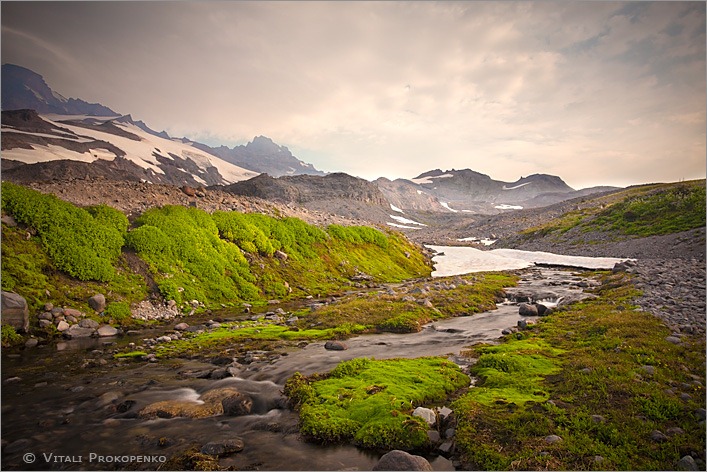
Mood. This photo reminds me the kind of photos I see from Iceland. Dramatic heavy skies and flat light. Tough climate creates tough landscape be it Iceland or this small oasis at Mt Rainier.
———-

Emotions and Light. I like this photo for the same dramatic skies combined with a tenderness of flowers and a island of light breaking thru the clouds.

Being Late

I have a pattern of being later. I always get too involved in photographing wherever I’m and end up being late for photographing sunset wherever I want to photograph sunset. Or I wake up just a little bit late and late to photographing sunrise.

Sometimes it plays out well though. Like in this case I was driving to photograph sunrise at mountain Rainier and I was late, I was too late.

On the way there I was passing a lake as usual. The morning was very cold and steam was rising from the lake. The sky had just a touch of pastel pink from a distant sunrise. I decided that this scene was worth stopping and photographing. Even though I was in a hurry. And that’s how I met the sunrise.

Opportunity Gone

That’s interesting how sometimes we underestimate the changes that happen around us.

A while ago I took this photo near Reflection Lake at Mount Rainier. It is not as good technically as I’d like, or at least not up to my current more experienced standards of execution. But now nothing like this can be done.

This year I went to this spot again and found that the road near the lake has been widened and rocks have been places on a side of the road close to the lake and the place where this photo was taken was gone.

Suddenly not very original photo turned into the one that cannot be repeated again. Life is a curious thing.

By Reflection Lake
By Reflection Lake

Intimate Waterfall

Long time ago I photographed waterfalls from a side to keep myself and equipment away from the water. One thing that I’ve started doing this year is working into water and photographing waterfalls from where the water flows.

Being in the water makes experience much more vivid. I can be more intimate with a waterfall; look at it face-to-face; take a photo of waterfall with water coming onto me. I hope it gives my photographs that intimate look.

Of cause, I have a special boots to keep my feet warm in freezing water. The boots themselves are kind of interesting development of a human mind in itself. Rather than fighting the water trying to keep your feet dry they let the water in and that water seals the boots. The little amount of water that got in is quickly warmed up by your body and the feet stay warm and cozy.

It sounds so much like what photographers do – letting the world around to sink into them and then lock it in with a camera.

Spring Spring (Homestead Creek)

Depth of Field Matters

One of the things photographer needs to think about is a depth of field. When photographing grand landscape, I typically set aperture to middle point between widest and most closed to get most sharpness in the image. For a landscape overall sharpness of an image is typically more important than depth of field.

The story is completely different when photographing close-ups. Depth of field becomes extremely important. It can make or break the image. And getting everything sharp is not necessarily a good thing. And I just happened to have two images to demonstrate the difference.

First, an “everything sharp” image. The aperture was closed to the sharpest setting for the lens that I used (f/8). To me the image ended up too flat. There is no separation between the lupine and shed boards, the lupine seems to be carved in the wall.

Lupine by a Shed

The second image, which I like, is with the lens wide opened (f/2.8). The lens is well focused on the lupine. It is tack sharp. The wall is slightly out of focus. This creates a three dimensional feel in the photograph, there is a space between the flower and the wall.

Lupine by a Shed
Lupine by a Shed

Another interesting thing to note is that I experiment with different depth of field, light, composition while photographing. I took 38 photos of this lupine over two days. Later I reviewed and pick just one of them that I felt worked the best.

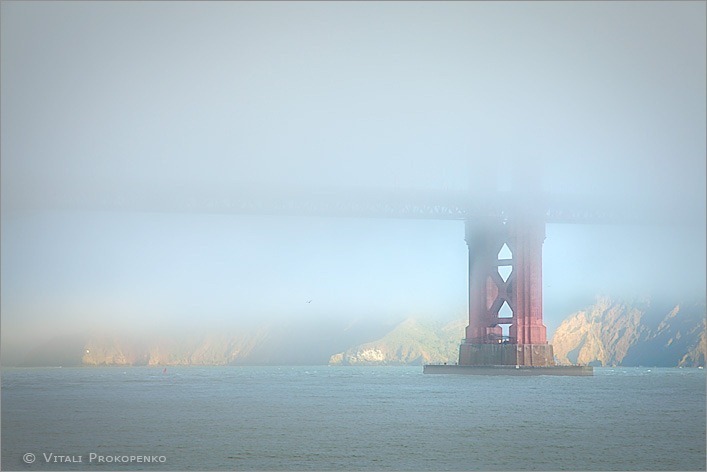
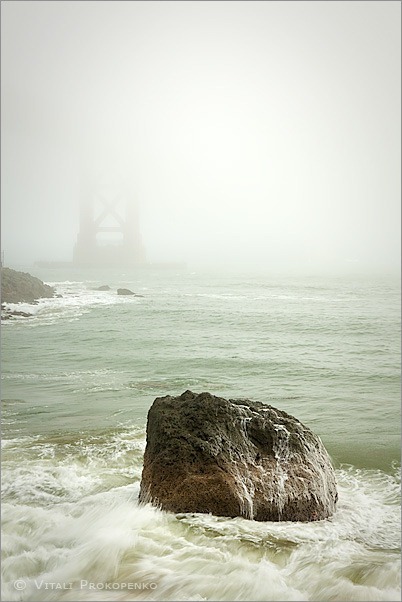
Fog over Golden Bridge

I always wanted to photograph Golden Bridge and Presidio in fog but in many times I had been to San Francisco I had never seen fog over Golden Bridge. Other photographers seemed to get it every time. Not me.

This May on the way back from The Lost Coast we spent a couple of days in San Francisco. One morning Very early before sunrise I went to photograph hoping to get lucky and see that mythical fog. And lucky I was. The was fog. And not just in the morning. It was there whole day. In fact it caused our flight to be delayed in the evening.

The fog was different from the one I used to. I’m used to fog in still windless weather. Golden Bridge fog was combined with strong winds. It was constantly on the move, thickening and lightening, lifting off and dropping back to the ground, letting sun in or blocking it off all together, constantly reshaping landscape.

It presented me with new and constantly changing photo opportunities. I could not get enough of it. I was running from one place to another and then back. The only limit was time.

On an Edge of Rain

We all have some small thing in our lives that we enjoy a lot. One of my things is to be under cover while it is raining. Not inside a house within four walls but almost outside, where I can smell the rain, feel a fresh breeze it is bringing, stretch my arm and feel wetness of rain drops. And yet at the same time feel protected from being completely wet. Like being in an open shed in a forest. Or just being in my garage with garage door opened, standing on an edge of the rain. Moments like that make me feel warm and cozy.

In one of those moments I photographed this iris growing next to my house:

Iris in Rain
Iris in Rain

Electric Pole

Let’s face it – electricity together with wires and poles are here to stay for a while. 🙂 So, what do you do when you see great light, great color, but electric pole and wires get in your way? Well, the only things to do is to make them part of a composition.

Waiting for the Light

Sometimes you chase the light and sometimes you need to wait for it.

By the afternoon of the second day the sky started to clear and I started heading back home. I still wanted to stop by a few places on my way home. One of those places was a large canola field that I saw on my way to Colfax.

In the first day with no sunlight in the first day the canola field looked dull and uninspiring. But with the light and shadow spots moving across it I thought it could be interesting. With a sunlight on it the canola field was bright yellow. The kind of color my son loves because it is warm and happy.

I drove around the field looking for a composition. I could not quite anchor the composition around anything, because there was not anything in the field. And just as I almost gave up I saw and intricate play between light and shadow which shaped up the field into something that was interesting to photograph by itself.

Clouds were moving very fast. By the time I stopped the car, got out of the car, setup tripod, put a camera on tripod the cloud moved on and shadow that was shaping the field was gone.

Sometimes you chase the light and sometimes you need to wait for it (or, to be more accurate, in this case wait for a shadow). The next two hours I’ve spend waiting for another cloud to come in… and here is the photo I was waiting for:

_MG_4437

Chasing the Light

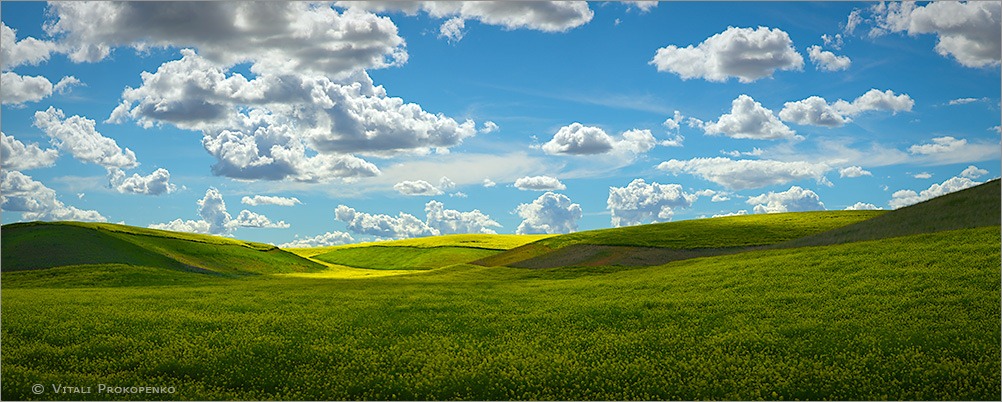
After dreadful first day in Palouse the second day everything a landscape photographer could have dreamed of. The sky was filled with puffy clouds moving fast across the sky dragging spots of light across the land. All I had to do was watching those light spots highlight something interesting in the landscape.

I enjoy chasing light and shadow moving across the landscapes, its continuous change of scenery. It is like looking in kaleidoscope. There is an infinite amount of beauty in it and all you need to do is watch.

Here are two photos of the same place and same composition but different light. The first one is about the barn, since the light is on it:

And the second one is about fields behind the barn, since they have light on them:

Which one is better? Not sure. They are just different and I like them both.

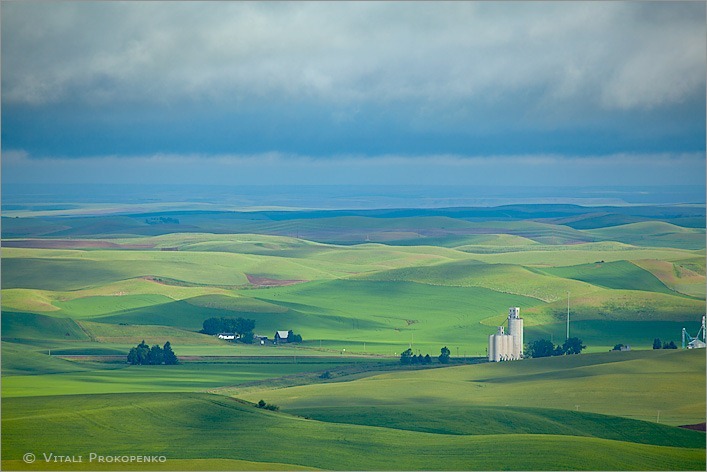
Here is one more example. The white silo stands out of landscape with the light on it and a cloud shadow behind it:

And here it blends with the landscape: