Dante’s Peak

Day 5, Noon

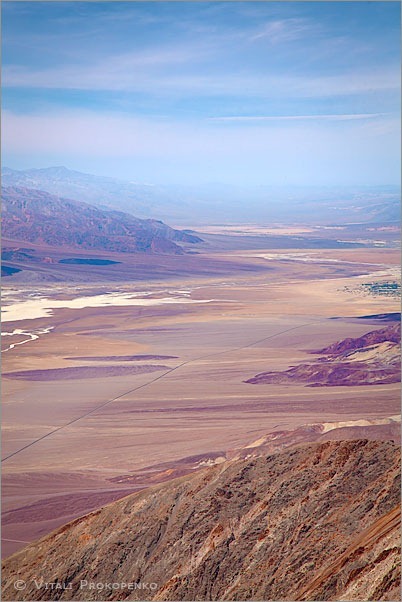
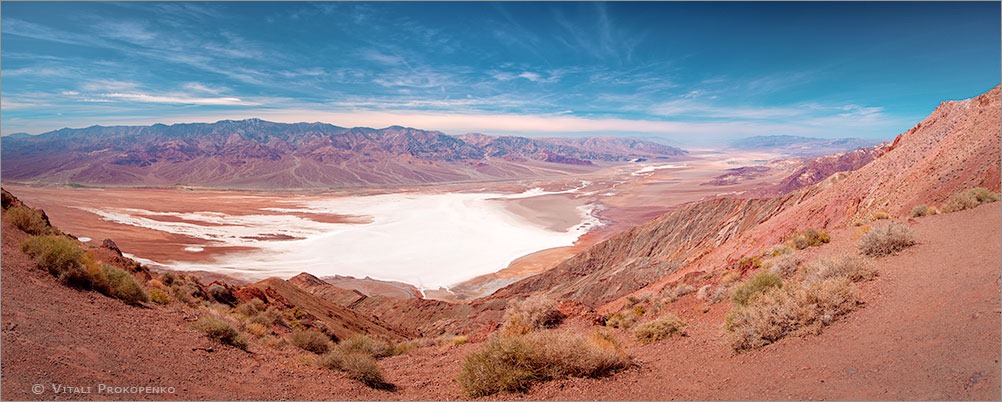
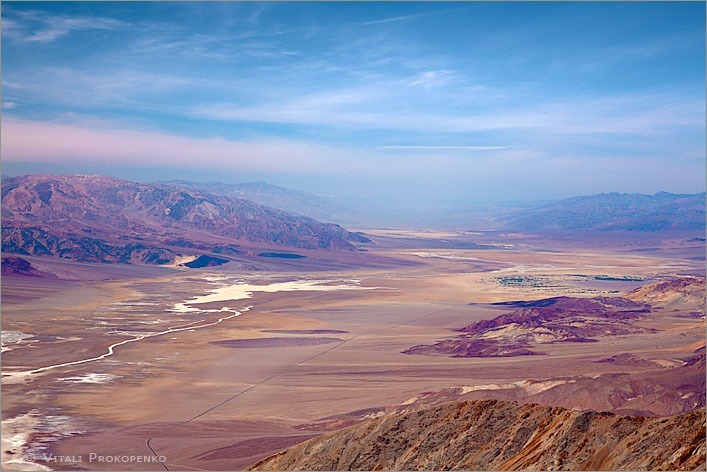
What an amazing breathtaking view of Death Valley opens up from Dante’s Peak!

The elevation gain of Dante’s Peak is so high that the temperature drops 15C comparing to the the temperature at the bottom of the valley. I got there in t-shirt and shorts but quickly had to put on long-sleeved shirt, warm jacket and gloves to keep myself warm.

Here is a panorama with Badwater in the front (click on the image to see bigger size):

View from Dante's Peak

Here is horizontal photo of the part in the distance:

View from Dante's Peak

And here are is a vertical:

View from Dante's Peak

Eureka Dunes

Day 2, Sunset

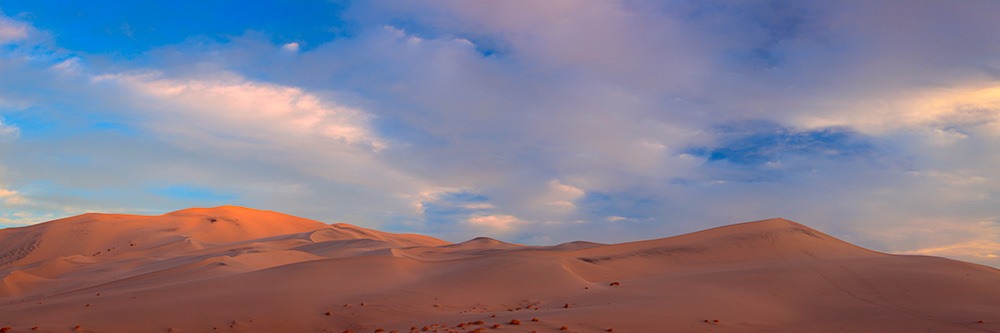
Here they are – Eureka Dunes. This is the first time I went there. Their size is magnificent and awe inspiring.

Eureka Dunes

Just as I approached Eureka Dunes a low pressure indicator came up on console. I stopped and stepped outside. I could here a fizzing sound coming from a punched tire. Photography aside I had to replace the tire first.

Changing tire in heat and dust is not fun. At first I thought it was kind of lame that I had made all this way without a problem and got a flat at the destination. But in retrospective I think it was good it happened there and not in the middle of the road. It was easier to change tire on a leveled camping site than a rough road. And there were other campers there who were more than happy to help.

Once the tire was replaced I was ready to photograph a sunset. And what a sunset it was!

Here is the last light on the highest dune. The clouds are still white and soft.

Eureka Dunes

And here are the clouds lit up.

Eureka Dunes

Big Pine Road

Day 2, Afternoon

My next destination in Death Valley was Eureka Dunes. Eureka Dunes are remote but are worth the drive. Their size is magnificent and awe inspiring.

The way I got there was by Big Pine Road coming from Scottys Castle. It was about 2 hour drive on a rough unpaved road. The views were great and I stopped several times to take photos. The very first post of the series about this trip (Death Valley) has one of the views opening up for traveller.

There are a couple of interesting sites a long the way. First one is Crankshaft Crossing that actually have a few crankshafts lying around:

Crankshaft Crossing

And the other one is remains of a sulfur mine that was abandoned long time ago. With much of equipment abandoned to rust it looks like a scar on a landscape. One sheet of metal was loose and flapping in the wind making a squeaky sound. This made the place feel ghostly and spooky.

Mine 1

Mine 2

Mine 3

Salty Lines

Day 2, After Dawn

Photographing Badwater is all about finding lines that are interesting a leading somewhere. Like in this photo I found a line that can be anchored in the bottom corners and goes into the image pointing toward a cloud in the sky. And there is a nice loop at the end of it that matches the cloud.

Badwater
Badwater

Dunes Are Alive

Day 1, After sunset

Dunes come to life after sunset. After heat of a day a cool breeze feels refreshing. Insects are flying, bugs are crawling, animal sounds fill the air. Lonely lights floating over dunes. Those are photographers coming back after photographing sunset. 🙂

In Dunes at Twilight

Death Valley

Day 1, Afternoon

This is a beginning of a story about my photographic trip to Death Valley. One of the things that I did differently this time around was writing a journal of some thoughts about scenes I saw and events that happened.

Death Valley is an unique place. It is a place of extreme heat, lack of water and Nature’s way to show adaptation and survival of life. It is a place of extreme contrasts – from heat of the bottom of the valley to cold mountain tops, from dunes at the bottom to forests at the tops.

Every time I go to Death Valley I spent most time in dunes. I’m captivated by their perfect geometry of line, shape and texture. That’s where I stent most of my time on this trip too. But let’s not skip too far ahead and start at the beginning.

Upon arrival to Las Vegas airport I rented a car – a large SUV with foldable second row of seats, so there is a large enough flat area in the back. The reason was that the way I travelled was very minimalistic: I slept in the car. Before going to Death Valley I stopped at the closest grocery store and loaded up the car with water and food for the whole trip.

Once all preparation was done without much delay I took off to Death Valley. After about 3 hour drive I arrived there. The weather was great. The sky was filled with clouds. It was not typical for Death Valley but great for landscape photography.

Road in Death Valley
Road to Eureka Dunes

Stormy Sky

Do you wait for sunny weather, clear skies? I’m waiting for a storm. Lately I’ve been fascinated with stormy skies. There is some wild unruly power in them, something that makes me appreciate the Nature and its rejection of a human will over it.

Rialto Beach, Olympic National Park

This photo was taken on a rainy, cold and windy day when most people stayed home warming up by a fireplace. Not me. I was out there, trying to capture a beauty of elements.

A Night of a Lost Star

This blog post is about this image, how it came about, my thought process and little bit about post-processing that helped me achieve what I wanted:

A Night of a Lost Star A Night of a Lost Star

There is a place in Palouse that is recognizable by many photographers who have visited Palouse. It is a tree not far from the Steptoe Butte near a fork of two dirt roads. I’ve photographed it quite a few times myself. Here is the most successful one: Sketch with a Tree and Road. That photograph was made from the Steptoe Butte with a long focal length.

All attempts to make a photograph from the ground level produced rather unremarkable results. The tree alone in a field was a strong anchor in a composition. Curves of hills coming down where creating an interesting shape leading to the tree. And yet resulting photographs were weak. There was not much going on beyond that.

I photographed this tree many-many times, year after year, every time I visited Palouse. I’ve become obsessed with it. I think I might have even seen it in my dreams. I was sure a great photograph was there I just had not found it yet.

This year I thought again of this tree while planning my trip to Palouse. I reflected back and thought of what attracted me – a tree alone in a field, a good anchor for a composition, a good base to work with. That leaded to thinking about painting-like picture.

I went to Palouse with a goal to take as many different photographs of this tree as I could think of, employing various photo impressionism techniques, like multiple exposures, Orton effect, long exposure with camera on a tripod for a movement in grass and tree canopy and long expose while shaking camera in various directions and patterns.

To my delight the tree was fully alive again (note that in earlier photograph linked above half of the tree appeared dead). This made a tree look complete.

I ended up taking 67 photographs of this tree. Out of those I chose the one with multiple exposures (21 exposures to be accurate). What I did not like in multiple exposure image though was that it made tree trunk too fuzzy and soft. I wanted the tree to have a strong trunk to support that canopy. At the same time I did not want to have a sharp trunk as it would not go with the rest of the image. I looked thru the images taken with a long exposure while shaking the camera and found the one with the tree trunk visually strong enough and at the same time with the fuzziness that matched the rest of the picture. Masking out the tree trunk was easy since it was taken in exact same conditions – same luminosity and color.

The other thing that I was looking for during the trip was cloud textures. From my previous experiments – such as Still Life. Tulips – I knew they make a great base texture, making a photograph look like painting. I did not find good cloud textures but what I found on the second day of the trip was this strong cloud that was striking thru the sky like a lightning.

I layered the sky with the cloud over the tree in the field and used blending mode “Multiply” which was equivalent of stacking two slides one on top of another – the same approach as in Orton effect except slides contained completely different images.

The first two things I’ve pre-visualized in my mind. I knew what I wanted the image to look like and was just looking for a way to get that quality. When I overlaid the sky with the cloud and the tree in the field, I realized that this will be a night picture. This was a surprise. I did not think of that but sometimes I tell the picture what I want it to be and sometimes the picture tells to me what it wants to be – this makes it even more interesting.

That meant that I needed to have stars in the sky. The sky just looked to empty for the clear night sky. Being true to the nature of this picture being completely made with photographic material that I captured, I needed to take photo of the night sky with stars. I tried to take photo of the stars from my backyard. That did not work out, there was too much light pollution from city lights. I had to put this image aside until I have an opportunity to take a good photo of the stars.

The wait was burning me. I wanted to share this picture so much, but at the same time I knew it is not finished. Next trip – could not get any photos of the stars, the sky was covered with clouds. Finally, on the next trip I went to Rainier and had clear sky. I took a few photos of the stars. This picture was finally coming to completion! What a joy was that!

There are much more technical details to this picture. There were a lot of detours and dead-ends I ran into – I had to backtrack and start over because the image did not look and feel the way I wanted it. I worked about a month on this image – the most I had spent on a single image.
Last light on a puffy cloud

For I don’t know which time I learn over and over not to give up on a sunset too soon. It is not over until it is dark.

We were photographing Half Dome in Yosemite Valley at sunset. The Dome was partially covered with cloud. Golden rays of a low Sun were breaking thru the clouds. That’s when I got this nice moody photograph of the Dome:

Half Dome painted with golden Sun rays

And after that the light completely disappeared. We packed our cameras and tripods and went to nearby small village to do some shopping before leaving to our camp for the night.

Just as were leaving the village I saw top of Half Dome lit up with this gorgeous purple light. The setting Sun has found its way thru the clouds for the last time for the day. We sharply turned around and parked. As quickly as I could I unpacked camera, set it up on tripod and managed to catch last purple light on a puffy cloud hanging at the top of Half Dome:

Purple cloud at the top of Half Dome