Better late than never

Fog in Yosemite Valley

The goal on my last trip to Yosemite was to wake up before sunrise every day and be at a point of interest early before sunrise. First day I woke up at four in the morning before alarm even went off. I guess I was refreshed and eager to photograph.

Next day I missed it. The alarm probably went off but I did not hear it. (This type of things happen when there is a load river rushing down just outside your tent. I’ve learnt the lesson and put alarm next to my ear the next night.) So, what do you do in this case? Stay in a sleeping bag for a bit more and let yourself relax? Or do you get packed quickly and move to capture whatever is left of early morning?

At first I wanted to be lazy but then I thought that I came there to photograph and I would photograph. We packed quickly and went to Tunnel View again. And I was so glad we did! When we got to the Tunnel View (for the third time during the trip), we saw fog flowing into the Yosemite Valley and clouds falling down from El Capitan like waterfalls.

Most important advice

Look at the world around you with your eyes wide-open. Like a child. There are endless possibilities for photography around. While photographing a sunset look at what’s behind it might be even more beautiful.

This is a series of posts with translation of my interview published in Russian at http://landscapists.info/vitaly-prokopenko. The question from the interview: “Give one Very Important Advice to our readers?” This is the last question from the interview.

Photography – hobby or work?

This is a series of posts with translation of my interview published in Russian at http://landscapists.info/vitaly-prokopenko. The question from the interview: “Is photography your hobby or job? Or maybe both at the same time?”

Photography is a hobby for me. I thought of making it my job but talking with photographers that made it their job I abandoned that idea. There is a lot of work goes into having photography as your job that is not directly related to making photographs like marketing, finances, workshops, etc. I’m not interested at all in that. I might as well to have a job completely unrelated to photography and do photography I like in the remaining time. After all I probably spend as much time doing photography I like as some professional photographers.

As far as money concerned I think the only way to make money in photography is to photograph weddings, portraits or advertisement.

By the way Brooks Jensen wrote it in a funny way in his book Letting Go of the Camera. Though he has built a successful business based on his love of photography.

Why photography?

This is a series of posts with translation of my interview published in Russian at http://landscapists.info/vitaly-prokopenko. The question from the interview: “What’s photography in your life? What do you do besides photography?”

What’s photography in my life? – It is a hard and complex question. A short answer: it is a meaning and passion, a way of self-expression.

Besides photography I have job and family. Before my son’s birth I was also snowboarding a lot. After my son’s birth one of my hobbies had to go. Photography stayed.

Best and worst moments

This is a series of posts with translation of my interview published in Russian at http://landscapists.info/vitaly-prokopenko. The question from the interview: “What are your most favorite and least favorite moments while photographing?”

Favorite moment #1: I get a photograph just the way I wanted or even better. Or a surprise – did not expect to find such beauty but nature presents a surprise and I am impressed take my camera out and start photographing.

Favorite moment #2: After hard day of photographing tired and excited at the same time after seeing lots of beautiful places, talk slowly with fellow photographers over dinner about things we’ve seen, impressions we’ve got and photographs we’ve made, relive the day’s experience and get a feeling the this day in my life was worth it.

Least favorite moment #1: When someone comes over and starts asking about my camera, lenses or simply compliment me on my gear. Gear is not why or what I’m interested in photography. It is just a tool, not a goal. Better ask me what I see, what I like about a landscape, how I compose a photograph.

Least favorite moment #2: When someone asks me if I got a good picture. While in a field I don’t know, I’ll know when I get back home. Small preview on a camera screen gives too high level overview of a photograph. I cannot say whether it is good or not.

Workflow

This is a series of posts with translation of my interview published in Russian at http://landscapists.info/vitaly-prokopenko. The question from the interview: “Could you describe in a few words how you do post-processing of your photographs? What software do you use, what workflow?”

I use Adobe Photoshop for editing and post-processing of photographs. I start with reviewing photographs in Bridge in slideshow mode. I stop slideshow on photographs that catch my attention, open them in Photoshop, touch up slightly (to bring them all to some common denominator) and save them off to a different folder. After that I continue with the slideshow. At the end I may have 10 images selected out of 500 taken.

Then I start rating selected photographs. Rating 5 is given to photographs that I think is some of my best work (not just on that particular trip but in general). Rating 4 is for good photographs, 3 – good quality but static, boring, does not move me. 2 – not good, 1 – can be deleted. (Jumping a bit ahead – in the end I show to others only photos which I rated 4 or 5 stars.)

Then I do accurate post-processing of the photographs with 4 and 5 star rating (and some with 3 stars). This can take a few days. I try not to rush thru this process.

Next step: leave photographs a side for a while – a month or two – to let immediate feelings about the trip to wear off. I always want to show them immediately but every time I do so I regret about it later.

Here is why I regret showing photographs immediately. After a while i go back and look at photographs with a fresh perspective and many of them look differently to me. Rating of some of them may change. Some need more detailed processing. I realize that some might look better in black-and-while others may look better in color. Some might benefit from a slightly different angle and I go back to originals and see if I took that photograph from that different angle.

Only after going thru this strict editing process I, finally, start showing photographs to friends, observe their reaction and listen to their comments. I rarely re-adjust photographs at this point, I do changes a rating though. For example, if I see that a particular photograph does not evoke any emotion, people just pass thru it, I might lower its rating even if I love it.

The last step I started doing only recently. In a set of photographs I look for a common theme. It might be a place where they are taken, common subject, color palette, or something else. When I have enough photographs around common theme, they become a basis for a folio. The idea is to tell a story with a series of photographs.

I do the final pass of adjustments in photographs selected for a folio, to make sure they have saturation, contrast, etc that make them look better together. I add titles, description. And then publish them on my website.

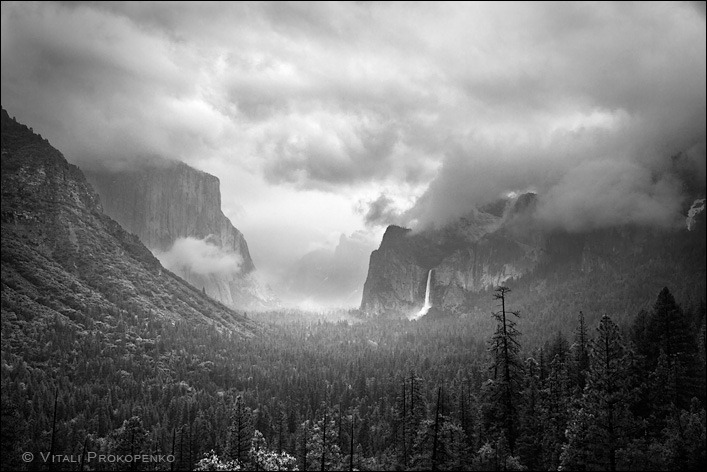
Tunnel View in Rain

Tunnel View in Rain

During my last trip to Yosemite the valley was both unbelievably beautiful and crowded. On the second day when we went to Tunnel View during midday, it was packed, we could not find a parking spot. Then the rain started and washed away all the tourists and photographers. But the rain is one of the best weather to photograph. Clouds create drama, light is constantly changing, rain adds depth and mist starts rising from ground heat up by the sun earlier. Just watching the scene changing continuously right in front of your eyes is awe-inspiring.

Tunnel View at Sunset

Tunnel View at Sunset

I was on a trip to Yosemite last week. Now I’m back home and started working thru the photographs that I took on the trip.We were very lucky – the sky was gorgeous three out of four days we spent in Yosemite.

Here is a classic "Tunnel View" of Yosemite valley. This photograph was taken at sunset on the first day of our trip.

I find myself constantly drawn to black-and-white photography. This image is a great example of where black-and-white look great (and better than color one) for my taste.

Copyrights and Trademarks

Thank God he copyrighted Nature before we did, otherwise we would not have anything to photograph.

I’ve recently submitted a few of photographs to a juried book. While reading the rules I stumbled on this (copying copyrights and trademarks section in its entirety):

So, what are some of the things that will get your photo rejected?

  • Logos and Trademarks– this is a big reason for rejections. It doesn’t have to be a picture of a logo, just the presence of a logo in the image. Some actual examples:
    • Photo of a person wearing a baseball cap with an MLB team logo on it.
    • A small Nike swoosh on a pair of running shoes. It was pretty small, but still easily seen.
    • A Ferrari decal.
    • A logo on a building that was discernable as a logo.
  • Copyrighted material – So often makes one say “you’re kidding”.
    • Art work – things like paintings, public art. Most likely we’ll reject it, but if you know that it’s OK you’ll have time to argue your case.
    • Buildings – lots of buildings are copyrighted and the rules are weird.
      • Space Needle – a photo of the Space Needle isn’t OK, but if it’s part of the skyline that’s ok.
      • Eiffel Tower at Night – a photo of the Eifel Tower is OK, but not of it at night when the lights are on it. The light display is copyrighted.
    • Private Property – images of private property are often copyrighted
    • Check http://www.istockphoto.com/tutorial_copyright_list.php
      • If something is not listed on this site, it is not a guarantee that it’s OK.

That’s right – “are you kidding me?”. Thank God he copyrighted Nature before we did, otherwise we would not have anything to photograph.

Equipment

This is a series of posts with translation of my interview published in Russian at http://landscapists.info/vitaly-prokopenko. The question from the interview: “What equipment do you use to take photos? Do you use any unusual equipment while photographing? Maybe something handmade?”

I prefer to avoid gear discussions. Canon or Nikon or something else – does not matter. What matters is the person taking a photograph. My only advice, if you want to try yourself in photography, is not to spend too much money on the first camera and lenses. The first camera is needed to understand if you like doing photography, what kind of photography you like and what you might need to do what you like.

One of unusual pieces of equipment I use is a shower cap (the one you get for free in pretty much all hotels and motels). It comes very useful while shooting in rain or next to a large waterfall – I always have a few in my backpack. It is easy to put on a camera and protects it from rain or mist. It still allows to compose a photograph and adjust polarizer. Then I open up front lenses take a photograph and snap it right back on.

Also I use my hand to cover lenses a bit to avoid glare. On a long exposures with high dynamic range I can block some of the light coming in (kind of burning image in the field. Also I can block the sun when it happens to be in a corner of my frame. That way I avoid white spot in the corner and the sky in that corner will turn red-orange color.

And of cause I always have a flashlight with me. It has three main functions: light my way to where I’m going to photograph sunrise or when I come back from photographing a sunset; helps me focus camera at night and, finally, light up a subject while photographing at night.

Also I always have a compass with me to help me figure out where a sunrise or sunset is going to be.