Art Fair: My Experience

This year I tried something new – selling canvases with my photographs at art fairs. I’ve been to two art fairs: Kirkland Uncorked and 6th Street in Bellevue. A few weeks passed since the last one. I had time to recover and reflect on this new for me experience.

The Most Important Takeaway

The most important takeaway – my audience. I found more people who like my work and keep in touch with me. Talking to people gave me insights and unusual perspectives on my photography.

Thanks to all who stopped by my booth on either of the art fairs, talked to me, purchased my work – you’re my audience and I love you all.

The Best Encouragement

I got encouraging response to my photo impressionism work. This was very surprising. This is something that I like to do a lot and at the same time I thought people would not accept. Well, I was wrong, people loved it.

The Best Moment

When someone passing by would suddenly freeze seeing my work and in a few seconds after catching a breath slowly say “wow!”.

The Worst Moment

Pouring rain on the first day of the art fair in Kirkland. Everyone simple disappeared from art fair. Staying alone in a booth without anyone even passing by is the worst.

The Funniest Moment

When a woman passing by saw my photo with a boat Stillness and said “I love this image but I’m done with color blue”. Should I have offered it to her in some other color?

Kirkland Uncorked

Last month I have been extremely busy printing a lot of my images preparing for Kirkland Uncorked – an art fair in downtown Kirkland. The art fair is at the end of this week July 15-17.

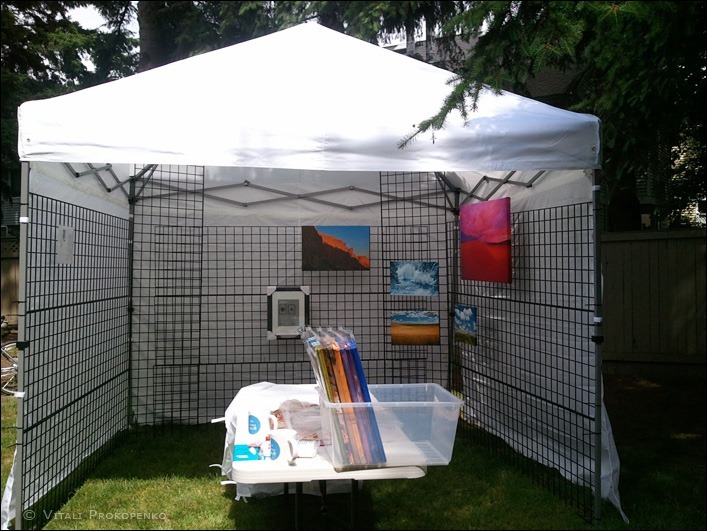
50 canvases are ready to be hung. Today we did a “dry run” of the art fair. We’ve raised the tent, assembled grid walls, hung a few canvases.

Below is the result of the test. It will be even prettier at the art fair. I hope to see some of you there. I’ll post booth number and location once I have it.

WP_000441

Naïve and Romantic

Recently I got a link to a somewhat interesting article Preparation In Fine Art Landscape Photography. While I found it interesting (I do myself lots of the things listed in the article and find them useful), at the same time I thought it is too simplistic and pragmatic.

The most important thing I do in the field is missing from the article’s list: connecting with a landscape. Before I even take my camera out of a bag I spend time observing landscape that surround me – from tiny flowers to tall mountains to high sky up above. What’s interesting in it, how do I feel about it, is it a happy place or a sad place, is it powerful or weak? I spend as much time as I need to feel the things that surround me, walking around or simply sitting. I may even close my eyes and focus on scents or sounds of birds singing or waves crashing onto the shore. Can you imagine that – a photographer with his eyes closed?

Call me naïve and romantic – because quite frankly that who I am – but when I photograph I don’t follow any specific list of steps, I follow my emotions.

Two Trees on a Hill at Sunset

Image vs. Print

This question bugged me for a while: is an image an ultimate goal and result of creativity or execution and presentation are important as well? And I came to conclusion that execution and presentation are important.

Let’s talk about paintings for example. I think of paintings not only as two dimensional images. There is a third dimension – brush strokes. They capture artist hand motion and his emotions as much as color, composition or subject. When I look at those strokes I can imagine how the artist hand was moving, and that passes artist emotions to me. The brush strokes can be powerful, forceful, angry or they can be casual, light and soft. A reproduction of a painting can have accurate representation of an image but does not capture the brush strokes as well and in some sense erasing that third dimension.

I grew up in a fairly provincial town seeing only reproductions of paintings in books. Seeing them later in museums changed my perception of them completely. I remember how seeing one of van Gogh’s self-portraits in Seattle Art Museum (in a temporary exhibition) made unforgettable impression on me. Much of van Gogh’s face was not painted. Either skin-toned paper was used or paper was covered with skin-toned paint. And then on top of that van Gogh painted his beard, eyes, hair. It was like the face was already in that skin-toned paper, van Gogh just helped me to see it in a few brush strokes. No reproduction has been able to show that.

Now the paintbrush strokes can be meaningless too. For example, I have some cheap painting hanging in my house. It may have been produced by printing on canvas first and then laying paint on top to make it look like painting, the paintbrush strokes just random and “don’t fit”. That’s kind of example of good image bad painting. Another example of good image and good painting but where strokes don’t mean much [to me] is Pointillism which branched off Impressionism. In paintings that I’ve seen in museum executed with this technique application of dots looks very mechanical. While technique is interesting it did not give enough freedom to artist hand.

Same goes to photography but in photography it is a matter of technology and not directly related to us. Platinum-palladium print has incredible tonal range and looks like the image is in paper, where print from inkjet printer looks like image is coated on top of paper, like a polaroid emulsion transfer (in some sense). All that is left to us is to choose what matches what we want the best. And don’t get me even started on paper, I have ton of paper samples at home and I just enjoy looking at them and feeling their texture.

Is this important to most of people? No. Paintings are not much of importance either. And even famous ones. Have you been to Musée du Louvre and saw Mona Lisa? Have you looked at the crowd? How many people were looking at the painting and how many were actually with their backs toward the painting taking infamous “hey, I’m 10 feet from Mona Lisa painting” photo? And using flash despite all “no flash” signs? I like this statistic from Wikipedia: “Visitors generally spend about 15 seconds viewing the Mona Lisa.” Is it really worth only 15 seconds? (Granted it may have lost its value as painting and has become something else. Sadly.)

So what can we photographers do? We can do our best explaining this and teaching everyone to see this. Even if the rest think we are a bit crazy.
Demilitarization of Photography

I find it a bit disturbing the amount of military words used by photographers. Shoot instead of take picture. Shot instead of a photograph. Weapon of my choice instead of camera and lenses. Just today I’ve read interview of one photographer where while talking about his street photography he said “I keep my weapon close [referring to camera] ready to fire”. Why so much aggression? Aren’t we supposed to make our world better with our art?

I avoid those word in my language and use real photographic words when talking about photography. For me photography is a peaceful experience. Let’s declare photography a demilitarized zone. Are you with me?

Quality vs. Quantity

Why are we chasing after making more and more photographs?

A famous Russian artist – Alexander Andreyevich Ivanov – spent 20 years on one painting which turned to be his whole artistic life. The painting is absolutely breathtaking.

We, photographers, on the other hand seem to want to produce more photographs per minute than ever. I’m not sure if industry is encouraging us or industry just meets our demand by producing faster shot per second cameras, faster cards, software to go thru photo-editing faster.

Do we produce something great or just visual noise? Is it time to slow down and think about what we trying to get to by doing this? I used to be inspired by single photographs of the past and I still am. Nowadays I’m subscribed to all kinds of digital photography feeds but for the most part all I get is one stream of noise. It seems that photography has become more about inventing something new rather than about creating something beautiful. Now single photograph is not enough, today it is all about folios. Is a folio just a way to unload more photographs into the market?

I wonder what would be an equivalent of spending twenty years on a single painting in photography? How would one work on one photograph their whole life? And what that photograph would be? Maybe a folio is an equivalent of that painting? And it is all about polishing that set of photographs: substituting some of them with other, reshooting some of them, redoing post-processing, etc. That seems to make sense, just don’t make me look at a folio of a thousand photographs.

Art?

Is a photograph of an art an art? Is a photograph of a sculpture an art? Is a photograph of a painting an art?

What is important in a photograph – an image or how it was made? Similarly for paintings: if we have two visually undistinguishable copies would we value the one that is proven to be original thru chemical analysis higher? Does it mean it is more important how something was made than its purpose?

I don’t have answers to either of the questions. It is just something I find interesting to think about.