Spring Is In The Air

Spring… What do you do to us. Emotions over the top. Creativity spruces.

After dreadful winter rains nice spring weather came to Pacific Northwest. And I cannot stop photographing. I have not sorted thru all the photos from Death Valley trip yet and I already took photos of cherry blossom, that I have not even looked thru, tulip festival, that I only quickly looked thru.

Today I wanted to hike up to some waterfalls, stopped on the way there to check out a creek running over the rocks and got stuck there for hours photographing the creek, rocks, flowers, reflections. I have not even made to the trailhead to the waterfalls that I was originally planning to go to.

Here is one of the photos from today’s trip:

_MG_7538

I really need to step up processing of all my photos.

PS And today while reviewing photos in camera I accidently navigated to the first photos on the card a discovered interesting images of plum blossom that I have not even download off the card yet.

Dunes Are Alive

Day 1, After sunset

Dunes come to life after sunset. After heat of a day a cool breeze feels refreshing. Insects are flying, bugs are crawling, animal sounds fill the air. Lonely lights floating over dunes. Those are photographers coming back after photographing sunset. 🙂

In Dunes at Twilight

Black and White – Naturally

I love color photography. At the same time I have a great appreciation for good black and white photography. Once in a while I do black and white photos myself albeit not as often as color. To be more accurate I do monochromatic photos as I like to tone or colorize them.

And sometimes the nature presents a photo that is monochromatic even in color. Like this photo of fog over Port Angeles. This is an actual color photograph and as you can see it is almost monochromatic.

Fog over Port Angeles

When Night Looks Like Day

When night looks like day? When it is full moon. And tonight is full moon. With a fellow photographer I went to photograph Aurora which was supposed to be very strong today but the full moon was stronger. Its light was so strong that we could walk on a trail and work with photographic equipment without flashlights.

And here is a proof that night can look like day – a couple of photos I took tonight. The only hint of it being night are star trails in the sky.

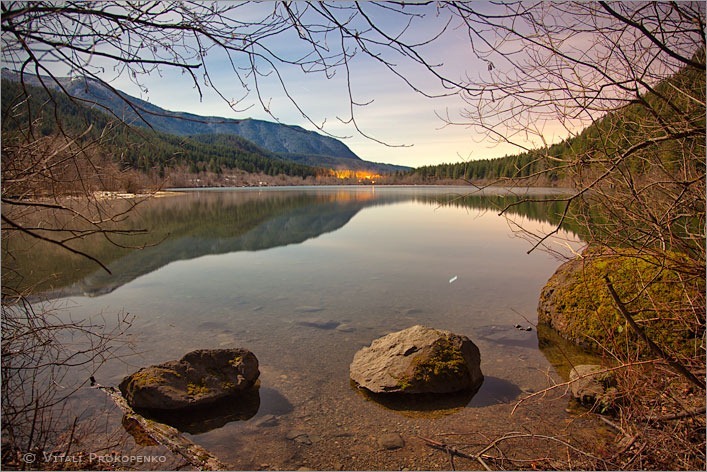
Rattlesnake Lake in Moonlight #1

Rattlesnake Lake in Moonlight #2

Beauty Is Next Door

Yesterday we had a beautiful white morning in Klahanie (where I live). Everything was covered in snow. While jogging I discovered a part of a trail with trees covered in snow. When I got back home I put my camera backpack on, got tripod and took off back to this place to take a photo.

Klahanie Trail after Snow Storm

Walk into Fall

This post was supposed to be about fall and beautiful foliage colors I captured last fall during my visit to my home town in Ukraine. But as I was preparing an image to include in this post the topic of the post changed because of my struggle to fit large image with lots of details in a small viewing area of a screen and make it as enjoyable as original.

Here is the image I’m talking about (you can click on the image to see it in a bigger size):

Walk into Fall
Walk into Fall

In full size it has every leaf with its unique color and details. The whole image is vibrant and lively. You practically want to follow the dirty trail covered with foliage and walk into fall. After reducing it to such small size all the colors blended together into something more or less average.

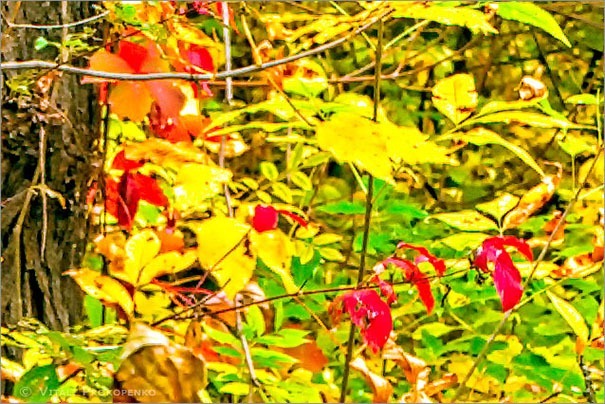
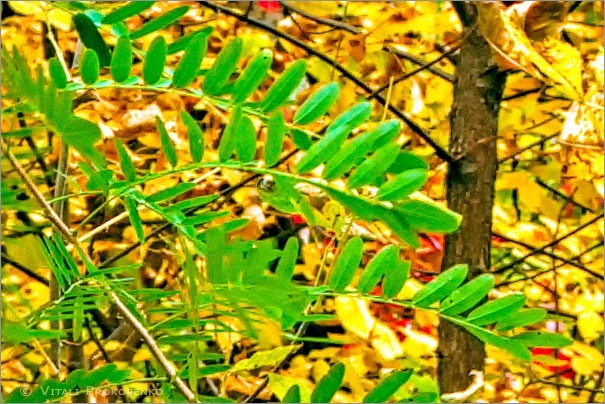
That’s just another reason I still enjoy more prints over images on a screen. Just to show what I’m talking about here are a couple of snippets at full resolution.

Foliage

Foliage

Fun in the… Moonlight

Light – the basic principal of photography. That’s why so many photographs made during day when we have a lot of sunlight. But photographing at night in moonlight is just as much fun for me (or maybe even more fun).

Night photography is full of surprises. I only have a general idea of a composition since I cannot see as much at night as in sunlight. Then experimenting begins. First, I need to find the right exposure, then find an actually interesting composition. Each attempt lasts for minutes – that how long exposure needs to be.

Then the fun with artificial lights begins. Adding flashes or flashlights to lit up some elements of landscape. There is no limit for creativity, except time.

On my last trip to the Palouse I spent about 5 hours photographing one night, mostly to get this photo. Each exposure was 5 minutes. Once I found exposure I noticed streaks of clouds moving in the sky. I thought it would be cool to align them with the tree, so they coming from behind the tree. Took me about 10 attempts to find that spot. Another hour is gone. Then I started experimenting with two flashlights lighting up the crown of the tree or creating light spots in the field. Eventually I stopped at this image, right around 1am.

Fun in Moonlight

A Night of a Lost Star

This blog post is about this image, how it came about, my thought process and little bit about post-processing that helped me achieve what I wanted:

A Night of a Lost Star A Night of a Lost Star

There is a place in Palouse that is recognizable by many photographers who have visited Palouse. It is a tree not far from the Steptoe Butte near a fork of two dirt roads. I’ve photographed it quite a few times myself. Here is the most successful one: Sketch with a Tree and Road. That photograph was made from the Steptoe Butte with a long focal length.

All attempts to make a photograph from the ground level produced rather unremarkable results. The tree alone in a field was a strong anchor in a composition. Curves of hills coming down where creating an interesting shape leading to the tree. And yet resulting photographs were weak. There was not much going on beyond that.

I photographed this tree many-many times, year after year, every time I visited Palouse. I’ve become obsessed with it. I think I might have even seen it in my dreams. I was sure a great photograph was there I just had not found it yet.

This year I thought again of this tree while planning my trip to Palouse. I reflected back and thought of what attracted me – a tree alone in a field, a good anchor for a composition, a good base to work with. That leaded to thinking about painting-like picture.

I went to Palouse with a goal to take as many different photographs of this tree as I could think of, employing various photo impressionism techniques, like multiple exposures, Orton effect, long exposure with camera on a tripod for a movement in grass and tree canopy and long expose while shaking camera in various directions and patterns.

To my delight the tree was fully alive again (note that in earlier photograph linked above half of the tree appeared dead). This made a tree look complete.

I ended up taking 67 photographs of this tree. Out of those I chose the one with multiple exposures (21 exposures to be accurate). What I did not like in multiple exposure image though was that it made tree trunk too fuzzy and soft. I wanted the tree to have a strong trunk to support that canopy. At the same time I did not want to have a sharp trunk as it would not go with the rest of the image. I looked thru the images taken with a long exposure while shaking the camera and found the one with the tree trunk visually strong enough and at the same time with the fuzziness that matched the rest of the picture. Masking out the tree trunk was easy since it was taken in exact same conditions – same luminosity and color.

The other thing that I was looking for during the trip was cloud textures. From my previous experiments – such as Still Life. Tulips – I knew they make a great base texture, making a photograph look like painting. I did not find good cloud textures but what I found on the second day of the trip was this strong cloud that was striking thru the sky like a lightning.

I layered the sky with the cloud over the tree in the field and used blending mode “Multiply” which was equivalent of stacking two slides one on top of another – the same approach as in Orton effect except slides contained completely different images.

The first two things I’ve pre-visualized in my mind. I knew what I wanted the image to look like and was just looking for a way to get that quality. When I overlaid the sky with the cloud and the tree in the field, I realized that this will be a night picture. This was a surprise. I did not think of that but sometimes I tell the picture what I want it to be and sometimes the picture tells to me what it wants to be – this makes it even more interesting.

That meant that I needed to have stars in the sky. The sky just looked to empty for the clear night sky. Being true to the nature of this picture being completely made with photographic material that I captured, I needed to take photo of the night sky with stars. I tried to take photo of the stars from my backyard. That did not work out, there was too much light pollution from city lights. I had to put this image aside until I have an opportunity to take a good photo of the stars.

The wait was burning me. I wanted to share this picture so much, but at the same time I knew it is not finished. Next trip – could not get any photos of the stars, the sky was covered with clouds. Finally, on the next trip I went to Rainier and had clear sky. I took a few photos of the stars. This picture was finally coming to completion! What a joy was that!

There are much more technical details to this picture. There were a lot of detours and dead-ends I ran into – I had to backtrack and start over because the image did not look and feel the way I wanted it. I worked about a month on this image – the most I had spent on a single image.

Random Stops

When we go on a photo trip we typically set for ourselves a final destination – a place we plan to spend the most time photographing on a trip. While driving there it is easy to get into “get to the destination” mode. Landscapes pass by largely ignored. They don’t seem to be important or interesting comparing to what waits for us at a destination. It is like I’m in a tunnel with a light at the end being destination of my trip.

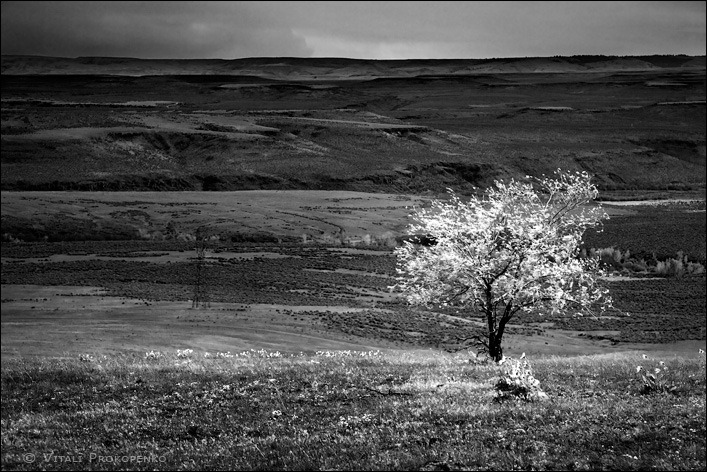
On my last trip I decided to break out of the tunnel. As we were passing some hills that appeared to be empty – there were no subject to stop an eye on – we just turned from a highway to a random dirt road just to stop and look around. And it is just amazing how much interesting we found. Hills were covered in tiny flowers and occasionally some large flowers. The dirt road was nicely zigzagging to the top of the hill. There was a tree on the top of the hill. And great view opened up from the top of the hill. We’ve spent quite a while photographing there.

Now I’m wondering if I could do great photographs at any random points along the way? In some sense it is not a great place that I’m going to that helps me to do photography, it is the state of mind that opens up the possibilities. I’m sure going to try to do more random stops on my trips and see what’s around me along my way.

Here is one of the picture made at one of such random stops:

Tree on a Hill