Day 2, Sunrise

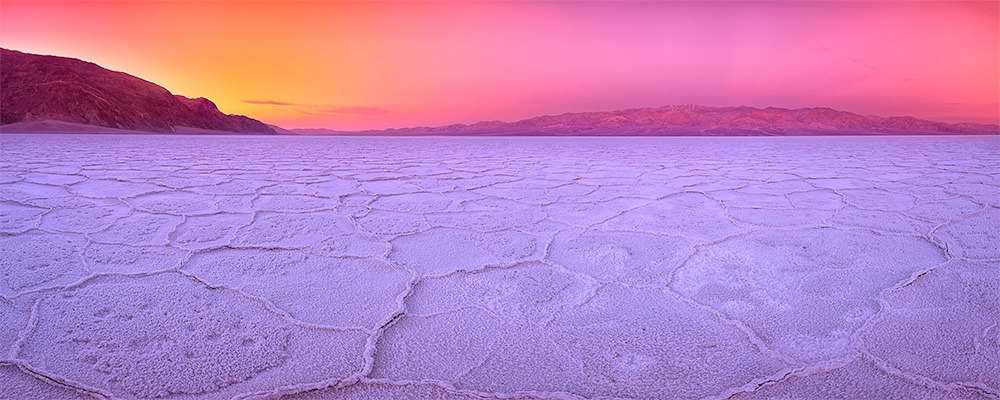
My first sunrise on this trip was at Badwater. That’s a large flat with lots of salt deposits from drying out water. The salt is brought by streams running down the mountains surrounding the valley in those rare cases there is a rain in Death Valley.
I wanted to capture psychedelic twilight and early dawn colors that I saw long time ago here but now with better techniques. This time colors were too weak, so I had to put gold-n-blue polarizer to give them a punch. I use this filter very rarely because it saturates and shifts colors too much for my taste. The only exception when I use would be photographing sunrise or sunset when rich orange colors would be expected and I don’t get those colors without this filter.
I liked how sky came out with gold-n-blue polarizer but I did not like the color cast on salt flats. Thus in post-processing I removed the color cast and put back the color of salt flats without gold-n-blue polarizer.
My first attempt to remove cast was to do color balance. Unfortunately, I could not color balance uniformly across the whole field. That’s because gold-n-blue polarizer produces different color casts depending on an angle to light source (Sun in this case). Given that this is more than 180 degree panorama the color casts produced by the filter in the middle and on the sides was significantly different. As I color balanced middle of the photo, I’d have unpleasant green color cast on the sides. As I color balanced sides I’d get magenta cast in the middle.
After that struggle I decided that the only way to fix color cast on the salt flats was to get rid of color information completely and bring back color from a photo without polarizer. The first step was putting a black and white layer on top of salt flats to remove color completely. Then I put photo filter with color picked from photo taken without the gold-n-blue polarizer. The last step was blending that with original color of this photograph to add variation and make smooth transitions between colors.


 vitali prokopenko | fine art