The Lost Coast

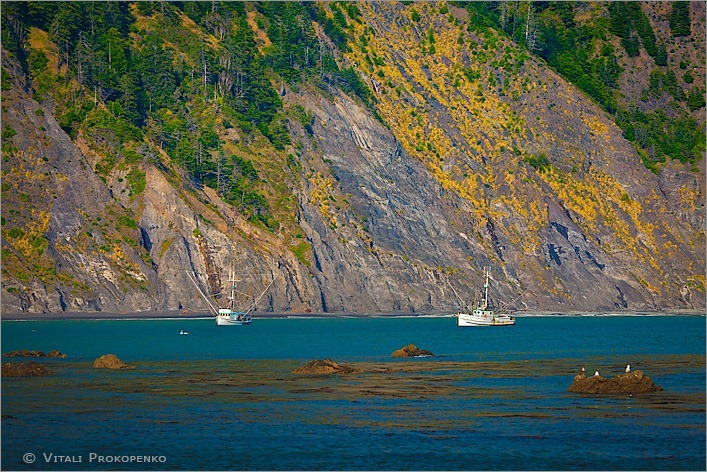
Back in May my family and friends took a trip to Shelter Cove. It is a very small town located in the area with an intriguing name The Lost Coast. It is the only section of Pacific US coast that does not have Highway 1 following the coast. Once you get there you’ll understand why. Mountains with steep drop-offs come directly to the ocean. There is a small piece of flatland squeezed in between the mountains and the ocean. And that’s where Shelter Cove is located.

The road there is hard: long, narrow, windy and slow. That kept the place remote and less developed than the rest of the Pacific coast. There was no cell phone coverage, no Internet access, which made it into a nice experience. Suddenly there was so much time for family fun and games once those distractions were removed.

While this was a family vacation there was still a little bit of opportunity for photography. With the next few posts I’ll share the images and experiences I captures during the trip.
San Francisco Post Card

My family and I have just returned from a week long vacation in a small ocean shore town in an area with intriguing name "The Lost Coast". This is the only section of US Pacific coast that does not have highway 1 following the coast line.

This is probably the only remote place left on the west coast. No cell coverage, no internet for 5 days. And we’ve survived! More than that it was pretty enjoyable. Lots of fun for kids and parents. And a lot of photographic opportunities.

On the way back we stopped in San Francisco for a couple of days where I had fun photographing Golden Gate and Presidio in fog.

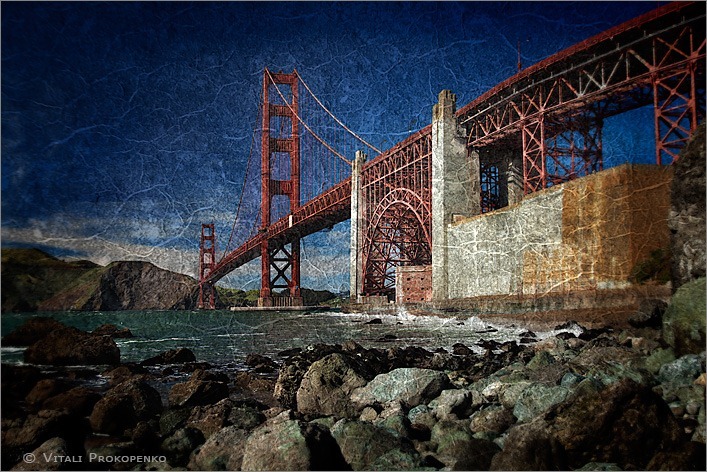
I’m just starting to dig thru all the photos I took on the trip. Meanwhile here is an image I made a year ago. A photograph of iconic Golden Gate bridge overlaid with a texture of a rock that I found just about where I took this photo of the bridge.

_MG_7313
Golden Gate Post Card

PS I’ll keep posting to my blog from my backlog of photos while I’m digging thru the images from a trip to The Lost Coast.

Tulip Fatigue?

Every year there is a tulip festival in Skygit Valley. It is probably one of the best events in the northwest. It attracts a lot of people and that includes photographic crowd. I’ve photographed there many times of the years.

This year I went to photograph there too. Strangely enough I ended up with no photographs of tulips. I photographed workers picking up bunches of tulips for sale. I photographed dirt roads, fences, trees, and everything else around except tulips. Do I have tulip fatigue and don’t respond visually to fields of tulips anymore?

Workers Picking Tulips

Bus at the End of the Road

A Tale of Light

Day 6, Dawn

It is my last day in Death Valley, to be more accurate my last morning at Death Valley since after sunrise I will be driving back to Las Vegas and flying home. I can’t wait to hug my wife and son.

On my last morning at Death Valley I decided to photograph at Zabriskie Point. Morning photos from Zabriskie Point has become cliché. I heard stories of tens of photographers showing up there at sunrise. Strangely enough with several trips to Death Valley I’ve never been there. It was about time to change that.

Surprisingly I was the only person there… That’s one hour before sunrise. By sunrise there were 9 photographers and about 15 spectators.

I took several panoramas before, during and after sunrise. The sunrise was not very impressive – there were not much clouds in the sky. Only while reviewing panoramas at home I realized that I created a tale of light of that morning – I was taking a panorama every time there was significant change in light.

So here it is, a tale of light at Zabriskie Point. (Click on the images to see them in larger size.)

6:07 Deep blue of twilight.
Deep blue of twilight

6:21 Sunrise moving across the sky.
Sunrise moving across the sky

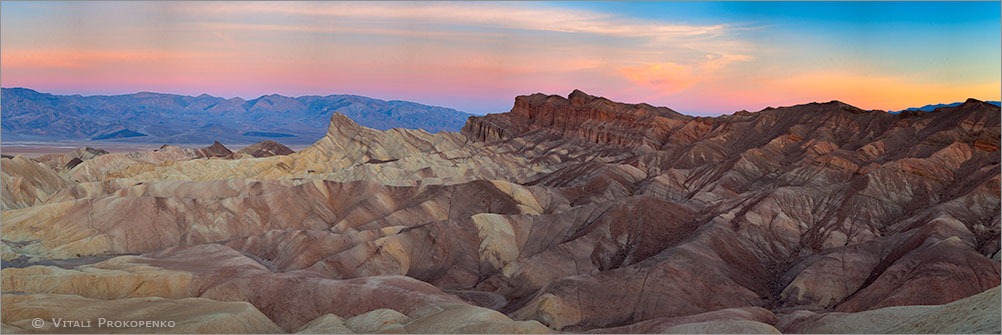
6:29 Touchdown. The gap between horizon and line of sunrise closed. The clouds lit up.
Touchdown

6:32 Sun kissed the mountains.
Sun kissed the mountains

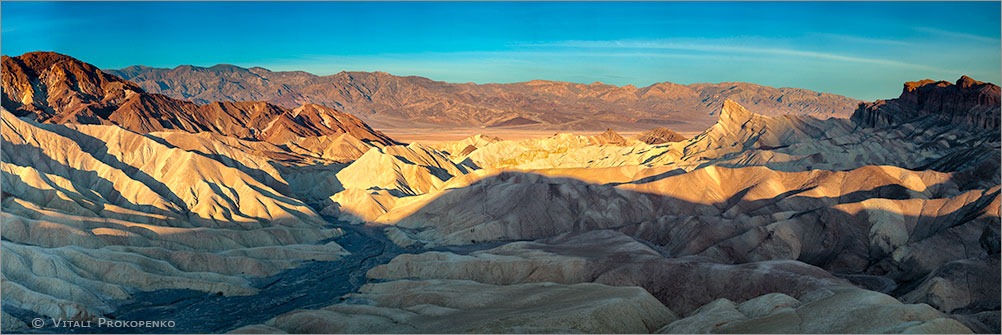
7:03 The light is deep in the valley.
The light is deep in the valley

Just a Little Bit of Water

Day 5, Sunset

Finding water is a bit of a challenge in Death Valley. On a rainy year (which was a few years ago) there was water on Badwater flats and lots of photographers and spectators were taking photos of reflections. This year there was no water at all on Badwater.

As I was driving thru the valley I noticed a brisk reflection of the Sun. It must have been water.

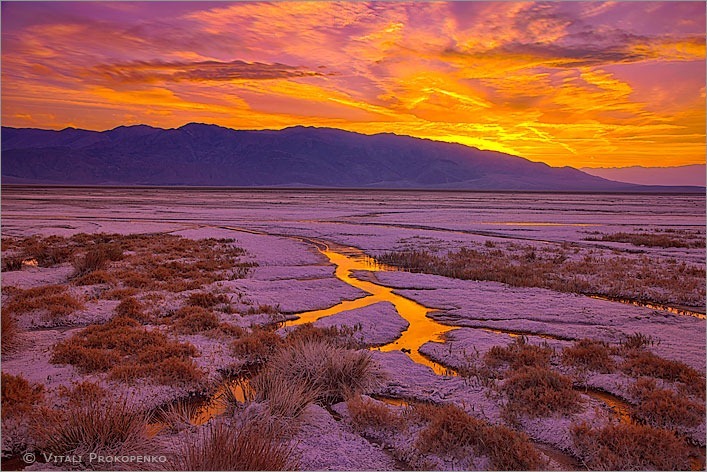
Indeed there were a few small creeks with salty banks. And where water is there is life. There was some grass. Most of it dried out but there was some still green. The dry ones mineralized with salt turned into sharp spikes.

That’s where I settled waiting for a sunset.

Here are a couple of images I took at that place. The first one is right before the Sun disappeared, the last rays just touching the tops of the greenery:

Last Rays
Last Rays

And here the afterglow:

Afterglow
Afterglow

Dante’s Peak

Day 5, Noon

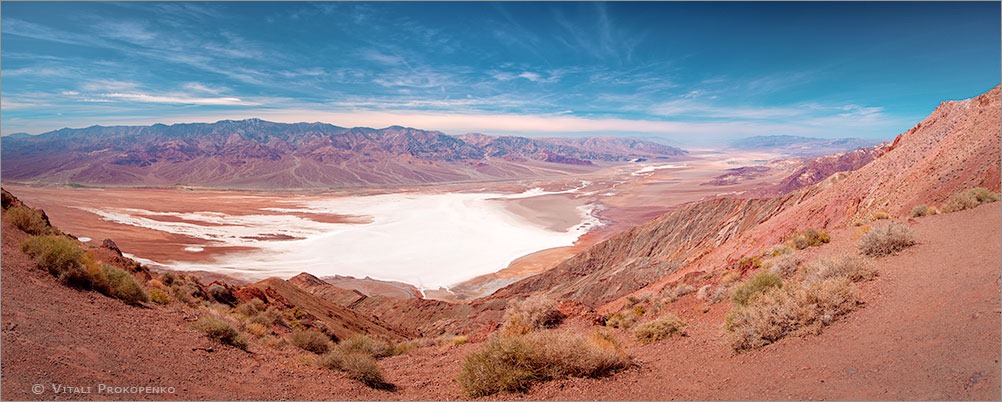
What an amazing breathtaking view of Death Valley opens up from Dante’s Peak!

The elevation gain of Dante’s Peak is so high that the temperature drops 15C comparing to the the temperature at the bottom of the valley. I got there in t-shirt and shorts but quickly had to put on long-sleeved shirt, warm jacket and gloves to keep myself warm.

Here is a panorama with Badwater in the front (click on the image to see bigger size):

View from Dante's Peak

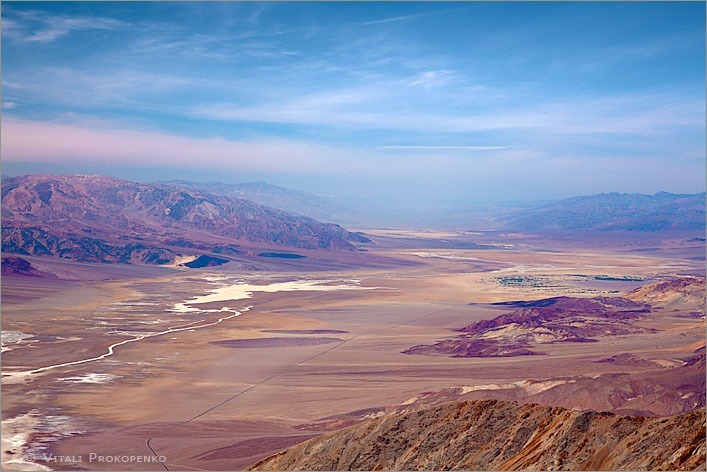
Here is horizontal photo of the part in the distance:

View from Dante's Peak

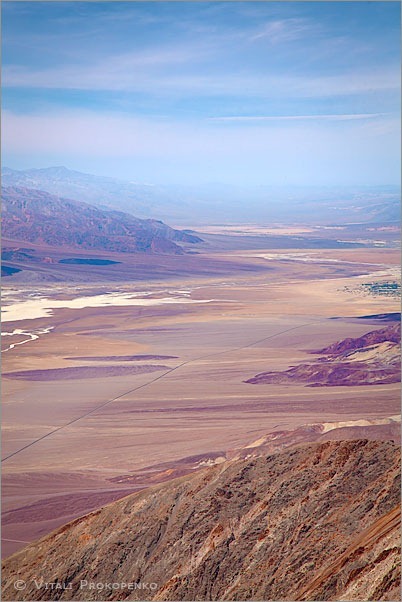
And here are is a vertical:

View from Dante's Peak

Barefoot

Day 4, Dawn

Walking dunes barefoot adds another dimension to the experience of being in sand dunes. The dunes density changes – sometimes it feels like walking on a paved road and sometimes your feet sink deep into sand. Sand texture changes too – sometimes it is grainy and rough and other times it is powder soft.

And it is so quiet and calm in the morning before sunrise. Working barefoot on sand that cooled down during night is such a relaxing experience.

Morning in Dunes

Dust Storm

Day 3, Sunset

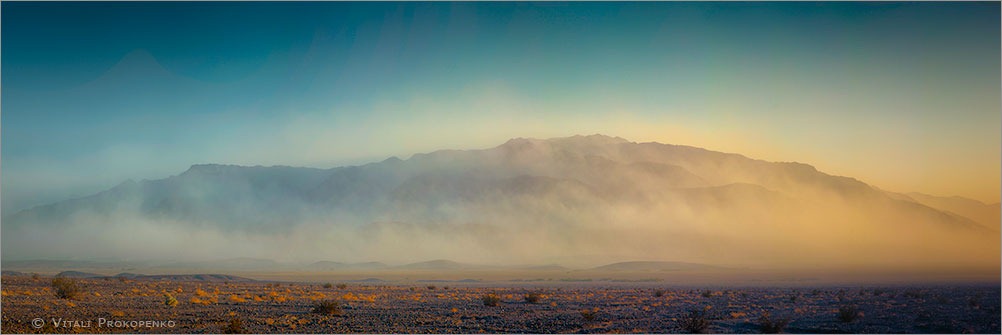
Back in Death Valley I went to Mesquite Dunes – my favorite place in Death Valley. The wind was strong I saw dust storms on the way to Death Valley and there was a dust storm in the valley too.

Dust Storm

As sunrise was getting closer the wind was picking up more and more. Visibility dropped. The wind was continuously moving sand. Bare legs were getting a treatment with sand paper. Sand was getting everywhere.

The sand was getting into my eyes, my eyes were teary and I could not see anything. I had to retreat back to the car, wait for my eyes to clear out and then drive away to observe this from safe distance.

Dust Storm

Big Pine

Day 3, Noon

With a spare tire that I put the day before I could not get far, since it was not regular size. I needed to fix that problem first. The closest town – Big Pine – was over an hour away, especially with spare tire with a limit of 50 mph.

The drive to Big Pine turned out pretty interesting and picturesque. From there I decided to drive along Sierra Nevada mountain range south and re-enter Death Valley from west. That way I would have entered the valley from every road available.

The road was very nice. If I were to go to Eureka Dunes again that’s probably the way I would approach it. And for convenience I could even stay in Big Pine for a night.

The drive to Big Pine and then driving west of Death Valley turned out very picturesque. Here is a road from Eureka Dunes with snowy Sierra Nevada in the distance:

Road from Eureka Dunes

Here is a nice roller-coaster ride to the west entrance to Death Valley with mountains in the distance hidden behind dust storm:

Roller Coaster

And here are the curves of road descending into Death Valley with its colorful mountains (click on the image to see it larger):

IMG_2095

Texture

Day 3, Morning

The most interesting thing for me in dunes is their texture. I just walk the dunes and collect different textures like a biologist collecting specimens. And sometimes texture leads somewhere like in this case lines of the texture lead into valley. White peaks of Sierra Nevada range are visible in the distance (barely visible on a small picture). It is amazing how such extremely hot and cold places are located so close to each other.

Texture