Fun in the… Moonlight

Light – the basic principal of photography. That’s why so many photographs made during day when we have a lot of sunlight. But photographing at night in moonlight is just as much fun for me (or maybe even more fun).

Night photography is full of surprises. I only have a general idea of a composition since I cannot see as much at night as in sunlight. Then experimenting begins. First, I need to find the right exposure, then find an actually interesting composition. Each attempt lasts for minutes – that how long exposure needs to be.

Then the fun with artificial lights begins. Adding flashes or flashlights to lit up some elements of landscape. There is no limit for creativity, except time.

On my last trip to the Palouse I spent about 5 hours photographing one night, mostly to get this photo. Each exposure was 5 minutes. Once I found exposure I noticed streaks of clouds moving in the sky. I thought it would be cool to align them with the tree, so they coming from behind the tree. Took me about 10 attempts to find that spot. Another hour is gone. Then I started experimenting with two flashlights lighting up the crown of the tree or creating light spots in the field. Eventually I stopped at this image, right around 1am.

Fun in Moonlight

Naïve and Romantic

Recently I got a link to a somewhat interesting article Preparation In Fine Art Landscape Photography. While I found it interesting (I do myself lots of the things listed in the article and find them useful), at the same time I thought it is too simplistic and pragmatic.

The most important thing I do in the field is missing from the article’s list: connecting with a landscape. Before I even take my camera out of a bag I spend time observing landscape that surround me – from tiny flowers to tall mountains to high sky up above. What’s interesting in it, how do I feel about it, is it a happy place or a sad place, is it powerful or weak? I spend as much time as I need to feel the things that surround me, walking around or simply sitting. I may even close my eyes and focus on scents or sounds of birds singing or waves crashing onto the shore. Can you imagine that – a photographer with his eyes closed?

Call me naïve and romantic – because quite frankly that who I am – but when I photograph I don’t follow any specific list of steps, I follow my emotions.

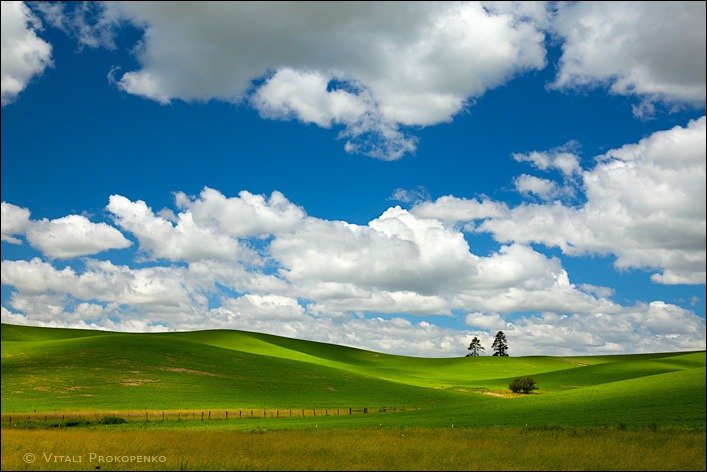
Two Trees on a Hill at Sunset

Taking a Risk

As I mentioned in the previous post I’ve recently visited Palouse during winter time. I watched for this opportunity for a while. Everything seemed to fit this time. But the day before I left for a trip I checked road conditions and they were icy. One city – Spokane – alone saw more than 200 car accidents as a result of cars sliding down hills on icy road. And what Palouse is famous for? Right, hills!

That made me consider staying home instead. But my photo-biological clock was set already. I woke up at 2 am – the time I planned to leave to get there for sunrise. I thought it might be a sign that I should go. And I went. Turned out that the roads cleared up and driving was as safe as it could be. I finally could see Palouse in white – what a pleasure.

The morale of the story: sometime it is worth taking a risk. And be safe on your next trip!

Road to Steptoe Butte

Palouse in White

Winter Sunrise in Palouse

I’ve dreamt of seeing Palouse in white for several years but every winter when it was snowing in Palouse there was a snow storm at mountain summits that I would need to cross to get to Palouse and those summits would be closed. Finally, this year I caught a forecast of snow in Palouse while it was not snowing at all on the west coast of the state of Washington. This meant that I would have an opportunity to get there.

There was only one day on the forecast between snow and rain with possibility of sunshine. That’s the day I wanted to be there.

I woke up at 2am, checked driving conditions, put clothe on, re-checked equipment and took off for a long drive to Palouse. Four and a half hours later I was standing on Steptoe Butte looking at Palouse in white. I was there just in time for a gorgeous sunrise. It was like a Christmas dream come true.

Hand Waving

Photographer’s hand is a very useful tool. And it is useful not only for pressing a shutter button. It can also be used to create a shade for lenses to avoid lens flare. Or it can be used to block out sun that gets into a corner of a frame.

It can also be used as a gradient neutral density filter. With a long expose you can simply block out part of the frame for some time to reduce amount of light that gets into the frame. That’s exactly what I did when I took the photo below. While composing it I put my hand in front of a lens to cover sky down to horizon and took a note of how “deep” my hand should go to cover the sky. I pressed the shutter and started waving my hand in front of the lens, so my hand is not recorded but it blocked out enough light to produce dark moody sky.

Sure I could actually use gradient neutral density filter but it would not be so much fun. At some point I understood that photographer is a human and can carry only so much weight on his back. I started lightening up my backpack, gradient neutral density filters were one of the things that went away. In some way it actually made photography more interesting to me as I would spend less time unpacking my gadgets and preparing for a shot and spend more time seeing and connecting with a scene.

Kauai. Early Morning. Storm is comingKauai. Early Morning. Storm is coming

Close to Home

Lots of things are waiting to be discovered right around the corner. You just need to make the first step toward them.

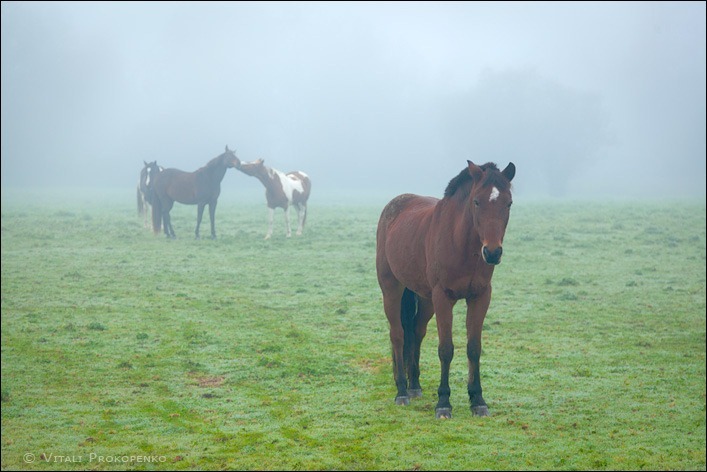
I adore photograph made in fog. At the same time there have not been much fog where I live. At some point I share my fog obsession with another local photographer and she suggested me to go to Carnation Valley in fall.

It is only about 10 minutes drive from where I live. To my surprise even when it is clear sky and sunshine outside the valley, the valley itself is filled with thick thick fog. This is likely because there are a lot of marshes there. Driving downhill into the valley is like diving into the fog.

From that point on I always go to Carnation in fall. Here are some photos I’ve made this year:

_MG_9152

_MG_9306

_MG_9438

_MG_9398

Noon

Noon with clear sky is like a dead season for landscape photographers. The reason is simple – at noon when the sun is high there are almost no shadows and without shadows everything looks flat. Shadows is one of the ways to add perception of the third dimension in landscape photographs.

This is why many photographers who I know (including me) prefer to take a nap during day. We wake up very early before sunrise; photograph at sunrise and during early morning while the sun is low; sleep thru the noon; and then again photograph during evening, sunset and maybe shortly after.

On my last trip to Palouse I had another project in mind besides landscapes (I’ll be writing about that project later). And for that project noon was just fine. So I stayed up. This allowed me to photograph some good landscapes too. There was an interesting weather pattern I observed. At around 12pm clouds would show up and by 2pm they would be gone. Fellow photographers I traveled with would take noon nap around 11am because sky was clear and boring. They would wake up after 3pm when the sky was clear again. Their perception of the trip was that they were unlucky with weather.

I could not stop photographing thru midday on the other hand. Clouds were adding drama to landscape and light and shadow spots were moving over the hills changing landscape. My most landscapes last trip were photographed during midday.

Light and Shadow Light and Shadow

Low contrast

I’m always drawn to photographs with low contrast. They don’t immediately “pop” into your eyes. They slowly draw you in and ask to explore. This one from the last trip to Palouse drew me in:

Anticipation of StormAnticipation of Storm

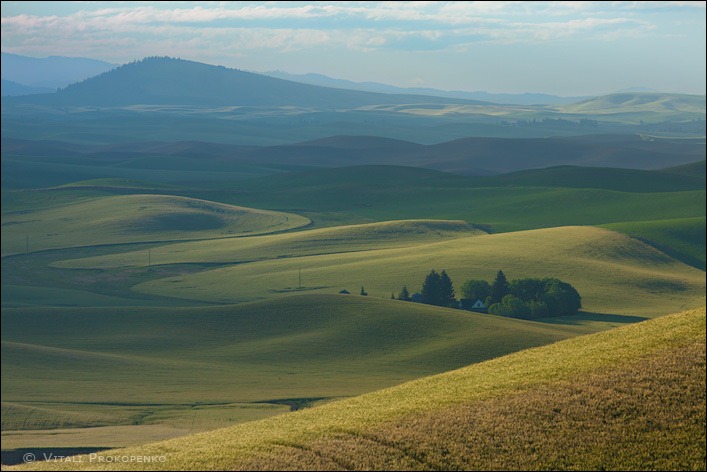
It did not pop, I skipped it at first, but then I stepped back because there was something in it. As I looked at it more I got a feeling of storm anticipation. A huge storm cloud was coming on, while viewer cannot see the cloud, he can see a shadow of it moving in. You almost sense heavy humidity that condenses right before the storm.

If a photograph communicates feelings in my mind it is a good photograph. I tried to make it pop by increasing contrast, vibrancy, saturation and it was ruining that feeling. The image was too static and too obvious.

Dust Storm

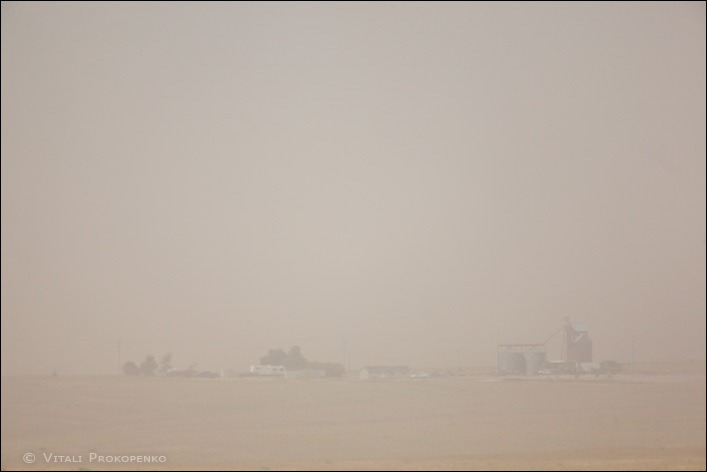
The first day of the trip I’ve experienced a dust storm for the first time. I’ve never been in a dust storm before. At some point of the driving to Palouse I had to stop completely because there was no visibility at all. Then I started moving slowly ahead hoping there is nobody ahead and nobody will smash into me from behind.

When there was visibility it looked like this:

Dust Storm in Cenral Washington

While visually dust storm was as interesting a fog, it was practically impossible to photograph. Strong wind was knocking off my camera on a tripod. I was trying to shoot handheld but I could not stand still because of the wind. Dust was getting everywhere – into my ears, nose, eyes and, worse of all, into my gear. I had to give up.

Better late than never

Fog in Yosemite Valley

The goal on my last trip to Yosemite was to wake up before sunrise every day and be at a point of interest early before sunrise. First day I woke up at four in the morning before alarm even went off. I guess I was refreshed and eager to photograph.

Next day I missed it. The alarm probably went off but I did not hear it. (This type of things happen when there is a load river rushing down just outside your tent. I’ve learnt the lesson and put alarm next to my ear the next night.) So, what do you do in this case? Stay in a sleeping bag for a bit more and let yourself relax? Or do you get packed quickly and move to capture whatever is left of early morning?

At first I wanted to be lazy but then I thought that I came there to photograph and I would photograph. We packed quickly and went to Tunnel View again. And I was so glad we did! When we got to the Tunnel View (for the third time during the trip), we saw fog flowing into the Yosemite Valley and clouds falling down from El Capitan like waterfalls.