Pastel Colors of Fall

Finally, the colors of fall foliage is behind us. It is my favorite time of year. For photographers October is like August for farmers – time to collect the harvest. The reason I’m saying “finally” is because I felt burnt out pushing myself too much trying to capture it a s much as possible. For some time I tried to keep up with post-processing but then gave up – I was not getting enough sleep that way. And that was combined with two more art shows that I needed to get ready for.

Now, when fall foliage is almost gone in Pacific Northwest and my last art show of this year is behind me, I can catch up on post-processing, blogging, planning.

***

For a few months I’ve been fascinated with pastel colors. I like their subdued soft feel. So, this fall I’ve done several images with intent of having pastel colors.

An important thing about photographing color is to be clear that the subject of a photo is color, not individual branches, leaves or trees. To me it means getting rid of all those details in an image.

One technique to do that is to take photos with long exposure handheld and intentionally move camera in some direction. It seems to work the best when moving camera along visually strong lines such as tree trunks or branches.

On Fire
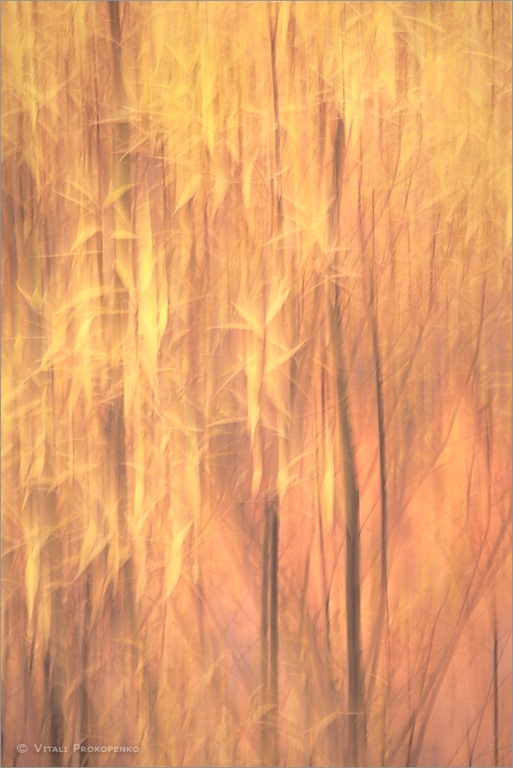
On Fire

Fall Butterflies
Fall Butterflies

Fall Forest
Fall Forest

Happy Halloween

I took this photo in the Palouse back in August this year but was holding it back to use it to wish everyone a happy Halloween. Enjoy this image of an abandoned house on one very stormy summer night. It looks very much like a haunted house.

_MG_5089

Breaking Patterns

Do you know what fascinates me in my visual world? Patterns. Here is an image I made last weekend, when I was passing by a small island of young aspen trees:

_MG_1913

Do you know what fascinates me even more? Breaking patterns. Just seconds after I made the image above I noticed another island of young aspen trees with one tree bent and still having leaves breaking the pattern of bare trunks:

_MG_1928

Imaginary Worlds

I’m not sure where I picked this up but I was stuck with a thought that Photoshop is bad for photography. as a landscape photographer I should use as little of it as possible. It dawn on me that I was holding myself back from what I craved for a long time. I wanted to create landscapes from my imaginations. I always envied artists who could draw what they saw in their minds, not what they saw with their eyes. So, this summer I started working on a new project “Imaginary Worlds”. In this project I use multiple images to combine into one. I don’t limit my creativity.

The first of the series was in my post a month ago: From Real into Surreal. Though I was not yet conscious at that point about why I was attracted to it and where it was going. This image is the first one where I was consciously working on it as a new project. (click on it to see larger size)

_MG_3969

From Real into Surreal

“The thing’s hollow – it goes on forever – and – oh my God – it’s full of stars!” – Arthur C Clarke “2001: A Space Odyssey”

When I was a kid I loved science and I loved science fiction, not the kind with goblins, demons and fairy tale creatures but the kind about interstellar voyage and discovery, distant stars and worlds around them.

One of those stories that I remember particularly well was about a world with three suns, a world where darkness had no place, a world without stars, with intelligent race who believed there is only small space around them, that they are alone in the Universe. Every so often a global cataclysm was sweeping thru the planet as all three suns where aligning and giving a gift or curse of night with all the stars in the sky. Every adult on the planet would turn mad from the shock of realization that there were infinite number of worlds in the Universe, that they are not alone. What remember from the story the most is that feeling of shock and awe of seeing so many stars.

Now I’m a grown up man but I still love science fiction. How is it relevant to photography? What if we imagine a world where stars can be visible even during day…

***

A while ago I published this photo from my trip to the Palouse: Taking Advantage of Imperfections. I like the photo. It has some surreal quality to it. But to me it was not finished yet or at least it was not what I intended for it.

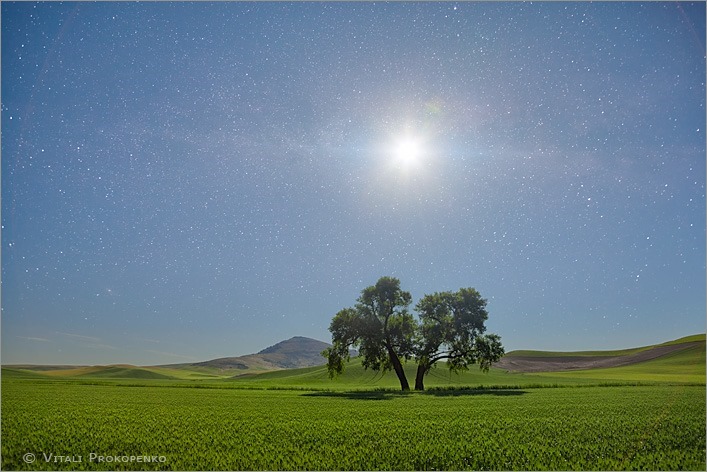
I wanted to create an imaginary world where sun and stars can be seen at the same time. I took the same photo at night with intention to merge the two into one. When I did it it became even more surreal. At the same time I recognized that the pattern of stars from that view point was completely random. They were randomly filling the sky making it more interesting but not adding anything to the composition.

If only I had Milky Way spreading its wings around the Sun, along the sun rays extended by imperfection in my polarizer – that would be really interesting. So, on my recent trip to Rainier I photographed Milky Way positioning it within frame where I ‘d like to have it on the final image. Here is the end result the way I intended it. To me it looks even more surreal than before and at the same time somehow very harmonic.

_MG_3000

I’m interested in what you think about these to images?

Taking Advantage of Imperfections

I’m increasingly photographing with more and more challenging lighting. Such as including sun high in the sky into the picture. The creates a lot of glare in the photo. And I’m working thru those issues, finding how to avoid them or incorporate them in my pictures.

There is a couple methods I use to avoid glare in my pictures. First one that I used for a while already is to block out the Sun with a finger, take photos without the Sun and the glare. The next photo is with no fingers in the frame. Both photos should be taken with the same exposure, the same focus point, the same aperture and on tripod. I would take the normal photo as a base and then use the one where I blocked out the Sun to patch any areas with a glare. This methods works really well during sunset or sunrise when the Sun is placed closer to an edge of a frame.

The other method I discovered during my trip a week ago to the Palouse. Turns out that if I open aperture to its widest setting I get almost no glare or at least its impact becomes imperceptible. This method works well even if the Sun is in the middle of the frame. That’s the technique I used for the photo below that I took during the trip.

Again I would use the photo with aperture set to where I want it. In this case I wanted to close down aperture to get sun burst rays. Closing down the aperture produced a lot of glare in the sky, on the Steptoe Butte and in the fields, that would be hard to patch in Photoshop if I did not take another photo with open aperture and used parts of that photo to patch out all the glare.

Then I discovered that polarizer that I had on my lens had imperfection that resulted in light spilling further from the Sun in two directions along one line. (And just in case you did not know any additional glass surface adds more glare to the photo as sun light bounces back and forth between glass surfaces.) My first reaction was to remove the filter. But then I thought of incorporating that effect and make that line horizontal by rotating the filter. Later I also did take photos without the filter but I like the one with imperfection more. It gives some surreal feel to the scene.

_MG_3000

On the Other Side

I went to Olympic National Park again, just 3 weeks after last time. The last time it was all about visiting old friends. This time it was about making new.

I like the saying “The real voyage of discovery consists not in seeking new landscapes but in having new eyes.” by Marcel Proust. It has been my guide in photography for long time. But… sometimes we can let our mind rest and let legs do the work.

I did visit a place I had been to many times – Rialto Beach – but this time I walk past Hole in the Wall, further than I’ve ever been before. I was enjoying excitement of exploration, walking the ground I’ve never been to before, soaking in new landscapes.

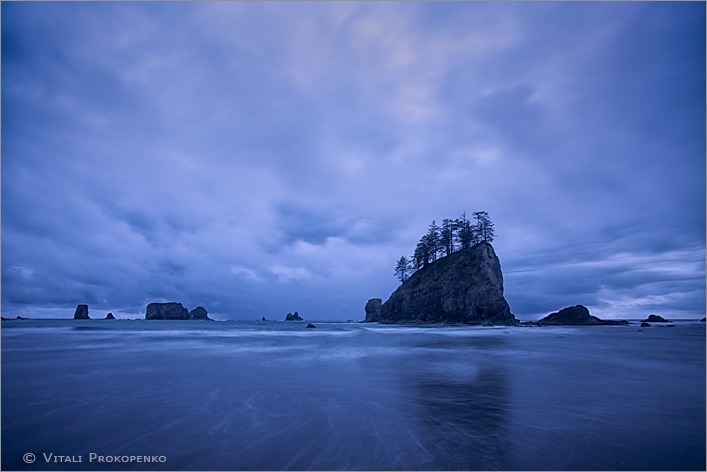
That’s where I made this photo at twilight. It has some mysterious feel too it, strangely attracting the eye. I’m wondering if its mystery has anything to do with a you-know-which movie.

_MG_9190

Minimalizm

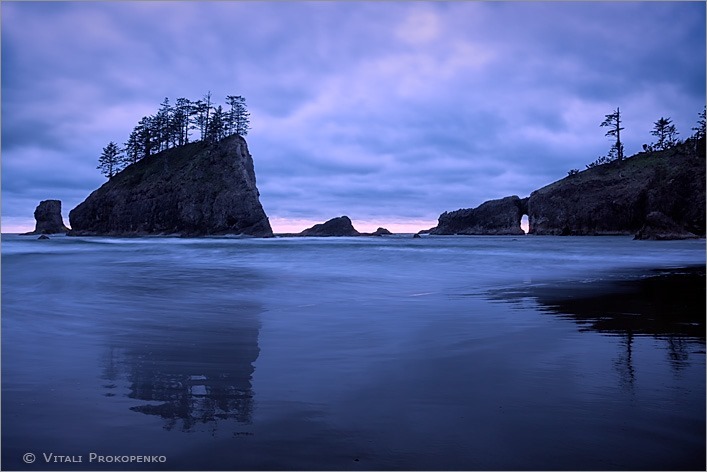
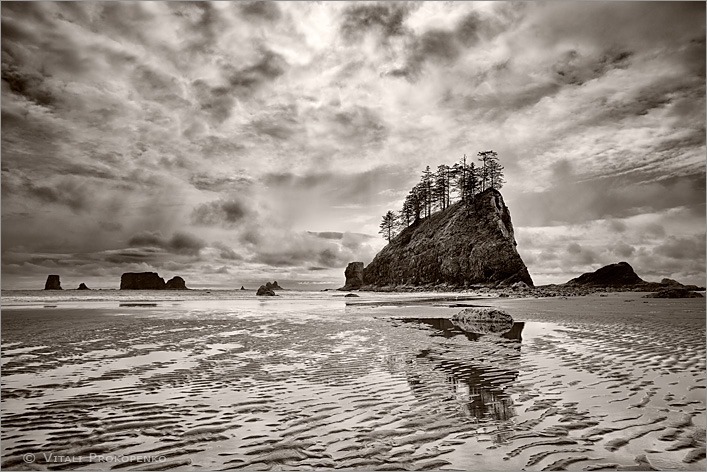
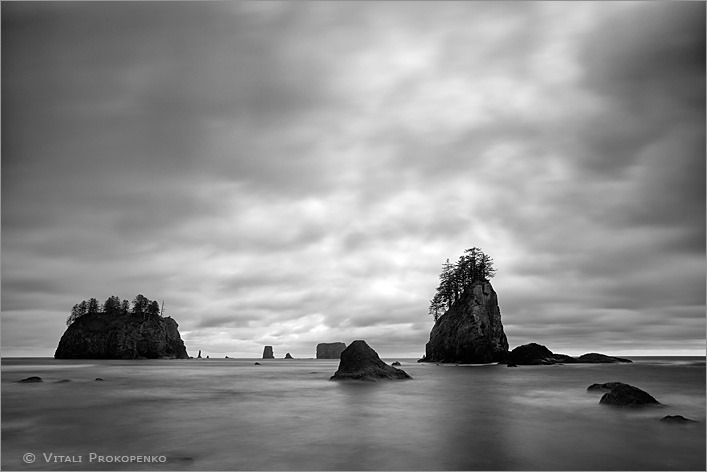
There was something new in the way I photographed Second Beach this last time which was different fro previous times. Many photographs are very minimalistic with vast open spaces of sky and ocean. I’m wondering if that an influence of Michael Kenna’s and John Paul Caponigro’s work.

_MG_7750

_MG_7776

_MG_7805

_MG_7841

_MG_7858

_MG_7870

Many Faces of the Same Place

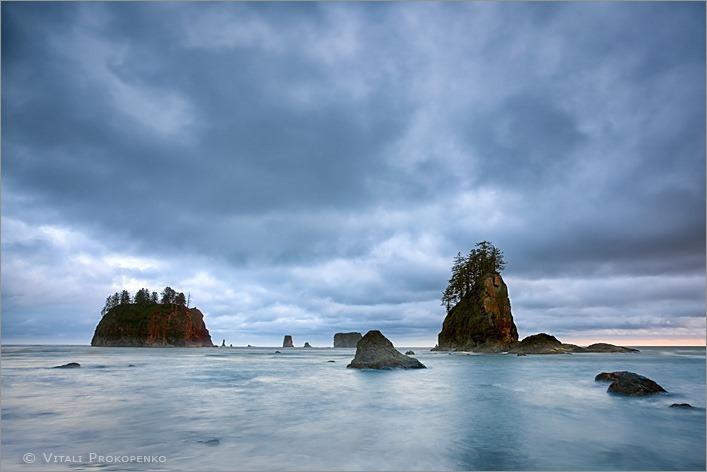
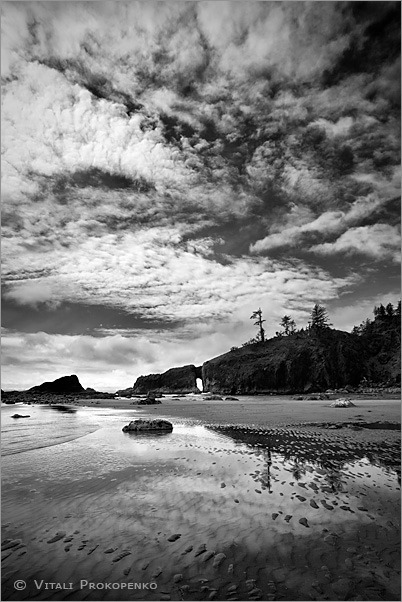
It is amazing how many different photos can be made in the same spot and of the same subject. Look at this photos for example. The same sea stack at Second Beach, just different atmospheric conditions, different light and different exposure.

And here is a couple of photos with a different angle:

Yet one more angle:

More photos of this place from my earlier trips can be found on my website: http:///www.vitphoto.com/?folio=Olympic.

Patience is a Virtue

Patience is a virtue for landscape photographer. Waiting for the right weather, for the right light takes indefinite amount of time.

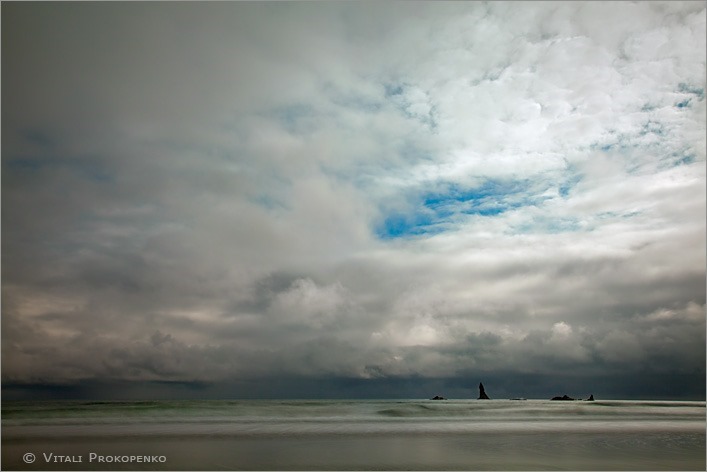
In Olympics when it rains it pours. But it can stop as suddenly as it starts. This is my favorite time to photograph as I get great cloudy sky. All I need is a bit of patience.

On my second day of the last trip to Olympic Peninsula I woke up to a pouring rain. Well, what could I do about that? Nothing, really nothing. What I can do is to read a book or a magazine. And that’s what I did. I was sitting in a car in a pouring rain reading thru a recent issue of Lenswork. Once I was done with it I moved onto a photography book.

By the noon the rain stopped. I got out of the car put on my backpack and headed to Second Beach. I was rewarded with great skies. Just the kind I like.

_MG_7561

_MG_7615

_MG_7699

_MG_8131