Inspiration Help

A while ago an interesting discussion happened in one of photographic online communities which I’m a part of. One of the members asked what helped other photographers to find inspiration. I’ve written quite detailed response which I include with some edits and additions below.

Here are some ideas I have come up with (I’ve done some of it, it does not mean it will work for you):

  1. Shift thinking from gear to thinking about idea/message.
    • Limit yourself to a single camera, single lens, polarizer and ND, and natural light for a while.
    • Shift from reading gearful info sources to gearless. For example, instead of reading about latest cameras, lenses, etc, read about history of photography. Delete all mails that mention gear without reading.
    • Read photo books by film photographers. Unfortunately, most digital photographer books I’ve seen fall into technology trap. Somehow film photographers were not writing books on Velvia or best processing of the first 1 inch of a film but on what they felt in the field, how they tried to capture that feeling and how to transfer it during processing.
    • Don’t do whatever is the latest wave in photography: HDR, astro-photography, etc. Just because it can be done does not mean each of us should do it. Try to do what photographers did 20 years ago. They were still doing great photography without latest and greatest we have.
  2. Think about the moment.
    • What’s so special about a moment that you’re photographing? Is it in any way different than an hour ago, a day ago? How to express what’s special in the best way?
    • Who is it special for? For example, I have a lot of photos of my son, but I have not published them or shown to anyone except my family and close friends, because they capture moments special for very narrow group of people (really only me and my wife).
  3. Be very critical in selection process.
    • Set a limit on number of photos to publish after weekend long trip to 2, after week long trip to 10. Make an effort to select those best and not more than that.
    • Jay Maisel once said something like “[Good] photographer is the one that does not show bad photos.” I love this saying.
    • Set some quality gates on photograph that you show. I value color, texture and subject in photograph. If something is missing, sorry it does not pass my quality gates and I’m not going to show it. For example, I have photographed a great texture of clouds, rocks, frost but they were just that – great textures. They did not have any subject – thus I don’t show them. But they come useful in my exploration of impressionism in photography.
  4. Study something related to art but not photography, like painting.
    • No need to learn how to paint, but read about artists, see documentary, look at paintings, read about paintings.
    • What is helps it to think about idea (back to my first point). When I look at paintings I think about color, light, composition, look at brush strokes and try to move my hand like that, imagine what was artists emotional state (I don’t think about brand of paint or brush they used, since I’m not interested in that).
  5. Block yourself from social photography.
    • Don’t look at Flickr, Facebook, etc. Look at photo books, magazines (that don’t mention gear).
    • It is easy to get overwhelmed by all the images we look at on websites (especially if not everyone in your social circle is critical in selection process). In some sense I feel like a composer trying to write a new tune after listening to a cacophony of an orchestra where each musician played a different tune.
  6. Analyze photographs.
    • Analyze your own photographs. What can be done better? After first time I photograph new subject or place I bring a bunch of photos none of which I show to anyone. I use them to learn what kind of photos I’d like to make. For example, I was very disappointed with photos I took on my first visit to the Palouse. Then after a while I started seeing in those photos the photos I’d really like to take.
    • Decompose someone else’s photos that you love. Why you love them? What makes them work?
    • Try to repeat someone else’s photos you love. Compare. Is it as good? If not, why? Repeat. That’s what I largely did during my first couple years of photography beyond snapshot. This made me learn a lot about interplay of objects, textures, light, color, etc.
  7. Find a local group of photographers like yourself.
    • Meet regularly in a small group to discuss each others photographs. Give a little walk out with a lot. You may contribute a little but once each member contributes a little you walk out with a lot of ideas to think about. You’ll grow together as a group.
    • Have prints that can be written on. What you might come out with from such meetings is a plan of how to improve a photograph written right on the print.
    • I was lucky enough to find such group of photographers early in my photographic journey: http://www.groupf56.com/. Thank you, everyone in Group f/5.6.

One idea that might help you but did not help me:

  • Work in projects. Put a goal to create a series of photos about something: particular kind of events, particular light, subject, time of day, etc. And produce 10-20 good photographs, each showing it in unique way. It cannot be something short lived, like a single wedding, but it can be single element of a wedding shown thru multiple weddings.

The reason it did not work for me is because I’m not systematic in my photography. I go to photograph something for a project and end up seeing something else that I’d rather photograph in that particular moment. Or my mood changed and I’m not interested in photographing in the same style or mood.

Hopefully, some of you might find this helpful. Happy photographing!

Getting off a Beaten Path

How much time changes landscape. Last time I visited Zion 7 years ago. Two friends-photographers and me were the only ones photographing at sunrise behind old visitor center. Here is the photo I took that morning: Zion in the Morning.

Just a couple of weeks ago I visited Zion again. This time there were 40 photographers there waiting for sunrise. It looked like a line of people attacking the landscape. I’m glad the popularity of landscape photography grew so much over the years. At the same time I start missing serenity and serendipity of some landscapes.

Nevertheless it was a good thing for me because it forced me to leave that place and go on the search for new places. And I’m glad I did. I found what I think is much stronger composition:

IMG_6062-copy

To My Wife on 11/11/11

Today is a special day. Not only because today is 11/11/11 but also because today is 11th anniversary of Elia’s and my marriage.

That 11 years of joyful moments. Thanks, Elia, for being by my side all this time. Thanks for supporting me in my photographic endeavors. Thanks for being the best and most honest critic. And most of all thanks for our son.

Till Pitch Black

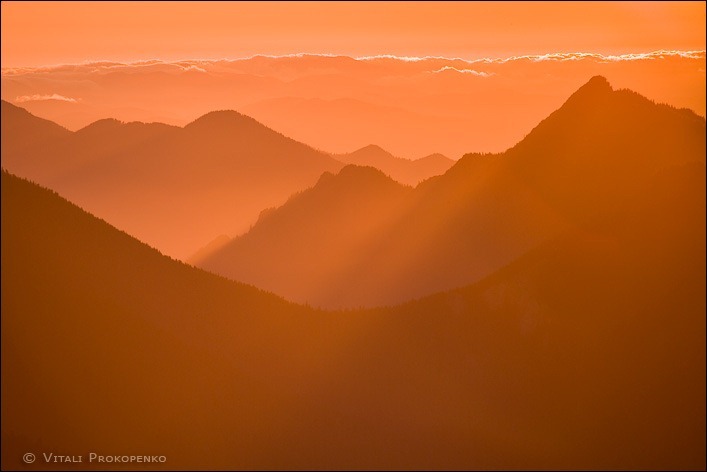
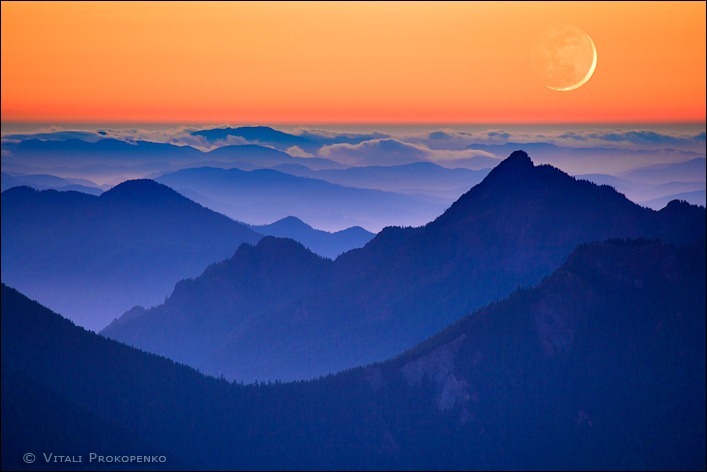
I was looking thru some old photographs and found this three that I saw as a great illustration of what I like to say about photographing sunset: it is not over until it is pitch black. All three photos were made a top of Hurricane Hill at different times.

The sky was clear. The evening started with sun slowly setting behind mountain peaks. The streaks of sunshine were breaking thru mountain tops, highlighting mist rising from the bottom of valleys.

Sunset on Hurricane Hill

Once the last light of sun vanished the valleys were filled with blue cool tones of shade, while the sky was still deep orange. A few minutes after the moon rose just where the sun disappeared.

Quiet Evening

Later when it got so dark, you could barely see anything deer started gathering at the top against last warm tones of sunset on the horizon.

Deer at Hurricane Hill

Adrian is 5

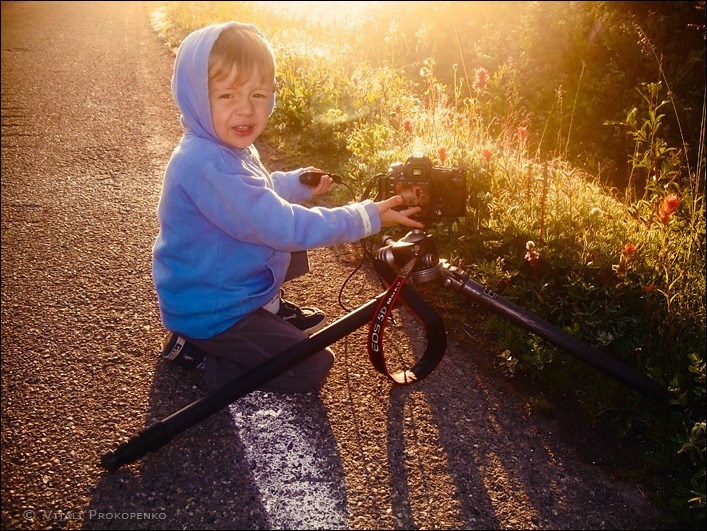
My son Adrian turned five three days ago. It is a big milestone for him and for his parents. Now he is old enough to participate in family activities. Last summer I took it on a photo trip with me. He has a lot of fun. He had his own camera taking pictures as well as pressing a shutter on my camera.

Here Adrian explains that he took a photo of a beautiful flower on a chilly morning:

DSCF2093

Next year we’ll do several trips like this. Especially, since he expressed specific interest in certain things. Like he wants to see how wheat grows. So, several trips to Palouse will help him to see it.

Too Many Eggs in One Basket

I just got back from 3 week vacation and… it is a second time I lost all vacation photos.

First time I lost vacation photos was due to hard drive failure in my laptop close to the end of the vacation. The problem was mechanical, thus recovering disk content was just too expensive ($2000). I had an external drive with me to make backups but never got around to actually do them. From that case I told myself I’m going to do backups every night on my trips.

A few years forward. This time I have done backups to two external hard drives. Both laptop and hard drives as well as some other valuables were in one very important bag – the most important bag, the only bag not to lose. And I lost it in an airport. Later I was contacted by airport authorities that the bag was found and everything but laptop was in it. I have not got the bag back yet and I can only hope that I eventually get it back with hard drives undamaged. But I was not very persistent about backing up to external hard drives every night and thus a lot of photos are lost for sure.

What I have learnt from this? First, backup should be simple and done consistently during a trip. Second, those backups should be placed to different bags to decrease probability of losing all photos as a result of loosing one bag.

What camera should I buy?

I get this question asked a lot “What DSL should I buy?”. I understand why I’m asked this question. I’m a photographer. I must know a lot about cameras and photographic equipment. That’s true I know some but not a lot.

What camera to buy is a question that you and only you can answer. What camera or lenses to buy depends on what you’d like to do with it. It takes some time to learn that. So, my answer is always buy the cheapest. That’s what I did when I started.

I don’t follow what’s current in photographic equipment. Rather than follow the latest trends in cameras and gear I spend time learning history of photography, work by old and contemporary photographers, reading books about photography. It is more satisfying to me and allows me to grow myself, my vision, rather than acquiring more gear.

And if you’re in photography because you are into photographic gear. I’m not the right person to ask for an advice; there are plenty of photography gear magazines and websites out there.

Fun in the… Moonlight

Light – the basic principal of photography. That’s why so many photographs made during day when we have a lot of sunlight. But photographing at night in moonlight is just as much fun for me (or maybe even more fun).

Night photography is full of surprises. I only have a general idea of a composition since I cannot see as much at night as in sunlight. Then experimenting begins. First, I need to find the right exposure, then find an actually interesting composition. Each attempt lasts for minutes – that how long exposure needs to be.

Then the fun with artificial lights begins. Adding flashes or flashlights to lit up some elements of landscape. There is no limit for creativity, except time.

On my last trip to the Palouse I spent about 5 hours photographing one night, mostly to get this photo. Each exposure was 5 minutes. Once I found exposure I noticed streaks of clouds moving in the sky. I thought it would be cool to align them with the tree, so they coming from behind the tree. Took me about 10 attempts to find that spot. Another hour is gone. Then I started experimenting with two flashlights lighting up the crown of the tree or creating light spots in the field. Eventually I stopped at this image, right around 1am.

Fun in Moonlight

Art Fair: My Experience

This year I tried something new – selling canvases with my photographs at art fairs. I’ve been to two art fairs: Kirkland Uncorked and 6th Street in Bellevue. A few weeks passed since the last one. I had time to recover and reflect on this new for me experience.

The Most Important Takeaway

The most important takeaway – my audience. I found more people who like my work and keep in touch with me. Talking to people gave me insights and unusual perspectives on my photography.

Thanks to all who stopped by my booth on either of the art fairs, talked to me, purchased my work – you’re my audience and I love you all.

The Best Encouragement

I got encouraging response to my photo impressionism work. This was very surprising. This is something that I like to do a lot and at the same time I thought people would not accept. Well, I was wrong, people loved it.

The Best Moment

When someone passing by would suddenly freeze seeing my work and in a few seconds after catching a breath slowly say “wow!”.

The Worst Moment

Pouring rain on the first day of the art fair in Kirkland. Everyone simple disappeared from art fair. Staying alone in a booth without anyone even passing by is the worst.

The Funniest Moment

When a woman passing by saw my photo with a boat Stillness and said “I love this image but I’m done with color blue”. Should I have offered it to her in some other color?

Kirkland Uncorked

Last month I have been extremely busy printing a lot of my images preparing for Kirkland Uncorked – an art fair in downtown Kirkland. The art fair is at the end of this week July 15-17.

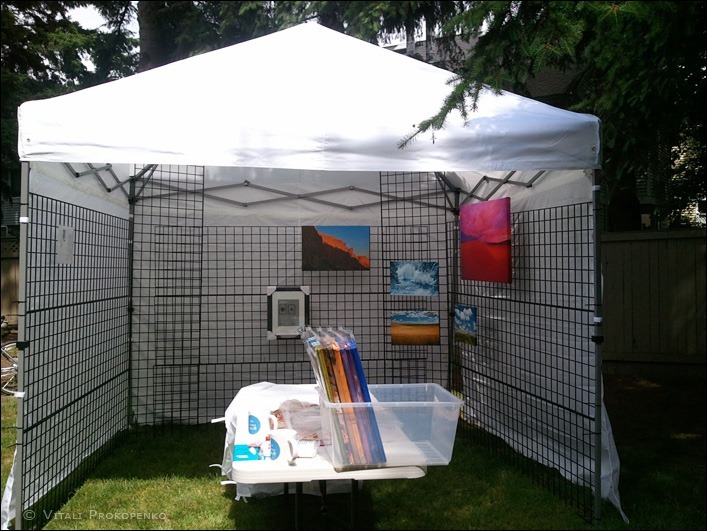
50 canvases are ready to be hung. Today we did a “dry run” of the art fair. We’ve raised the tent, assembled grid walls, hung a few canvases.

Below is the result of the test. It will be even prettier at the art fair. I hope to see some of you there. I’ll post booth number and location once I have it.

WP_000441