Till Pitch Black

I was looking thru some old photographs and found this three that I saw as a great illustration of what I like to say about photographing sunset: it is not over until it is pitch black. All three photos were made a top of Hurricane Hill at different times.

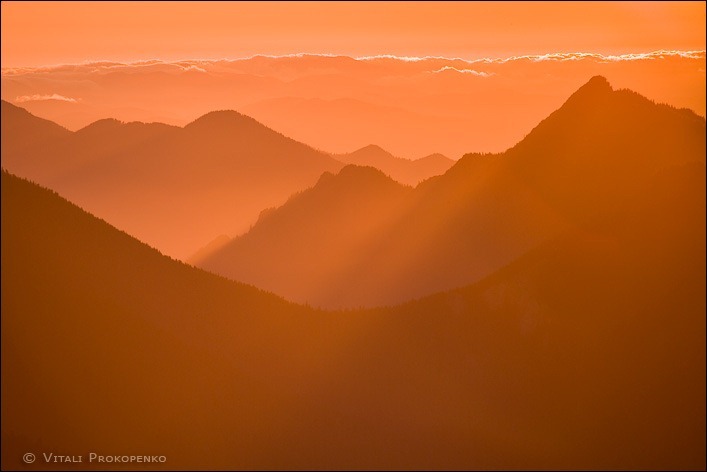
The sky was clear. The evening started with sun slowly setting behind mountain peaks. The streaks of sunshine were breaking thru mountain tops, highlighting mist rising from the bottom of valleys.

Sunset on Hurricane Hill

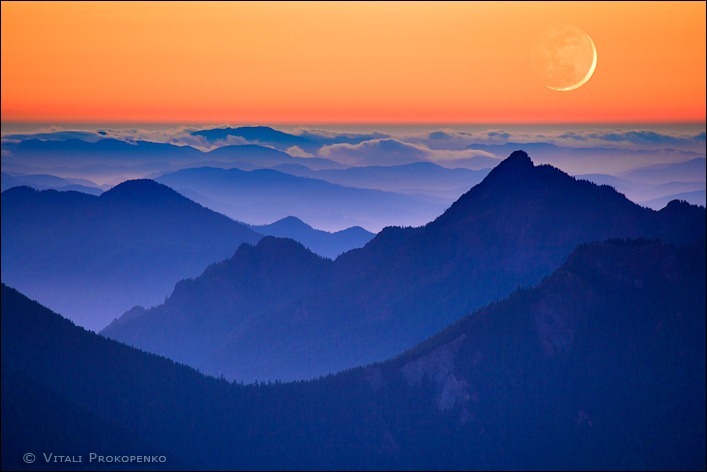
Once the last light of sun vanished the valleys were filled with blue cool tones of shade, while the sky was still deep orange. A few minutes after the moon rose just where the sun disappeared.

Quiet Evening

Later when it got so dark, you could barely see anything deer started gathering at the top against last warm tones of sunset on the horizon.

Deer at Hurricane Hill

Fun in the… Moonlight

Light – the basic principal of photography. That’s why so many photographs made during day when we have a lot of sunlight. But photographing at night in moonlight is just as much fun for me (or maybe even more fun).

Night photography is full of surprises. I only have a general idea of a composition since I cannot see as much at night as in sunlight. Then experimenting begins. First, I need to find the right exposure, then find an actually interesting composition. Each attempt lasts for minutes – that how long exposure needs to be.

Then the fun with artificial lights begins. Adding flashes or flashlights to lit up some elements of landscape. There is no limit for creativity, except time.

On my last trip to the Palouse I spent about 5 hours photographing one night, mostly to get this photo. Each exposure was 5 minutes. Once I found exposure I noticed streaks of clouds moving in the sky. I thought it would be cool to align them with the tree, so they coming from behind the tree. Took me about 10 attempts to find that spot. Another hour is gone. Then I started experimenting with two flashlights lighting up the crown of the tree or creating light spots in the field. Eventually I stopped at this image, right around 1am.

Fun in Moonlight

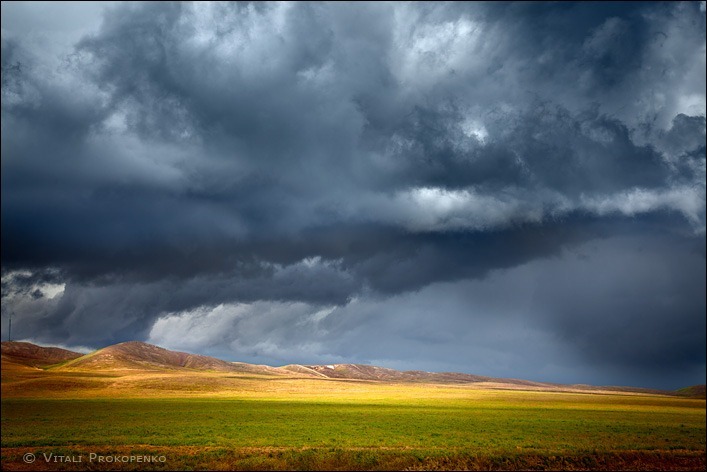
Riding in the Storm

I admire stormy skies. There is just so much energy, power, emotions in it. Sometimes I just take pictures of such skies. On my last trip to California I saw just that kind of skies, when you can actually see a storm front with a blue sky on one side and wild darkness on the other.

Riding in the Storm

Photography Starts on a Plane

When I go on a photo trip, my photography starts on a plane. I take my camera out of a bag and start photographing thru airplane window. It is a great way way to jump start my creativity, get into photographic mindset. And sometimes I also get some interesting photographs. Here is a couple of photos I took from the plane on my last trip:

_MG_7136

_MG_7172

Taking a Risk

As I mentioned in the previous post I’ve recently visited Palouse during winter time. I watched for this opportunity for a while. Everything seemed to fit this time. But the day before I left for a trip I checked road conditions and they were icy. One city – Spokane – alone saw more than 200 car accidents as a result of cars sliding down hills on icy road. And what Palouse is famous for? Right, hills!

That made me consider staying home instead. But my photo-biological clock was set already. I woke up at 2 am – the time I planned to leave to get there for sunrise. I thought it might be a sign that I should go. And I went. Turned out that the roads cleared up and driving was as safe as it could be. I finally could see Palouse in white – what a pleasure.

The morale of the story: sometime it is worth taking a risk. And be safe on your next trip!

Road to Steptoe Butte

Palouse in White

Winter Sunrise in Palouse

I’ve dreamt of seeing Palouse in white for several years but every winter when it was snowing in Palouse there was a snow storm at mountain summits that I would need to cross to get to Palouse and those summits would be closed. Finally, this year I caught a forecast of snow in Palouse while it was not snowing at all on the west coast of the state of Washington. This meant that I would have an opportunity to get there.

There was only one day on the forecast between snow and rain with possibility of sunshine. That’s the day I wanted to be there.

I woke up at 2am, checked driving conditions, put clothe on, re-checked equipment and took off for a long drive to Palouse. Four and a half hours later I was standing on Steptoe Butte looking at Palouse in white. I was there just in time for a gorgeous sunrise. It was like a Christmas dream come true.

Hand Waving

Photographer’s hand is a very useful tool. And it is useful not only for pressing a shutter button. It can also be used to create a shade for lenses to avoid lens flare. Or it can be used to block out sun that gets into a corner of a frame.

It can also be used as a gradient neutral density filter. With a long expose you can simply block out part of the frame for some time to reduce amount of light that gets into the frame. That’s exactly what I did when I took the photo below. While composing it I put my hand in front of a lens to cover sky down to horizon and took a note of how “deep” my hand should go to cover the sky. I pressed the shutter and started waving my hand in front of the lens, so my hand is not recorded but it blocked out enough light to produce dark moody sky.

Sure I could actually use gradient neutral density filter but it would not be so much fun. At some point I understood that photographer is a human and can carry only so much weight on his back. I started lightening up my backpack, gradient neutral density filters were one of the things that went away. In some way it actually made photography more interesting to me as I would spend less time unpacking my gadgets and preparing for a shot and spend more time seeing and connecting with a scene.

Kauai. Early Morning. Storm is comingKauai. Early Morning. Storm is coming

Close to Home

Lots of things are waiting to be discovered right around the corner. You just need to make the first step toward them.

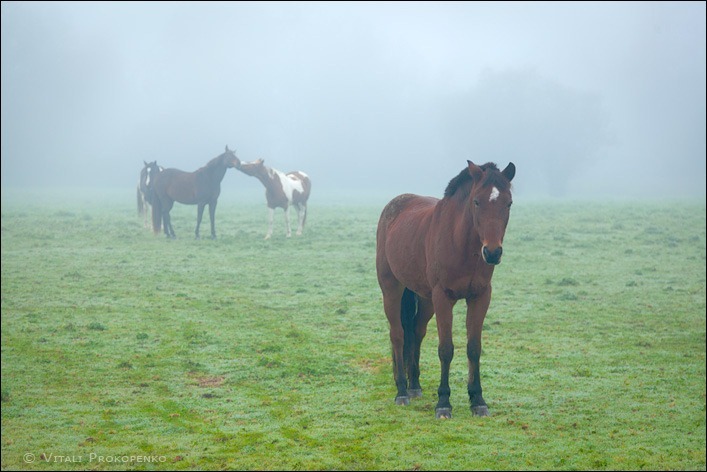
I adore photograph made in fog. At the same time there have not been much fog where I live. At some point I share my fog obsession with another local photographer and she suggested me to go to Carnation Valley in fall.

It is only about 10 minutes drive from where I live. To my surprise even when it is clear sky and sunshine outside the valley, the valley itself is filled with thick thick fog. This is likely because there are a lot of marshes there. Driving downhill into the valley is like diving into the fog.

From that point on I always go to Carnation in fall. Here are some photos I’ve made this year:

_MG_9152

_MG_9306

_MG_9438

_MG_9398

A Night of a Lost Star

This blog post is about this image, how it came about, my thought process and little bit about post-processing that helped me achieve what I wanted:

A Night of a Lost Star A Night of a Lost Star

There is a place in Palouse that is recognizable by many photographers who have visited Palouse. It is a tree not far from the Steptoe Butte near a fork of two dirt roads. I’ve photographed it quite a few times myself. Here is the most successful one: Sketch with a Tree and Road. That photograph was made from the Steptoe Butte with a long focal length.

All attempts to make a photograph from the ground level produced rather unremarkable results. The tree alone in a field was a strong anchor in a composition. Curves of hills coming down where creating an interesting shape leading to the tree. And yet resulting photographs were weak. There was not much going on beyond that.

I photographed this tree many-many times, year after year, every time I visited Palouse. I’ve become obsessed with it. I think I might have even seen it in my dreams. I was sure a great photograph was there I just had not found it yet.

This year I thought again of this tree while planning my trip to Palouse. I reflected back and thought of what attracted me – a tree alone in a field, a good anchor for a composition, a good base to work with. That leaded to thinking about painting-like picture.

I went to Palouse with a goal to take as many different photographs of this tree as I could think of, employing various photo impressionism techniques, like multiple exposures, Orton effect, long exposure with camera on a tripod for a movement in grass and tree canopy and long expose while shaking camera in various directions and patterns.

To my delight the tree was fully alive again (note that in earlier photograph linked above half of the tree appeared dead). This made a tree look complete.

I ended up taking 67 photographs of this tree. Out of those I chose the one with multiple exposures (21 exposures to be accurate). What I did not like in multiple exposure image though was that it made tree trunk too fuzzy and soft. I wanted the tree to have a strong trunk to support that canopy. At the same time I did not want to have a sharp trunk as it would not go with the rest of the image. I looked thru the images taken with a long exposure while shaking the camera and found the one with the tree trunk visually strong enough and at the same time with the fuzziness that matched the rest of the picture. Masking out the tree trunk was easy since it was taken in exact same conditions – same luminosity and color.

The other thing that I was looking for during the trip was cloud textures. From my previous experiments – such as Still Life. Tulips – I knew they make a great base texture, making a photograph look like painting. I did not find good cloud textures but what I found on the second day of the trip was this strong cloud that was striking thru the sky like a lightning.

I layered the sky with the cloud over the tree in the field and used blending mode “Multiply” which was equivalent of stacking two slides one on top of another – the same approach as in Orton effect except slides contained completely different images.

The first two things I’ve pre-visualized in my mind. I knew what I wanted the image to look like and was just looking for a way to get that quality. When I overlaid the sky with the cloud and the tree in the field, I realized that this will be a night picture. This was a surprise. I did not think of that but sometimes I tell the picture what I want it to be and sometimes the picture tells to me what it wants to be – this makes it even more interesting.

That meant that I needed to have stars in the sky. The sky just looked to empty for the clear night sky. Being true to the nature of this picture being completely made with photographic material that I captured, I needed to take photo of the night sky with stars. I tried to take photo of the stars from my backyard. That did not work out, there was too much light pollution from city lights. I had to put this image aside until I have an opportunity to take a good photo of the stars.

The wait was burning me. I wanted to share this picture so much, but at the same time I knew it is not finished. Next trip – could not get any photos of the stars, the sky was covered with clouds. Finally, on the next trip I went to Rainier and had clear sky. I took a few photos of the stars. This picture was finally coming to completion! What a joy was that!

There are much more technical details to this picture. There were a lot of detours and dead-ends I ran into – I had to backtrack and start over because the image did not look and feel the way I wanted it. I worked about a month on this image – the most I had spent on a single image.
Noon

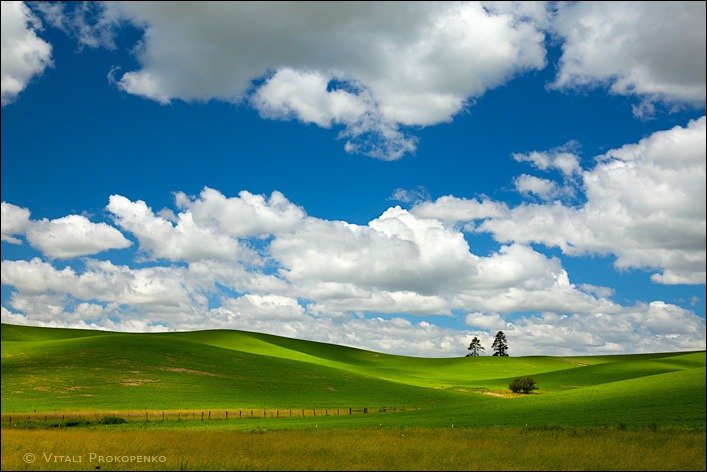
Noon with clear sky is like a dead season for landscape photographers. The reason is simple – at noon when the sun is high there are almost no shadows and without shadows everything looks flat. Shadows is one of the ways to add perception of the third dimension in landscape photographs.

This is why many photographers who I know (including me) prefer to take a nap during day. We wake up very early before sunrise; photograph at sunrise and during early morning while the sun is low; sleep thru the noon; and then again photograph during evening, sunset and maybe shortly after.

On my last trip to Palouse I had another project in mind besides landscapes (I’ll be writing about that project later). And for that project noon was just fine. So I stayed up. This allowed me to photograph some good landscapes too. There was an interesting weather pattern I observed. At around 12pm clouds would show up and by 2pm they would be gone. Fellow photographers I traveled with would take noon nap around 11am because sky was clear and boring. They would wake up after 3pm when the sky was clear again. Their perception of the trip was that they were unlucky with weather.

I could not stop photographing thru midday on the other hand. Clouds were adding drama to landscape and light and shadow spots were moving over the hills changing landscape. My most landscapes last trip were photographed during midday.

Light and Shadow Light and Shadow