White is not what it seems

I’m learning to paint for over three years now. It is not easy. It has never been and, I suspect, never will. It is a lot of hard work.

My progress came in qualitative jumps. That is, I painted a lot without much progress but with a lot of frustration until I finally grasped some important concept. At which point my paintings became much better and I became much happier for a short while. Until tension to progress further built up again.

Looking back one of the things I wish I did differently is to start with studying some fundamental concepts that I picked up along the way. I’ll try to capture some of those concepts in a series of blog posts, maybe not in a very systematic way.

The first concept is that things do not look the way we know they do. For example, we say a white cup. We define a cup as being white. Does it mean we use white to paint it? Wouldn’t that mean that a blank white canvas already has the white cup painted on it? And if so, why can’t we see it there?

It turns out that the white cup is not white, it is a multitude of distinct colors, depending on the sources of light. My first eye opening and memorable learning experience was painting a white cup on a white plate on a white table. What an exquisite kind of torture it was! But I’ve learnt to see the distinct colors that form our perception of those objects. (That is the painting at the top of this post. 3 years old.)

Later I’ve learnt about cube studies. Cubes of assorted colors laid out on a table, and you need to paint them (extra bonus: in different light condition). The idea is essentially the same: learning to see distinct colors, temperatures, values in shade vs in light vs in reflected light. Cube is the simplest shape to draw and that removes the pressure of drawing of something as a cup out of the exercise, it becomes only about colors. I would start it with white cubes on a white table. That’s the simplest and purest form of it, the first step to understanding that things don’t look the way we are taught they do.
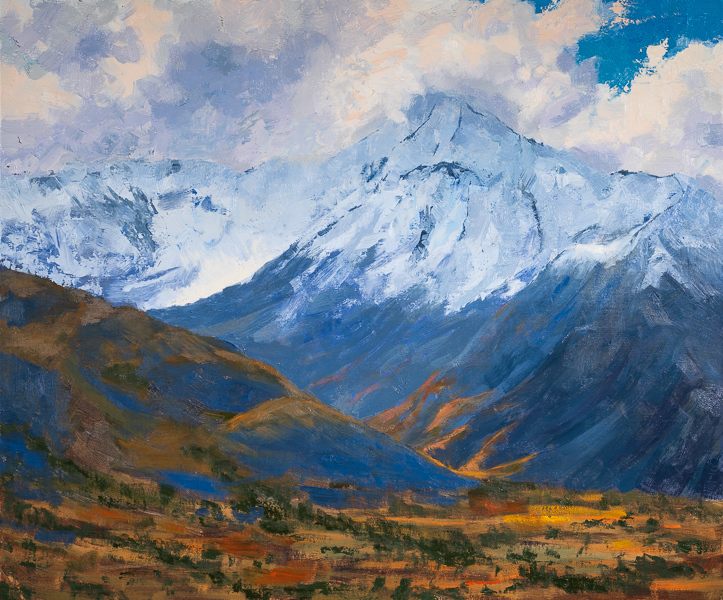
My Oil Painting Journey: The Beginning

Covid was quite disruptive for our everyday lives. A lot changed at that point. We had to cope, to overcome, to adapt.

I won’t delve into all the emotions and challenges I had to deal with, except one: the extra free time I had to fill in. I did not have to go to the office and as it turned out commuting took up a significant part of my life. Working from home, I suddenly got all that time back. I did not want to spend all that time wallowing in misery about all the plans that were ruined by covid. So, I needed to find something to occupy myself with.

Let me step back a bit. Actually, let me step back a lot. When I was a kid one of the dreams I had was to paint. I don’t know how it happened, but I convinced myself that I don’t have an aptitude for painting. I did not even try. Instead, I turned to photography as my outlet for visual creativity. It was quite limited at that. I was always frustrated that image would not come out the way I saw the scene. The photograph was more exciting and captivating in my memory than in camera’s memory. Yet, I persevered and, hopefully, produced some interesting images, while dreaming about painting all that time.

Now let’s step forward again to the time when covid started. I had a lot of extra free time and a lot of uncertainty about the future. The uncertainty was causing a lot of anxiety and I wanted to anchor myself in some activity I would be passionate about.

That’s when I remembered about my childhood dream. I contacted an art teacher (and amazing artist) and started taking oil painting lessons. I had to buy a lot of supplies (funny enough at the beginning I told the teacher that at least painting was not as expensive as photography, and now I can say I was wrong).

I was deeply committed to learning the craft. I painted every day. I would do still-lives at home: I would pick some fruit I had in the kitchen or put some random stuff on the table and start painting it. Weather permitting, I would take out my easel somewhere close to home (since all parks were closed) and try to paint landscapes.

Learning was not easy. There was a lot of frustration at inability to layout on canvas what I had in my mind. In the worst fits of it I broke canvases and brushes. There was a lot of despair at the lack of progress with me sitting and crying. But I persevered through being tired, confused, exhausted.

At this point I am more comfortable with color; I can play and experiment with it without making my paintings look garish; a couple of my paintings are in a gallery. But as with anything else, the more I learn the more I know how little I know.

Looking back at the three years that passed I can see interesting patterns in my learning, and I’d like to share some tricks or key concepts I learned. (I won’t pretend that I have any authority or qualifications to teach, I simply have a few things to say.)