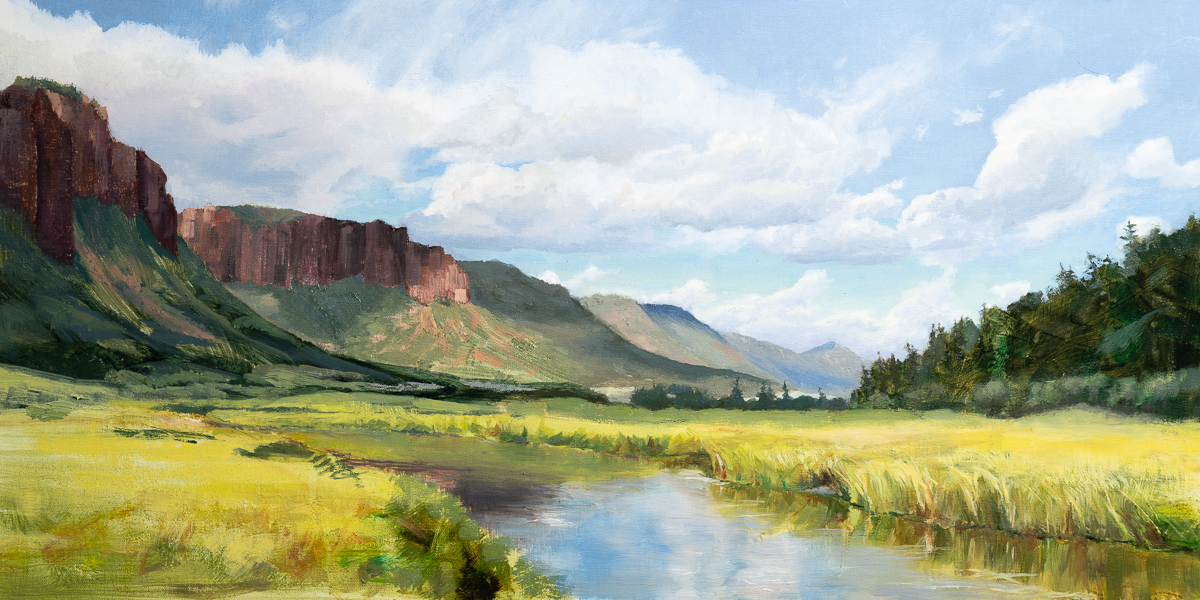
The Evil Green

The path of learning painting for me has been a path of unlearning what I was taught as a kid: the sky is blue, the grass is green, the trees are… green too. One might think that our world can be painted blue and green. 

It is far from being so. I have not seen pure green in nature yet. The “green” trees in the distance are reddish blue and the green lawn can be yellow or brown or blueish depending on light. 

Unlearning all that and learning to trust my eyes instead of my brain was hard.

My biggest struggle has been greens. For a while I was trying different kinds of greens sold in tubes, but nothing worked. My paintings continued to look cartoonish. Even when I learned that things we consider “green” were not actually green I still automatically would reach for greens on my palette when painting grass or trees. It was just that deeply ingrained in my mind. 

Tough problems demand out of box and sometimes radical solutions. My solution was to remove greens from my palette completely. That forced me into mixing “green” using other colors and doing that forced me to be mindful of what kind of green was needed. It also forced me to explore and experiment with different mixtures to find the green I wanted.

Almost a year I painted without any green on my palette. I have learned that foliage can be of many different colors: black mixed with cadmium yellow for dark firs, ultramarine blue mixed with burnt sienna on the slopes of distant mountains, ultramarine blue mixed with cadmium orange in shadows of the middle ground, or ultramarine blue mixed with cadmium yellow and some burnt sienna in the deep shadows of foreground, or ultramarine blue and cadmium yellow pale in highlights or sometimes even pure yellow pale mixed with white when the leaves vibrate in the hot summer sun.

And many other yellows (yellow ochre, cadmium yellow deep, lemon yellow), mixed with all kinds of blues (ultramarine blue, cobalt blue, cerulean blue, phthalo blue). All give many different shades of green. With all the rich shades of green I discovered I pretty much forgot about out of the tube greens.

Only recently I added some Viridian to my palette. But I use it carefully and rarely. 
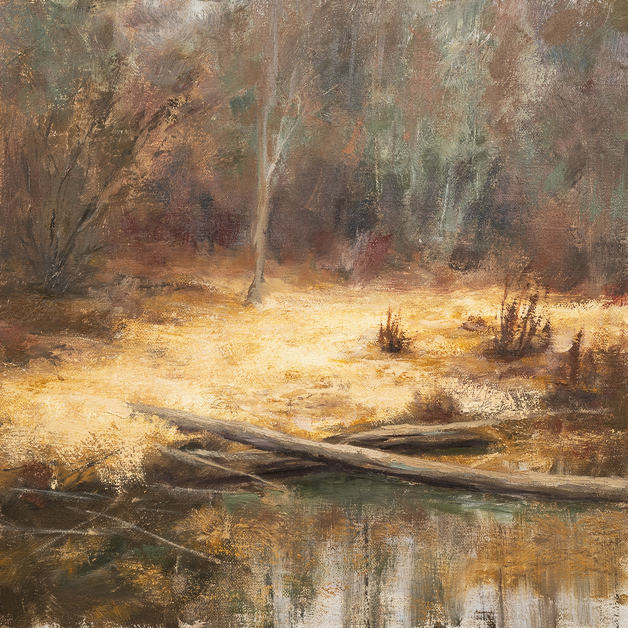
Limited Palette

That’s one of those things that I wish I started with. Instead, I started with a palette of six colors plus black and white plus my teachers would throw in a few more colors because they would work well with a scene we were painting. It was overwhelming. I was very confused most of the time. I tried to memorize what to mix with what to get which color and it was too much.

The breakthrough came when I learned about limited palette. It turns out that a lot can be done with just three primary colors and white. The easiest three colors to start with are ultramarine blue, cadmium yellow and cadmium red. Black can be achieved by mixing those three, green can be achieved by mixing blue and yellow, orange by mixing yellow and red, and so on.

I painted with this limited palette for a few months. My painting improved and I was developing the sense of color faster.

Once I got comfortable with those three colors, I tried to add more colors, but it didn’t work. I instinctively kept reaching for familiar colors.

That was until I heard from another painter that the limited palette can be constructed with some other primary colors. For example, phtalo blue, alizarin crimson and yellow ochre. Now that was a fun triad to tame.

Both phtalo blue and alizarin crimson are very intense colors. Especially, phtalo blue. It is so intense that at some point I gave up on it because even with a lot of neutral I could not tame it. That’s why it was a lot of fun to, finally, learn to control it. The painting in this post is painted with phtalo blue, alizarin crimson, yellow ochre and white.

And an interesting thing happened when I let both of those triads on my palette. I was freely mixing and using all of them in a single painting.

That what I was experimenting with last winter. Then nice weather came to the Pacific Northwest and I put experiments aside to spend most of the time painting pleinair with the palettes I’ve already learned.

Once rainy days again will force me to stay inside, I want to experiment with palettes that have no blue. It is quite unusual. The idea came after I discovered that mixing viridian green and cadmium red gives a gentle blue. Mixing viridian with alizarin crimson gives even deeper blue. Adding some kind of yellow would complete the triad.

White is not what it seems

I’m learning to paint for over three years now. It is not easy. It has never been and, I suspect, never will. It is a lot of hard work.

My progress came in qualitative jumps. That is, I painted a lot without much progress but with a lot of frustration until I finally grasped some important concept. At which point my paintings became much better and I became much happier for a short while. Until tension to progress further built up again.

Looking back one of the things I wish I did differently is to start with studying some fundamental concepts that I picked up along the way. I’ll try to capture some of those concepts in a series of blog posts, maybe not in a very systematic way.

The first concept is that things do not look the way we know they do. For example, we say a white cup. We define a cup as being white. Does it mean we use white to paint it? Wouldn’t that mean that a blank white canvas already has the white cup painted on it? And if so, why can’t we see it there?

It turns out that the white cup is not white, it is a multitude of distinct colors, depending on the sources of light. My first eye opening and memorable learning experience was painting a white cup on a white plate on a white table. What an exquisite kind of torture it was! But I’ve learnt to see the distinct colors that form our perception of those objects. (That is the painting at the top of this post. 3 years old.)

Later I’ve learnt about cube studies. Cubes of assorted colors laid out on a table, and you need to paint them (extra bonus: in different light condition). The idea is essentially the same: learning to see distinct colors, temperatures, values in shade vs in light vs in reflected light. Cube is the simplest shape to draw and that removes the pressure of drawing of something as a cup out of the exercise, it becomes only about colors. I would start it with white cubes on a white table. That’s the simplest and purest form of it, the first step to understanding that things don’t look the way we are taught they do.