I am an Amateur photographer!

History sometimes yields interesting facts. One of such is that a while back Amateur would be a compliment to a photographer. From French amateur "lover of", this meant a photographer who does photography for the love of it (as opposed to professional who does it for the money).

Henri Cartier-Bresson in his famous essay “The Decisive Moment” writes: “I still regard myself as an amateur: but a dilettante I certainly am not." Somehow over time amateur has become an equivalent of dilettante. So let’s restore its original meaning. And I’ll do it first by stating:

I’m an Amateur photographer because I’m doing photography for no other reason but the love of it.

1000, 2000, 2500000000, …

With so many photos produced every second is there any room left for photographers?

Facebook is the biggest photo sharing website with 2.5 billion photos uploaded monthly according to Facebook blog. That translates into roughly 1000 photos per second. Can you imagine that? 1 second – 1000 new photos uploaded, 2 seconds – 2000 new photos uploaded, …

Should photographers be worrying that soon any possible photograph will be captured and published? At first I thought it could be then I recalled the old theorem about monkey writing all plays by Shakespeare and an actual test. When University of Plymouth MediaLab Arts setup an experiment with real monkeys, the most they got was 3 pages of letter S.

The same happens in photography. With almost everyone possessing a camera we get a lot of me in front of something and here is something famous photos. In some sense most of 1000 photos uploaded every second are very repetitive kind of like printing the same letter with some variations. At the same time there are still very few photographs like this that is very much different kind of photography.

I hope I did not offend anyone with such comparison. That was not my point. I myself have a lot of family photographs in famous places. I very much enjoy sharing them with my family. My only point is that there is another kind of photography that is worth sharing with the world.

A Night of a Lost Star

This blog post is about this image, how it came about, my thought process and little bit about post-processing that helped me achieve what I wanted:

A Night of a Lost Star A Night of a Lost Star

There is a place in Palouse that is recognizable by many photographers who have visited Palouse. It is a tree not far from the Steptoe Butte near a fork of two dirt roads. I’ve photographed it quite a few times myself. Here is the most successful one: Sketch with a Tree and Road. That photograph was made from the Steptoe Butte with a long focal length.

All attempts to make a photograph from the ground level produced rather unremarkable results. The tree alone in a field was a strong anchor in a composition. Curves of hills coming down where creating an interesting shape leading to the tree. And yet resulting photographs were weak. There was not much going on beyond that.

I photographed this tree many-many times, year after year, every time I visited Palouse. I’ve become obsessed with it. I think I might have even seen it in my dreams. I was sure a great photograph was there I just had not found it yet.

This year I thought again of this tree while planning my trip to Palouse. I reflected back and thought of what attracted me – a tree alone in a field, a good anchor for a composition, a good base to work with. That leaded to thinking about painting-like picture.

I went to Palouse with a goal to take as many different photographs of this tree as I could think of, employing various photo impressionism techniques, like multiple exposures, Orton effect, long exposure with camera on a tripod for a movement in grass and tree canopy and long expose while shaking camera in various directions and patterns.

To my delight the tree was fully alive again (note that in earlier photograph linked above half of the tree appeared dead). This made a tree look complete.

I ended up taking 67 photographs of this tree. Out of those I chose the one with multiple exposures (21 exposures to be accurate). What I did not like in multiple exposure image though was that it made tree trunk too fuzzy and soft. I wanted the tree to have a strong trunk to support that canopy. At the same time I did not want to have a sharp trunk as it would not go with the rest of the image. I looked thru the images taken with a long exposure while shaking the camera and found the one with the tree trunk visually strong enough and at the same time with the fuzziness that matched the rest of the picture. Masking out the tree trunk was easy since it was taken in exact same conditions – same luminosity and color.

The other thing that I was looking for during the trip was cloud textures. From my previous experiments – such as Still Life. Tulips – I knew they make a great base texture, making a photograph look like painting. I did not find good cloud textures but what I found on the second day of the trip was this strong cloud that was striking thru the sky like a lightning.

I layered the sky with the cloud over the tree in the field and used blending mode “Multiply” which was equivalent of stacking two slides one on top of another – the same approach as in Orton effect except slides contained completely different images.

The first two things I’ve pre-visualized in my mind. I knew what I wanted the image to look like and was just looking for a way to get that quality. When I overlaid the sky with the cloud and the tree in the field, I realized that this will be a night picture. This was a surprise. I did not think of that but sometimes I tell the picture what I want it to be and sometimes the picture tells to me what it wants to be – this makes it even more interesting.

That meant that I needed to have stars in the sky. The sky just looked to empty for the clear night sky. Being true to the nature of this picture being completely made with photographic material that I captured, I needed to take photo of the night sky with stars. I tried to take photo of the stars from my backyard. That did not work out, there was too much light pollution from city lights. I had to put this image aside until I have an opportunity to take a good photo of the stars.

The wait was burning me. I wanted to share this picture so much, but at the same time I knew it is not finished. Next trip – could not get any photos of the stars, the sky was covered with clouds. Finally, on the next trip I went to Rainier and had clear sky. I took a few photos of the stars. This picture was finally coming to completion! What a joy was that!

There are much more technical details to this picture. There were a lot of detours and dead-ends I ran into – I had to backtrack and start over because the image did not look and feel the way I wanted it. I worked about a month on this image – the most I had spent on a single image.

Olde Town, WA. The Highways

This project is very different from the kind of photography I do. It is not a landscape as most of my photographs. It is in black-and-white while most of my photography is color. It is not a single photographs as usual but rather a set of photographs which I’m trying to create an impression with. And lastly when I think about this project I want to share my thoughts and impressions of these town rather than talk about how I took specific photographs and why.

Is highway a good thing? Well, of cause – most of you probably say. They let you get from point A to point B by car faster than ever. They are like blood vessels, they help to move things faster. And I say – what about those that left away from them? What happens to those towns?

I’m sure that’s not the only reason but some of the abandonment that I’ve seen in those towns can be contributed to not being on important road anymore. Some time in the pass they were important nodes in network of local roads. Then a highway was built and from that moment on travelers would have to take a detour from a fast moving traffic of highway to visit those towns. And as someone who travels by car a lot I know that once you get in a fast pacing rhythm of highway it is hard to slow down take a side road.

Well, we could say at least those towns which happened to be on highway prosper. And that is not the case either as cars are passing by those towns in a blink of an eye. At most some would stop to refill their gas tanks and what happens over time is that there is not much of a town left besides a gas station.

Final Destination Final Destination

Olde Town, WA. The Street Art

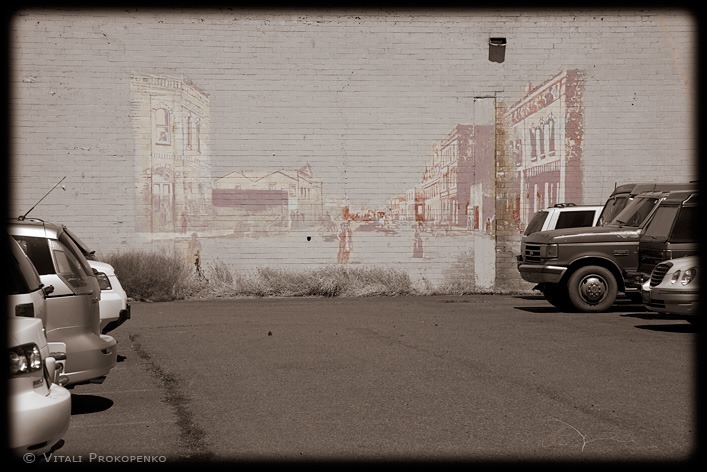
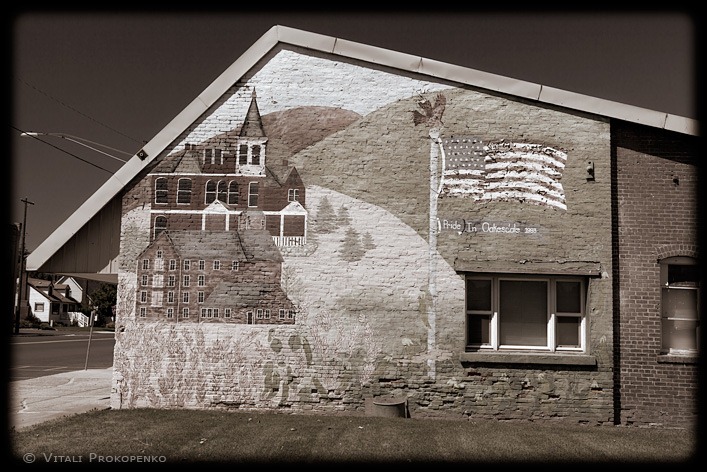
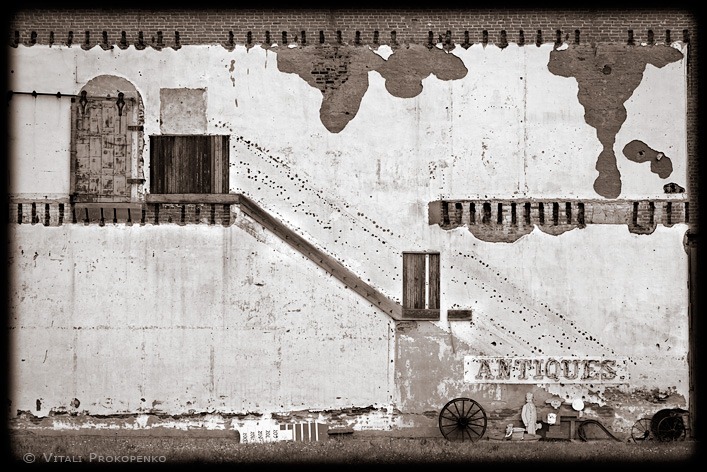
An interesting thing I found in these towns – wall art on buildings. It is not graffiti like large scale letters. It is often fading away paintings on brick walls.

The paintings capture towns in their previous life – how they looked a century or more ago. Were the painters in nostalgic mood when painting them as I were when photographing them? Or did the paintings actually survive a century?

Ellensburg Ellensburg

Colfax Colfax

Oaksdale Oaksdale
Olde Town, WA. The Name

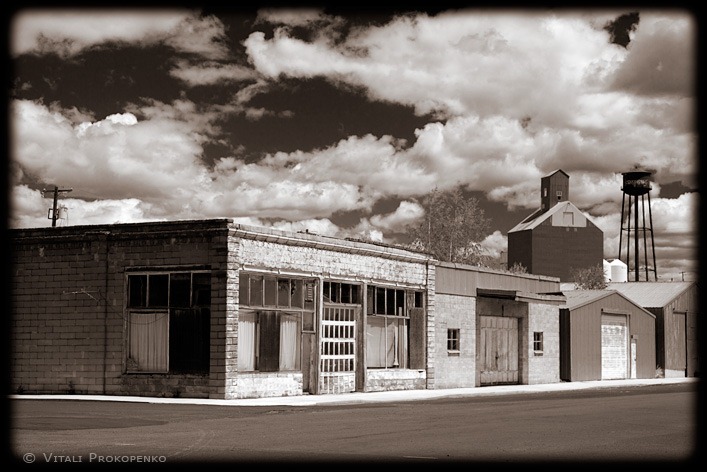
What is “Olde Town, WA”? It is an imaginary place, place with no people in the streets, place that is forgotten by people and ready to disappear as a mirage in a desert. It is a still capture in time of that place as it vanishes in front of our eyes.

I did not want this project to be about any specific town. At first, I simply called it Old Town. But I felt like this town deserves its place on the map, thus I’ve made the name more formal “Old Town, WA”. That’s how any town would be listed in US, with state abbreviation.

Then I added ‘e’ at the end of Old for two reasons. First this make it feel even older, that’s how it would probably be spelled ages ago and it closer to “older”. Second reason is more practical. Turns out that there is already a town in Washington called Old Town and an imaginary town better not match any real town name.

Corner of W Main St and 3rd St Corner of W Main St and 3rd St
Olde Town, WA. The Beginning

since it loves us
and forgives everything,
why was it abandoned forever?

Lyubov Sirota

What an exciting moment start of a new project. That is of cause when you know you start it. This project has begun before I knew it…

I’ve been traveling a lot to an area in the Eastern Washington called Palouse. This area offers really beautiful landscapes with rolling hills and patches of fields. Some call it American Toscana. While looking for beautiful landscapes to photograph I was driving thru small towns in this area and sometimes stopping, looking around and photographing of cause. Over time collection of these photographs grew and I was not sure why I was taking those photograph and what to do with them.

Riding from Seattle (where I live) to Palouse is a bliss – 4 hour drive across Washington state from West to East at about 70 miles per hour. There are quite a few towns you pass by on the way there. I used to drive thru them without ever stopping. Except once I travelled with a fellow photographer who wanted to get a coffee and we stopped in Ellensburg. Ellensburg turned out to be an interesting town, its historic center had a lot of old buildings. While walking its streets I realized that this is what attracted me in all other towns. The historic centers of many towns in Central and Eastern Washington look very old. And it is not like they are preserved for a history. They look abandoned like orphan children, they want some attention but don’t get it. While passing thru some of them I would find their streets empty almost like ghost towns. Some towns are slowly disappearing. In others people for some reason have moved away from their historic centers.

Once I noticed this pattern I begun to stop in every town on my way and capture those old town centers in their vanishing act. And thus the project “Olde Town, WA” was born.

Antiques Antiques

Being Yourself

I was learning photography from books. And a lot of what I did at the beginning I was decomposing photographs that were inspiring me, trying to repeat them and leaning from my mistake. This was extremely valuable and I have no problem suggesting this to anyone else. There is of cause a danger of getting stuck in repeating others.

At some point I felt a need to find my style and I got into a trap of trying to be different. I guess I had too much external influence telling me that to find my style I had to differentiate myself from others. I was continuously chasing after finding something that has not been done yet. All that produced to was a bunch of random photographs. All that was depressing as I was trying to photographs that could be different but not necessarily interested me.

It took me a while to figure out that the most important thing in photography – as probably in any other art – is to be true to yourself. You can try to be like someone else, you can try to be like nobody else or your can try to be yourself – the choice is yours. I prefer to be myself and it does not matter to me if what I photograph has been photographed before, if my image looks like something someone else did, or if it does not look like anything else (which is very unlikely given how many good photographers are out there in the world).

Noon

Noon with clear sky is like a dead season for landscape photographers. The reason is simple – at noon when the sun is high there are almost no shadows and without shadows everything looks flat. Shadows is one of the ways to add perception of the third dimension in landscape photographs.

This is why many photographers who I know (including me) prefer to take a nap during day. We wake up very early before sunrise; photograph at sunrise and during early morning while the sun is low; sleep thru the noon; and then again photograph during evening, sunset and maybe shortly after.

On my last trip to Palouse I had another project in mind besides landscapes (I’ll be writing about that project later). And for that project noon was just fine. So I stayed up. This allowed me to photograph some good landscapes too. There was an interesting weather pattern I observed. At around 12pm clouds would show up and by 2pm they would be gone. Fellow photographers I traveled with would take noon nap around 11am because sky was clear and boring. They would wake up after 3pm when the sky was clear again. Their perception of the trip was that they were unlucky with weather.

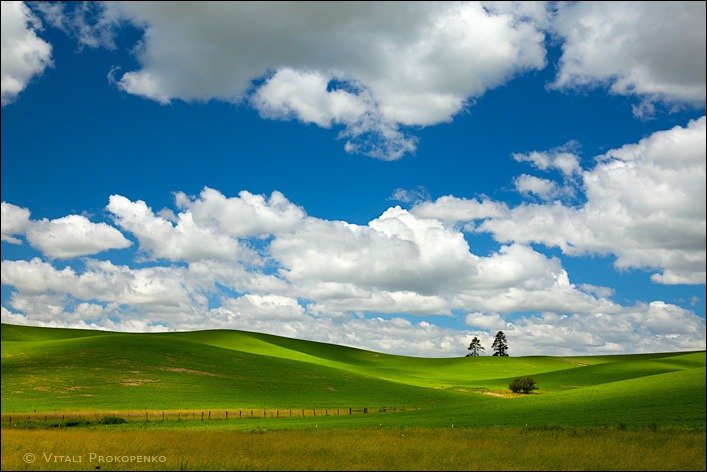
I could not stop photographing thru midday on the other hand. Clouds were adding drama to landscape and light and shadow spots were moving over the hills changing landscape. My most landscapes last trip were photographed during midday.

Light and Shadow Light and Shadow

Chasing a Sunset

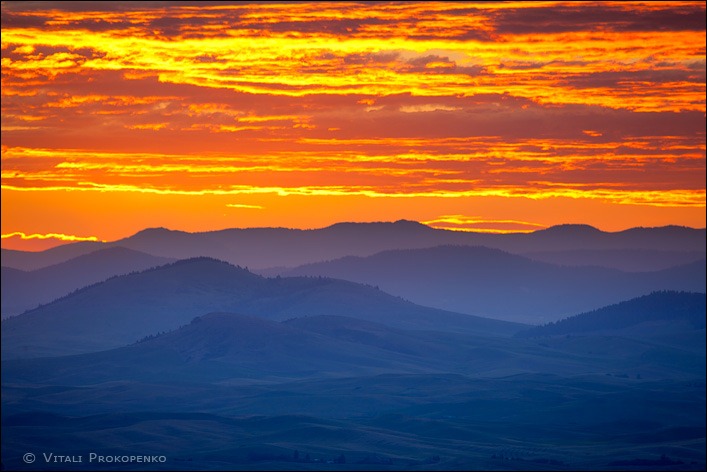
I’ve been to Palouse many times but still have not found a good place to photograph at sunrise or sunset except the Steptoe Butte. The last trip was not exception. One day we scouted pretty large area trying to find a good composition and end-up with missing sunset. There was a great sky but we could not find a great composition. I ended up taking pretty simple photographs like this:

Sunset in Palouse Sunset in Palouse

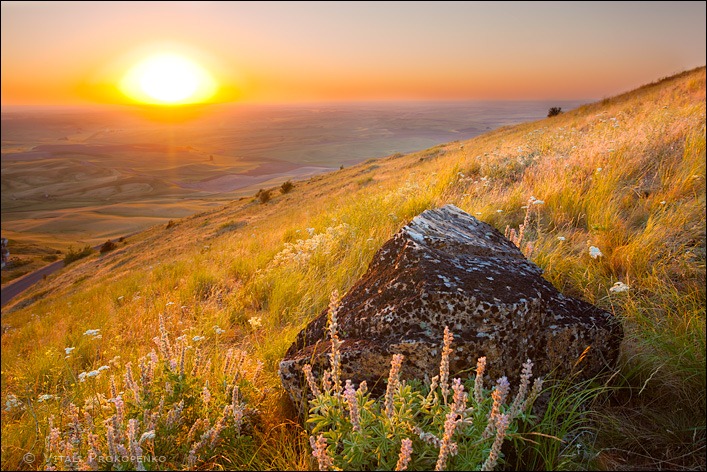
Other days I was experimenting with new angles from Steptoe Butte, trying to include some strong foreground into a picture:

_MG_3678 Sunset with a Rock