That’s one of those things that I wish I started with. Instead, I started with a palette of six colors plus black and white plus my teachers would throw in a few more colors because they would work well with a scene we were painting. It was overwhelming. I was very confused most of the time. I tried to memorize what to mix with what to get which color and it was too much.
The breakthrough came when I learned about limited palette. It turns out that a lot can be done with just three primary colors and white. The easiest three colors to start with are ultramarine blue, cadmium yellow and cadmium red. Black can be achieved by mixing those three, green can be achieved by mixing blue and yellow, orange by mixing yellow and red, and so on.
I painted with this limited palette for a few months. My painting improved and I was developing the sense of color faster.
Once I got comfortable with those three colors, I tried to add more colors, but it didn’t work. I instinctively kept reaching for familiar colors.
That was until I heard from another painter that the limited palette can be constructed with some other primary colors. For example, phtalo blue, alizarin crimson and yellow ochre. Now that was a fun triad to tame.
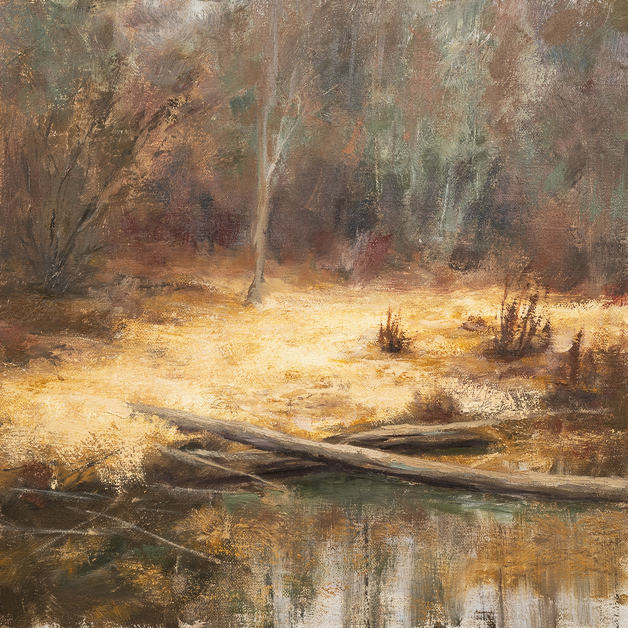
Both phtalo blue and alizarin crimson are very intense colors. Especially, phtalo blue. It is so intense that at some point I gave up on it because even with a lot of neutral I could not tame it. That’s why it was a lot of fun to, finally, learn to control it. The painting in this post is painted with phtalo blue, alizarin crimson, yellow ochre and white.
And an interesting thing happened when I let both of those triads on my palette. I was freely mixing and using all of them in a single painting.
That what I was experimenting with last winter. Then nice weather came to the Pacific Northwest and I put experiments aside to spend most of the time painting pleinair with the palettes I’ve already learned.
Once rainy days again will force me to stay inside, I want to experiment with palettes that have no blue. It is quite unusual. The idea came after I discovered that mixing viridian green and cadmium red gives a gentle blue. Mixing viridian with alizarin crimson gives even deeper blue. Adding some kind of yellow would complete the triad.
 vitali prokopenko | fine art